
By Dr. Sravan C.P.S, Vascular & Endovascular Surgeon
Yes, prostate artery embolization may help selected men who need a urinary catheter because an enlarged prostate obstructs urine flow. However, a catheter alone does not establish that PAE is suitable. I first need to understand why the bladder is not emptying and whether reducing the prostate’s blood supply is likely to address that problem.
My aim is to give you a practical answer: what treatment may achieve, what it cannot guarantee and how we would assess a safe attempt at passing urine without the catheter.
Why the reason for retention matters
A urinary catheter drains urine from the bladder. It relieves retention, but it does not identify or correct every cause of poor emptying. Prostate enlargement can obstruct the outlet. Bladder muscle weakness, a narrowing elsewhere in the urinary passage, medicines or neurological problems may also contribute.
Several problems may occur together. If the bladder cannot contract effectively, reducing prostate obstruction may not restore satisfactory emptying. That is why I review the urological assessment rather than treating the prostate scan in isolation.
If you are exploring the procedure for the first time, my overview of prostate artery embolization explains its purpose and basic steps.
How PAE may help
During PAE, I guide a small arterial catheter through a blood vessel to the arteries supplying the prostate. Embolization particles reduce blood flow to selected prostate tissue. The treated tissue gradually shrinks, which may reduce pressure on the urinary outlet.
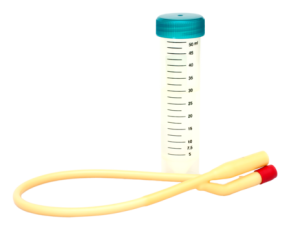
The arterial catheter used for the procedure is different from the urinary catheter draining your bladder. PAE does not pull out the obstruction through the urinary catheter. It also does not produce an immediate guarantee that the bladder will empty normally.
For a catheter-dependent patient, the important outcome is whether the bladder can empty adequately after treatment. A smaller prostate on a scan is useful information, but it is not the same as successful catheter removal.
What I need to review before recommending PAE
Bring the records that explain the retention episode, previous treatment and catheter history. I may need further assessment before making a recommendation.
- When the catheter was inserted and whether retention developed suddenly or gradually.
- Previous attempts to remove it and what happened afterwards.
- Prostate imaging, urine results, kidney function and relevant urology reports.
- Current medicines, other illnesses and any previous prostate or urinary procedures.
- Your main difficulty with the catheter and your treatment priorities.
A prostate examination, PSA assessment or further tests may be appropriate through the treating urologist. A raised PSA needs interpretation in context. PAE does not replace an assessment for prostate cancer or other causes of obstruction.
Urine infection also needs attention. Fever, chills or feeling unwell should not be treated as a routine part of living with a catheter.
I discuss these factors in more detail in who may be suitable for PAE.
Why catheter removal usually needs a separate plan
PAE works through changes that develop over time. The prostate may also become temporarily inflamed after the procedure. For these reasons, the urinary catheter may remain in place while the initial response develops.
The treating team plans a trial without catheter, often called a TWOC. During this trial, a clinician removes the catheter and assesses whether you can pass urine and empty the bladder sufficiently. The timing varies with your clinical situation and the local care pathway.
I would not promise a particular removal date before evaluating you. A hospital leaflet describing a trial after a few weeks is an example of that hospital’s protocol, not a timetable that applies to everyone.
Do not remove, clamp or alter your catheter yourself to test the result.
What happens if the first trial does not succeed?
An unsuccessful trial needs a safe drainage plan and reassessment. It does not automatically prove that the procedure had no effect, and it does not justify repeated unsupervised attempts.
The team may consider how much time has passed, residual obstruction, bladder function and whether another treatment is appropriate. Some patients continue to need a catheter or another bladder-emptying method. Others may require further urological treatment.
I explain this possibility before treatment because freedom from a catheter is a goal, not an assured result.
PAE or another prostate treatment?
The choice depends on your anatomy, prostate-related obstruction, bladder function, general health and preferences. Medicines, endoscopic prostate surgery and other options may remain relevant.
When discussing PAE and TURP, I focus on the differences that matter to your decision. These include the expected relief of obstruction, anaesthesia, recovery, possible complications and the chance of needing further treatment.
Being older or having other medical conditions does not automatically make PAE the best option. Equally, having a catheter does not automatically exclude it. The decision should follow assessment and a balanced discussion.
Risks still matter when the goal is catheter removal
PAE can cause pelvic discomfort, urinary irritation, infection and temporary worsening of urinary symptoms. Arterial access can cause bleeding or bruising. Contrast and radiation are part of the procedure, and medical conditions can affect how we manage them.
Unintended embolization of nearby tissue is an uncommon but important risk. Difficulty reaching the prostate arteries can also limit treatment. A catheter-free outcome does not remove the need to consider these risks beforehand.
Bring your medicine list, particularly anticoagulants, antiplatelets and diabetes medicines. Do not stop prescribed treatment without instructions. My guide to preparing for an embolization procedure can help you organise the consultation.
When catheter symptoms need urgent attention
Seek urgent medical assessment if the catheter stops draining and you develop lower abdominal pain or swelling. Fever, shaking chills, worsening pain or significant bleeding also need prompt advice.
Do not wait for an elective PAE appointment to deal with a blocked catheter or a possible infection. If you become severely unwell, seek emergency care.
Questions I encourage you to bring
Ask what is causing the retention, what evidence supports prostate obstruction and whether bladder weakness may affect the result. Ask who will supervise catheter care and the trial without catheter. Clarify whom to contact if the catheter blocks or a removal trial fails.
If you are considering treatment in Bangalore, you can request an assessment with your urology records. I will review whether PAE fits your circumstances and explain the alternatives.
Frequently asked questions
Can PAE be done while a urinary catheter is in place?
It may be possible in selected patients. I first review the cause of retention, infection status and suitability for the procedure.
Will my catheter come out on the day of PAE?
Do not assume that it will. Removal normally needs a separate supervised plan based on your response and clinical situation.
Can PAE repair a weak bladder?
PAE treats the blood supply to the prostate. It does not directly restore bladder muscle function, which can limit the chance of successful emptying.
Does a large prostate guarantee that PAE will work?
No. Prostate size is only one part of the assessment. The cause of obstruction, bladder function and arterial anatomy also matter.
Should I stop prostate medicines after treatment?
Continue or change them only as the treating team advises. Do not stop medicines simply because the procedure is complete.
What if I cannot pass urine after catheter removal?
Tell the supervising team immediately. You may need bladder drainage and further assessment rather than waiting at home with increasing discomfort.
Can I book PAE without a urology review?
An adequate assessment of retention and prostate disease is essential. I coordinate the treatment decision with the relevant urological findings.
Do you need a catheter after PAE?
Most men do not need a catheter after PAE. A few need one for a short time if they find it hard to pass urine in the first days. If you already have a catheter, I keep it in after the procedure and plan a removal trial with you once the prostate has had time to shrink, usually after a few weeks.
