 Skip to content

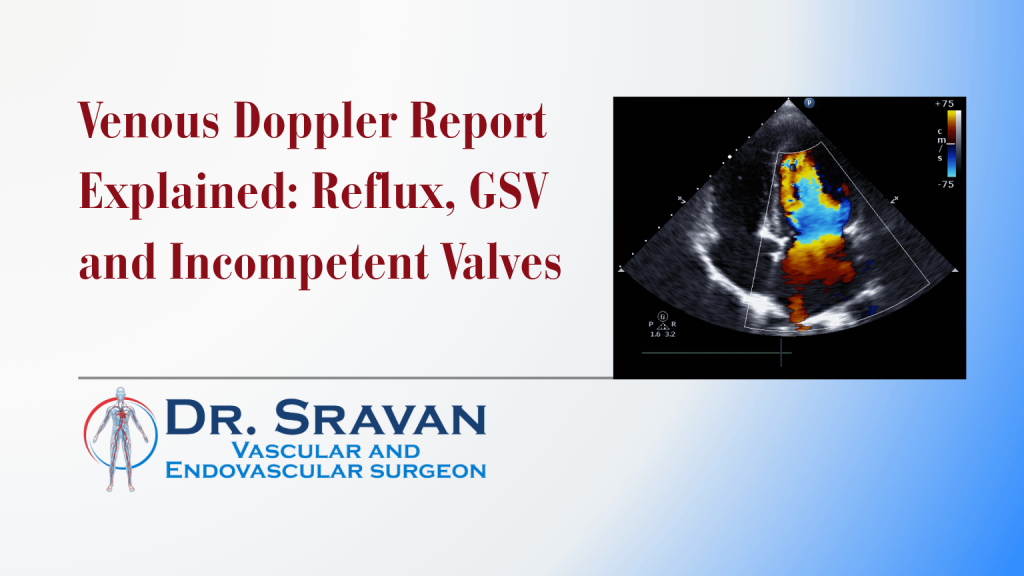
What is the venous Doppler report meaning in plain words? A venous Doppler report describes how blood flows through the veins and whether the scan found reflux, a clot or another abnormality. Reflux means that blood flows backwards through a vein when it should move towards the heart. However, the report alone does not establish whether you need a procedure.
When I explain venous Doppler report meaning to patients, I compare its findings with your symptoms, examination and previous treatment. I want to know which vein has a problem, how extensive it is and whether that finding explains what you feel. An unfamiliar term should lead to an explanation, not an automatic decision to treat.
What Is a Venous Doppler Scan?
A venous duplex scan combines ultrasound images of veins with information about blood flow. It can answer different questions depending on the reason for the examination.
A scan for suspected DVT looks for a clot in the deep veins. A reflux study assesses valve function and abnormal backwards flow, often when planning varicose vein care.
These are related examinations, but they are not identical. A report saying no DVT does not automatically mean that the laboratory assessed every possible reflux pathway.
My vascular Doppler scan guide explains the test more broadly. Here, I focus on how to understand a leg-vein report.
Venous Doppler Report Meaning: What Does Reflux Mean?
Vein valves help direct blood back towards the heart. If a valve does not close adequately, blood can move backwards under particular testing conditions.
The scan records that backwards flow and its location. Reflux can contribute to raised venous pressure, visible varicose veins and symptoms such as heaviness or swelling.
However, I would not assume every ache or swelling comes from reflux simply because the report mentions it. Symptoms can have more than one cause.
The significance depends on the vein involved, the pattern of abnormal flow, the extent of disease and your clinical findings.
A useful interpretation connects the scan to the patient. It does not stop at translating the word reflux.
Does an Incompetent Valve Mean a Blocked Vein?
No. Incompetence describes a valve that does not function properly. Obstruction describes difficulty with blood passing through a vein.
A vein can have reflux, obstruction or a combination of problems. These lead to different treatment questions.
For example, treating a superficial refluxing vein is different from assessing a deep vein that has residual changes after DVT.
I would explain which problem the report identifies and whether the scan provides enough information to plan care.
Do not read incompetent as a judgement about the whole leg or assume it means that circulation has stopped. It is a description of valve function in the examined pathway.
Venous Doppler Report Meaning: What Do GSV and SSV Mean?
GSV: great saphenous vein
The great saphenous vein is a major superficial vein that runs along the inner part of the leg and thigh towards the groin.
A report describing GSV reflux means the scan identified backwards flow in part of this pathway.
SSV: small saphenous vein
The small saphenous vein runs along the back of the calf. Its connection to deeper veins varies between people.
The report may describe reflux along this vein or near its junction.
Accessory saphenous veins
Accessory veins are additional superficial pathways. They can sometimes contribute to visible varicose veins or recurrent symptoms.
These names identify anatomy. They do not, by themselves, establish which vessel needs treatment.
What Are SFJ and SPJ Incompetence?
SFJ means saphenofemoral junction, where the great saphenous pathway joins the deep venous system near the groin.
SPJ means saphenopopliteal junction, referring to the small saphenous connection near the knee when that junction is present.
A report may describe valve failure at one of these connections. I then look at where the reflux travels and whether it matches the clinical problem.
An abnormal junction does not answer every treatment question. The rest of the vein map, branches, deep system and examination still matter.
Ask the doctor to show you the relevant route on a diagram. That is often more useful than trying to interpret several abbreviations independently.
What Is Truncal Reflux?
Truncal reflux refers to abnormal flow in a main superficial vein pathway rather than only in small visible branches.
This distinction helps with treatment planning. In some patients, a main refluxing vein feeds several visible branches. Treating only the branches may not address that source.
However, I would not recommend closing a named vein without confirming the anatomy, symptoms and role of the deep system.
My varicose veins treatment guide explains the available approaches. The scan helps establish which, if any, deserve consideration.
The treatment decision follows the clinical map; the presence of a particular abbreviation is not enough.
What Are Perforator Veins?
Perforator veins connect the superficial and deep venous systems. The report may identify a perforator with abnormal flow.
Its relevance depends on location, the surrounding vein pattern and findings such as skin changes or an ulcer.
Not every perforator mentioned in a report needs a separate procedure. I want to establish whether it contributes meaningfully to the patient’s problem.
If a treatment plan includes a perforator intervention, ask why that vessel matters in your case and what benefit the doctor expects.
A list of abnormal vessels should not automatically become a list of procedures.
Is Reflux the Same as DVT?
No. Reflux concerns abnormal direction of blood flow through valves. Deep vein thrombosis means a clot in a deep vein.
The conditions can coexist. A previous DVT can also leave obstruction or valve damage that affects later circulation.
If your report describes a new or suspected acute clot, contact the requesting or treating clinician promptly rather than treating it as a routine varicose vein finding.
My DVT treatment page explains the assessment and treatment pathway.
New one-sided swelling and pain need appropriate clinical review. Sudden breathlessness, chest pain or collapse require emergency care.
What Do Chronic Changes or Recanalisation Mean?
After a clot, the vein may not immediately return to its previous appearance or function. A report can describe chronic changes, partial reopening or residual obstruction.
Recanalisation means that a channel has reopened within a previously blocked or treated vessel. Its meaning depends on the context.
Reopening after DVT is different from reopening of a vein that a previous ablation aimed to close.
I would read these words alongside the dates, symptoms and previous procedure records. A chronic abnormal appearance is not automatically a new clot or a reason for another intervention.
If symptoms change suddenly, however, an old diagnosis should not prevent reassessment.
Do Reflux Time and Vein Diameter Tell You How Serious It Is?
They provide useful information, but they do not replace interpretation of the complete study.
Laboratories assess reflux using defined techniques and criteria. Results depend in part on the vein, patient position and how the examination provokes flow.
Vein diameter also needs context. A measurement alone cannot establish symptom severity or decide the treatment method.
I would not ask you to calculate your own need for surgery from a number in the report. Ask whether the study shows clinically important reflux and which findings support the recommendation.
The written conclusion should help the clinician answer that question rather than leave you comparing isolated figures online.
Why Might Two Doppler Reports Look Different?
The venous Doppler report meaning can differ between two scans for practical reasons.
The scans may answer different questions or examine different segments. The technique, position, terminology and interval between studies can also differ.
Your circulation may change after treatment or over time, so an earlier scan may not describe the current problem.
I would compare the reports and, when possible, the images before deciding that either study is wrong. Sometimes a focused repeat examination is appropriate.
Do not repeat a scan simply because the wording differs. Ask what information is missing and how it would change the clinical decision.
A second opinion is most useful when the specialist can review the original findings and your symptoms together.
What if the Report Says No DVT but Your Leg Still Swells?
No DVT means the study did not identify a deep clot within the scope of that examination. It does not explain every possible cause of swelling.
Reflux, lymphatic problems, medication effects and other medical conditions may need consideration. Symptoms and examination guide the next investigation.
I would ask whether the swelling is new or longstanding, affects one or both legs and changes with standing or elevation.
If it is sudden, painful or worsening, seek reassessment rather than relying indefinitely on a previous reassuring scan.
A negative test result is useful information, but it should answer the question for which the test was performed.
Does Reflux Automatically Mean You Need Laser Treatment?
No. I consider symptoms, skin changes, the extent of reflux, general health and the available treatment options.
Some patients need advice or conservative care; others may benefit from a procedure. The method can involve endovenous ablation, sclerotherapy, treatment of branches or another approach.
If you previously underwent treatment, the current reflux may involve a different route. My recurrent varicose veins guide explains that distinction.
Before agreeing to treatment, ask which vein the doctor proposes to treat, why it matters and what symptoms the procedure aims to improve.
What Should You Bring When We Review Your Venous Doppler Report?
Bring the complete report, images if available, previous scans and procedure records. Also bring your medication list and details of any DVT or blood-thinning treatment.
Tell me which symptom prompted the scan and when it started. The report becomes much more useful when we place it in that context.
You can read about my vascular and endovascular background before visiting.
For a venous assessment in Bangalore, book a consultation with your records. I would explain the relevant findings and the next step, including when no procedure is needed.
The Society for Vascular Surgery’s patient guide to duplex ultrasound explains how the scan is performed and what it can show about blood flow in the veins.
Frequently Asked Questions
What does GSV reflux mean?
It means the scan detected backwards flow in part of the great saphenous vein pathway. Its importance depends on the extent of reflux, symptoms and the rest of the examination.
Does an incompetent vein contain a clot?
Not necessarily. Incompetence describes valve failure; thrombosis describes a clot. A report can assess either or both, depending on the examination.
Is SFJ incompetence always treated with laser?
No. Treatment depends on the complete vein map, symptoms and suitability. The junction finding alone does not decide the method.
Can I have reflux without visible varicose veins?
Yes. A clinician still needs to establish whether the finding explains your symptoms. A scan result alone does not establish a need for a procedure.
Does no DVT mean that all my veins are normal?
No. It means no deep clot was identified within the examination’s scope. Reflux or other causes of symptoms may require a different assessment.
Does every abnormal perforator need treatment?
No. The doctor should explain its clinical relevance, particularly its relationship to other reflux, skin changes or ulceration.
Should I repeat the scan before seeing a vascular surgeon?
Bring the existing report and images first. The specialist can advise whether the study provides enough information or whether a focused repeat scan would change the plan.

