 Skip to content
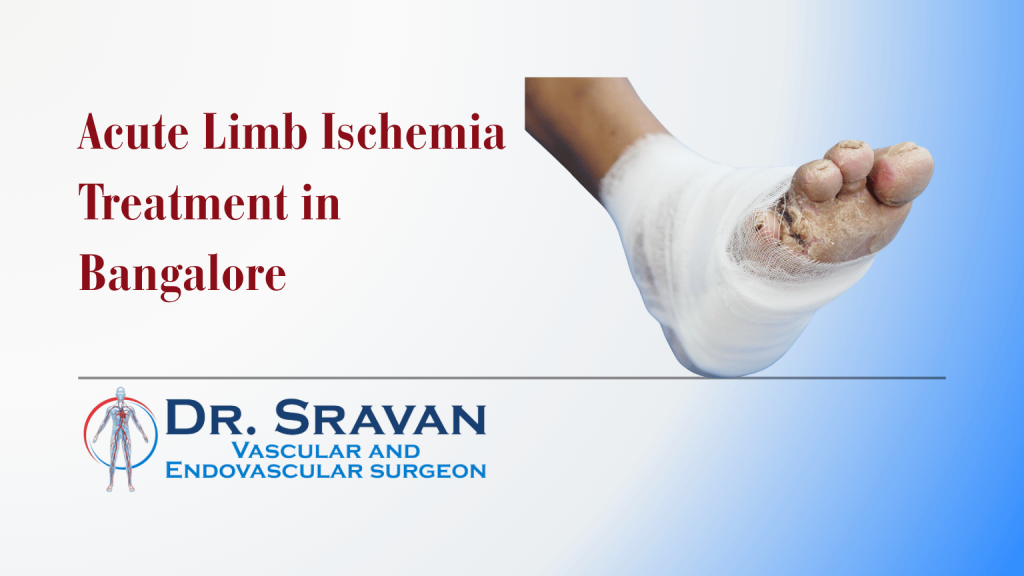
Acute limb ischemia means that blood flow to an arm or leg has suddenly fallen to a dangerously low level. It can cause severe pain, coldness, pale or blue skin, numbness, weakness and loss of pulse.
This is a vascular emergency.
If a leg, foot, arm or hand suddenly becomes very painful, cold, pale, numb or weak, go to the nearest emergency department immediately. Do not wait for a routine clinic appointment or try to monitor the symptoms at home.
Treatment depends on how threatened the limb is and what caused the blockage. Options may include blood-thinning treatment, catheter-based clot removal, thrombolysis, surgical embolectomy or thrombectomy, angioplasty, stenting, bypass surgery or a combination of these approaches.
What Is Acute Limb Ischemia?
Ischemia means that a part of the body is not receiving enough blood.
Acute limb ischemia, or ALI, is a sudden reduction in arterial blood flow to a limb.
It can affect:
- the leg
- the foot
- the arm
- the hand
The problem develops quickly rather than gradually over months or years.
Without adequate arterial blood flow, muscles, nerves and skin are deprived of oxygen.
The longer severe ischemia continues, the greater the risk of permanent tissue damage.
This is why acute limb ischemia is treated very differently from stable peripheral arterial disease.
What Are the Warning Signs of Acute Limb Ischemia?
Doctors traditionally describe six important warning signs, often called the 6 Ps.
1. Pain
The limb may suddenly become severely painful.
The pain can occur at rest and may be very different from the predictable calf pain some patients with peripheral arterial disease experience while walking.
2. Pallor
The foot, leg, hand or arm may appear unusually pale.
It may also become bluish or develop another sudden colour change.
3. Pulselessness
The pulse below the blockage may become weak or absent.
A patient does not need to check their own pulse to decide whether to seek care. Sudden severe symptoms are enough reason for emergency assessment.
4. Paresthesia
This means abnormal sensation.
The patient may describe:
- numbness
- tingling
- pins and needles
- reduced sensation
New sensory loss is particularly important because it can mean the nerves are beginning to suffer from inadequate blood flow.
5. Paralysis or weakness
Difficulty moving the toes, foot, fingers or hand is a serious sign.
Muscle weakness can indicate that the limb is immediately threatened.
6. Poikilothermia
In practical terms, this means the affected limb becomes unusually cold compared with the other side.
A suddenly cold foot or hand combined with pain, numbness or colour change needs urgent medical assessment.
What Should You Do if a Foot or Hand Suddenly Becomes Cold and Painful?
Go to an emergency department immediately.
Do not:
- wait until the next morning
- massage the limb
- apply tight compression
- rely on painkillers to see if the symptoms settle
- spend time arranging a routine outpatient appointment
- assume it is arthritis, neuropathy or muscle pain without assessment
Acute limb ischemia is time-sensitive.
The treating team needs to determine whether the limb still has enough circulation to remain viable and how quickly blood flow needs to be restored.
Is Every Cold Foot Acute Limb Ischemia?
No.
Some people have chronically cold feet because of long-standing circulation problems, environmental exposure, nerve problems or other conditions.
The concerning pattern is usually a new or sudden change, particularly when it is associated with:
- severe pain
- new colour change
- numbness
- weakness
- loss of function
A patient with slowly progressive symptoms may still require vascular assessment, but a sudden cold, painful or numb limb should be treated as an emergency until evaluated.
What Causes Acute Limb Ischemia?
There are several possible causes.
The distinction matters because treatment may differ according to why the artery became blocked.
A Blood Clot Travelling From Somewhere Else
This is called an embolism.
A clot forms elsewhere in the circulation and travels until it becomes lodged in an artery that is too small for it to pass through.
One possible source is the heart.
Certain heart conditions, including atrial fibrillation, can increase the risk of clot formation.
A clot may then travel from the heart into an artery supplying the arm or leg.
Dr Sravan has previously described an anonymised clinical example involving a patient who developed a sudden cold, pulseless hand because of an arterial embolus. You can read the acute limb ischemia case study involving emergency embolectomy.
A Clot Forming Inside an Already Diseased Artery
Some patients already have peripheral arterial disease.
The artery may have been narrowed gradually by atherosclerosis and then suddenly become completely blocked by thrombosis.
This can turn a chronic circulation problem into an acute emergency.
For the broader condition, read the guide to peripheral arterial disease and blocked leg arteries.
A Previously Treated Artery Becoming Blocked
Acute ischemia can sometimes occur if there is sudden thrombosis of:
- a previous bypass graft
- a previously treated arterial segment
- a stent
- another vascular reconstruction
New severe symptoms after previous vascular treatment need urgent assessment.
An Arterial Aneurysm or Other Arterial Disease
Certain aneurysms can develop clot within them or cause blockage of downstream circulation.
Other less common arterial problems can also lead to acute loss of blood flow.
Trauma
An injury can damage or completely interrupt an artery.
This may occur after:
- fractures
- dislocations
- penetrating injuries
- crush injuries
- other major trauma
A limb that becomes cold, pale or pulseless after an injury requires urgent vascular assessment.
Acute Limb Ischemia vs Peripheral Arterial Disease: What Is the Difference?
These terms are related but not identical.
| Feature | Peripheral Arterial Disease | Acute Limb Ischemia |
| Onset | Usually gradual | Sudden |
| Typical early symptom | Walking-related pain | Sudden severe pain |
| Temperature change | May be chronically cooler | May suddenly become cold |
| Numbness or weakness | Usually later in severe disease | Can develop rapidly |
| Treatment urgency | Depends on severity | Emergency assessment required |
| Main concern | Chronic reduced circulation | Sudden threat to limb viability |
A patient with PAD can develop acute limb ischemia, but ALI can also occur in someone without previously diagnosed PAD.
Acute Limb Ischemia vs Chronic Limb-Threatening Ischemia
These are also different conditions.
Acute limb ischemia develops suddenly.
Chronic limb-threatening ischemia develops from severe long-standing arterial disease and may cause:
- persistent ischemic rest pain
- non-healing wounds
- gangrene
Both conditions can threaten a limb, but their timing, causes and treatment pathways differ.
This distinction is important because a patient with a foot wound present for several months is not experiencing the same process as someone whose foot became cold and numb within hours.
How Is Acute Limb Ischemia Diagnosed?
Diagnosis begins with the patient, not the scan.
The first priority is rapid clinical assessment of how threatened the limb is.
Emergency Clinical Examination
The vascular team assesses:
- when the symptoms started
- whether onset was sudden
- pain severity
- limb colour
- limb temperature
- arterial pulses
- Doppler signals
- sensation
- ability to move the limb
- previous PAD
- previous vascular procedures
- heart rhythm problems
- anticoagulant use
- other medical conditions
Sensation and muscle function are particularly important because they help indicate how urgently blood flow needs to be restored.
Bedside Doppler Assessment
A handheld Doppler can help determine whether arterial and venous blood-flow signals are present.
This is different from waiting for a routine outpatient Doppler scan.
In an emergency, bedside vascular assessment is part of determining limb viability and planning the next step.
For non-emergency vascular testing, you can read the guide to vascular Doppler scans.
CT Angiography
CT angiography may be used when the patient and limb are stable enough for imaging and the scan will help guide treatment.
It can show:
- where the artery is blocked
- how much of the artery is affected
- disease above and below the blockage
- underlying atherosclerosis
- the arteries available for revascularisation
However, imaging should support emergency treatment planning.
If the limb is immediately threatened, unnecessary delay in restoring circulation can be harmful.
Other Tests
Depending on the suspected cause and the patient’s condition, assessment may also include:
- blood tests
- kidney function
- clotting tests
- ECG
- cardiac assessment
- echocardiography
- additional vascular imaging
Finding the cause matters because restoring blood flow addresses the immediate emergency, while preventing another episode may require treatment of the source.
How Do Doctors Decide How Urgent the Limb Is?
One of the key decisions is whether the limb is:
Viable
The limb is not immediately threatened.
Sensation and muscle function remain intact.
Urgent evaluation and treatment are still required, but there may be enough time to define the anatomy carefully before intervention.
Threatened
The limb has evidence that nerves or muscles are beginning to suffer.
This may include:
- sensory loss
- increasing numbness
- muscle weakness
A threatened limb needs rapid revascularisation.
The presence of weakness is particularly concerning.
Irreversibly Damaged
If severe ischemia has continued long enough, the muscle and nerve tissue may no longer be recoverable.
In that situation, attempting to restore blood flow may not benefit the limb and can sometimes create additional systemic risks.
The treating vascular team has to make this difficult assessment based on the clinical findings.
This is one reason there is no reliable home method for deciding how much time remains.
How Is Acute Limb Ischemia Treated?
The immediate goals are to:
- prevent the clot from extending
- restore arterial blood flow where the limb is salvageable
- identify and treat the cause
- monitor for complications after circulation returns
The exact treatment depends on:
- how threatened the limb is
- how long symptoms have been present
- where the blockage is
- whether the problem is embolic or thrombotic
- previous arterial disease
- previous bypasses or stents
- bleeding risk
- the patient’s overall health
Several treatments may be used.
Anticoagulation
Once acute limb ischemia is suspected and contraindications have been considered, anticoagulation is commonly started in the hospital to reduce further clot propagation.
This is part of emergency medical management.
It is not a substitute for revascularisation when the limb is threatened.
Patients should not attempt to start, stop or change blood-thinning medicines themselves in response to symptoms.
Surgical Embolectomy
An embolectomy is used to remove a clot that has travelled into an artery.
A vascular surgeon opens the affected artery through an incision and uses a specialised catheter to remove the embolus and restore blood flow.
This can be particularly useful when the clinical picture suggests a sudden embolic blockage that is accessible to surgical treatment.
The exact approach depends on where the clot is located and the condition of the artery.
Surgical Thrombectomy
Thrombectomy refers to removal of thrombus from an artery or vascular reconstruction.
Depending on the situation, this may be performed surgically or using catheter-based techniques.
The important difference is that simply removing the clot may not be enough when the underlying artery is already severely diseased.
The cause of the thrombosis also needs to be addressed.
Catheter-Directed Thrombolysis
In selected patients, a catheter can be positioned inside the blocked artery and clot-dissolving medicine delivered directly to the thrombus.
This is called catheter-directed thrombolysis.
It may be considered when:
- the limb remains salvageable
- the pattern of thrombosis is suitable
- there is enough time for the medicine to act
- the patient’s bleeding risk is acceptable
Thrombolysis is not appropriate for every patient.
Someone with an immediately threatened limb may need a faster method of restoring blood flow.
Patients with certain bleeding risks may also be unsuitable for thrombolytic treatment.
Mechanical or Catheter-Based Thrombectomy
Some acute arterial blockages can be treated with devices designed to remove or reduce clot through a catheter.
This can sometimes be combined with:
- thrombolysis
- angioplasty
- stenting
- other endovascular treatment
The choice depends on the clot, artery and urgency.
Angioplasty and Stenting
If a clot has formed over an underlying arterial narrowing, removing the clot alone may leave the original problem behind.
Angioplasty may then be used to widen the diseased artery.
A stent may be added when clinically appropriate.
For patients with chronic leg-artery narrowing rather than an acute emergency, the [peripheral angioplasty treatment page] should be used once its final September URL is published.
Bypass Surgery
Bypass may be needed when:
- the artery cannot be adequately reopened by another method
- there is extensive underlying arterial disease
- the anatomy is better suited to surgery
- a previous reconstruction has failed
- another revascularisation strategy is unlikely to provide adequate circulation
A new pathway is created for blood to flow around the blocked section.
Hybrid Treatment
Acute limb ischemia does not always fit neatly into “open surgery” or “endovascular treatment.”
Some patients need a combination.
For example, clot may be removed surgically and an underlying narrowing then treated with angioplasty.
The objective is not to choose the least invasive procedure at all costs.
The objective is to restore adequate blood flow safely and quickly using the approach most appropriate to the limb.
Can Acute Limb Ischemia Be Treated Without Surgery?
Sometimes catheter-based treatment is possible without open surgery.
But this should not be confused with simply treating the condition using tablets or waiting for the clot to dissolve naturally.
A threatened limb generally requires urgent restoration of blood flow.
The choice between:
- surgical embolectomy
- thrombectomy
- thrombolysis
- endovascular treatment
- bypass
- combined treatment
depends on the individual emergency.
What Happens After Blood Flow Is Restored?
Opening the artery is a major step, but treatment does not necessarily end there.
The limb needs close monitoring.
Doctors assess:
- pulses
- colour
- temperature
- sensation
- muscle movement
- pain
- kidney function
- blood tests
- the treated artery
There are also complications that can occur when circulation returns after a period of severe ischemia.
Reperfusion Injury
When blood suddenly returns to severely ischemic tissue, damaged muscle can release substances into the bloodstream.
This can affect the rest of the body, including the kidneys.
Patients with severe ischemia may therefore need careful monitoring after revascularisation.
Compartment Syndrome
Muscles in the arm or leg sit inside tight tissue compartments.
After blood flow returns, swelling can sometimes increase pressure inside one of these compartments.
This can threaten muscles and nerves even after the artery has been reopened.
If compartment syndrome develops or is strongly suspected, urgent surgical treatment may be required to release that pressure.
Why Did the Artery Block in the First Place?
Once the immediate emergency is controlled, the next question is prevention.
The investigation depends on the suspected cause.
If the clot may have travelled from the heart, evaluation may include:
- heart rhythm assessment
- ECG
- echocardiography
- review for atrial fibrillation
- appropriate long-term anticoagulation when indicated
If thrombosis occurred because of peripheral arterial disease, long-term treatment may include:
- smoking cessation
- cholesterol management
- diabetes control
- blood pressure treatment
- prescribed antiplatelet or anticoagulant medication
- surveillance of the treated artery
- treatment of additional significant arterial disease
The aim is not only to treat today’s blocked artery.
It is also to reduce the chance of another vascular event.
Can Acute Limb Ischemia Come Back?
Yes.
Recurrence is possible if the underlying cause remains.
For example:
- atrial fibrillation may continue to generate embolic risk
- severe PAD can lead to further thrombosis
- a bypass or stent can develop another blockage
- an untreated aneurysm may continue to cause arterial problems
The follow-up plan therefore depends on why the original event occurred.
Patients should understand which symptoms require immediate return to hospital.
Acute Limb Ischemia in the Arm or Hand
Although people often think of acute limb ischemia as a leg emergency, it can also affect the arm or hand.
Symptoms may include:
- sudden severe arm or hand pain
- a cold hand
- pale or blue fingers
- numbness
- weakness
- inability to use the hand normally
- absent or reduced pulse
The emergency principle is the same.
Sudden loss of blood flow to an arm or hand requires prompt vascular assessment.
Dr Sravan has published an anonymous clinical case demonstrating this type of presentation, where an arterial embolus caused a sudden cold and pulseless hand and emergency treatment was required.
Acute Limb Ischemia Treatment With Dr Sravan C.P.S
Dr Sravan C.P.S is a vascular and endovascular surgeon in Bangalore whose practice includes arterial emergencies, peripheral arterial disease, limb revascularisation, angioplasty, thrombectomy and open vascular surgery where clinically appropriate.
His qualifications include:
- MBBS
- MS in General Surgery
- MRCS from the Royal College of Edinburgh, UK
- DNB in Peripheral Vascular Surgery
- FEVS from National University Hospital, Singapore
He has also served as an Assistant Professor of Vascular Surgery at Sri Jayadeva Institute of Cardiovascular Sciences and Research.
In acute limb ischemia, the first treatment decision is not:
“Which procedure do we normally use?”
It is:
“How threatened is this limb, where has the blood flow stopped, what caused it, and what is the fastest appropriate way to restore circulation?”
That may lead to open surgery in one patient, catheter-based treatment in another, or a combined approach in a more complex case.
You can read more about Dr Sravan’s training and vascular and endovascular background.
When Should You Go to an Emergency Department?
Do not wait for a routine vascular consultation if a limb suddenly becomes:
- severely painful
- pale
- blue or unusually discoloured
- markedly cold
- numb
- weak
- difficult to move
Also seek urgent assessment after a vascular procedure if a previously warm and functioning limb suddenly develops these symptoms.
Acute limb ischemia can worsen quickly.
Go to the nearest emergency department for immediate assessment.
For non-emergency follow-up after treatment, assessment of chronic poor circulation, or discussion of an arterial condition that is not causing sudden symptoms, a planned vascular consultation may be appropriate.
Frequently Asked Questions About Acute Limb Ischemia
Is acute limb ischemia an emergency?
Yes. Acute limb ischemia is a sudden, severe reduction in blood flow to an arm or leg. A cold, painful, pale, numb or weak limb requires immediate hospital assessment because muscle and nerve tissue can become permanently damaged if severe ischemia continues.
What are the 6 Ps of acute limb ischemia?
The classic warning signs are pain, pallor, pulselessness, paresthesia, paralysis and poikilothermia, meaning abnormal coldness of the limb. A patient does not need to have all six signs. Sudden pain with coldness, colour change, numbness or weakness is enough to require urgent assessment.
Can atrial fibrillation cause acute limb ischemia?
Yes. Atrial fibrillation can increase the risk of a blood clot forming in the heart. A clot may travel through the bloodstream and suddenly block an artery supplying an arm or leg. Cardiac evaluation may therefore form part of the investigation after an embolic episode.
How is acute limb ischemia diagnosed?
Diagnosis begins with urgent examination of limb colour, temperature, pulses, sensation and muscle function. Doppler signals are assessed, and CT angiography or catheter angiography may be used when imaging will help guide treatment. Imaging should not create unnecessary delay when the limb is immediately threatened.
What is the difference between embolectomy and thrombolysis?
Embolectomy physically removes an embolic clot from the artery, usually through a surgical approach. Catheter-directed thrombolysis delivers clot-dissolving medicine into the blocked artery. They are used in different situations according to the cause, location and urgency of the blockage and the patient’s bleeding risk.
Can angioplasty treat acute limb ischemia?
It can be part of treatment in selected cases, particularly when thrombosis has occurred over a narrowed artery. The clot may first need to be removed or dissolved, after which angioplasty or stenting can be used to treat the underlying arterial narrowing.
Can acute limb ischemia be cured without an operation?
Some patients can be treated using catheter-based techniques rather than open surgery. However, a threatened limb usually requires urgent restoration of blood flow. Waiting at home or relying only on tablets is not an appropriate substitute for emergency vascular assessment.
Can the limb always be saved if treatment is started quickly?
No treatment can guarantee limb preservation. The outcome depends on how long blood flow has been severely reduced, the extent of tissue damage, the artery involved, the patient’s general health and how effectively circulation can be restored. Early emergency assessment gives the vascular team the best opportunity to determine whether the limb remains salvageable.
Conclusion
Acute limb ischemia goes well beyond ordinary leg or arm pain.
It represents a sudden loss of arterial blood flow that can threaten the muscles, nerves and tissues of the limb.
The warning pattern may include severe pain, coldness, pallor, numbness, weakness or loss of pulse. Not every patient develops every sign, and waiting for all six classic symptoms can delay treatment.
Emergency vascular assessment determines how threatened the limb is and what has caused the blockage.
Treatment may involve anticoagulation, embolectomy, thrombectomy, catheter-directed thrombolysis, angioplasty, stenting, bypass surgery or a combination of these approaches.
The most important patient message is simple:
If an arm, hand, leg or foot suddenly becomes painful, cold, pale, numb or weak, go to the nearest emergency department immediately. Do not wait for a routine appointment.

