
An enlarged prostate can disturb sleep, make travel stressful and turn a simple task like passing urine into a daily frustration. If medicines are no longer helping enough, two procedures often come up for discussion: Prostate Artery Embolization, called PAE, and Transurethral Resection of the Prostate, called TURP.
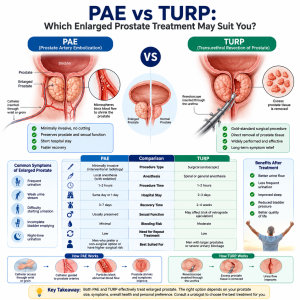
PAE and TURP can both help selected men with urinary symptoms caused by benign prostate enlargement. They work differently. TURP removes obstructing prostate tissue through the urine passage. PAE reduces blood flow to the prostate through a small catheter, allowing the gland to shrink gradually. The right choice depends on your symptoms, bladder function, prostate anatomy, health and personal priorities.
What are PAE and TURP?
PAE is a catheter-based treatment. A small tube is passed through an artery in the wrist or groin and guided to the arteries supplying the prostate. Tiny particles are then used to reduce blood flow to selected parts of the gland. Over time, the prostate may shrink and reduce pressure on the urine passage.
TURP is performed through the urethra, without an external incision. A urologist removes the part of the prostate tissue that is blocking urine flow.
Both procedures are used for symptoms related to benign prostatic hyperplasia, commonly called BPH. BPH is non-cancerous prostate enlargement. It is different from prostate cancer, although both conditions need appropriate evaluation.
Is PAE better than TURP?
There is no single answer that suits every patient.
TURP has been used for many years and remains an important treatment for men who need reliable relief from obstruction. It may be more suitable when symptoms are severe, bladder emptying is poor, or a urologist feels that removing prostate tissue will offer the clearest benefit.
PAE may suit selected men who prefer a less invasive approach, have not improved sufficiently with medicines, wish to avoid a more extensive procedure or have health concerns that make surgery less attractive.
PAE is not a shortcut around proper assessment. It is a different treatment path with its own benefits, limits and follow-up needs. In long-term studies, some patients who had PAE needed further treatment later. This is an important part of a transparent discussion before choosing either procedure.
Which symptoms suggest that treatment for BPH may be needed?
A prostate procedure is not decided only by scan size. It is considered when urinary symptoms are affecting quality of life or causing complications.
Symptoms that deserve evaluation include:
- Waking often at night to pass urine
- Weak, slow or interrupted urine flow
- Difficulty starting urination
- Straining to empty the bladder
- Urgency or frequent urination
- Dribbling after urination
- Feeling that urine remains in the bladder
- Repeated urinary infections
- Episodes of urinary retention
Some men have a large prostate but manageable symptoms. Others have a moderately enlarged prostate with severe symptoms. The impact on sleep, confidence, work, travel and bladder health is what matters.
Who may be a suitable candidate for PAE?
PAE may be discussed when a man has confirmed BPH with troublesome urinary symptoms and one or more of the following applies:
- Medicines have not given enough relief.
- Medicines are causing difficult side effects.
- He wants to explore a catheter-based alternative to an operation.
- He has a larger prostate and suitable artery anatomy.
- Other health conditions make anaesthesia or surgery a bigger consideration.
- Preserving sexual function is an important priority.
- His bladder function and prostate assessment support the procedure.
Before PAE, it is essential to confirm that BPH is actually causing the symptoms. A weak bladder, urethral narrowing, infection, stones or prostate cancer can create similar complaints but require different care.
Read more about Prostate Artery Embolization treatment.
Who may be better suited to TURP?
TURP may be the more appropriate option when a patient needs stronger relief from urinary obstruction or when the urology assessment shows that tissue removal is likely to offer a better result.
It may be considered when there is:
- Significant blockage affecting bladder emptying
- Repeated urinary retention
- Recurrent infections linked to obstruction
- A prostate shape or anatomy that is less suitable for PAE
- Concern that bladder damage may worsen if obstruction is not relieved effectively
- A need for a procedure that removes obstructing tissue directly
This does not mean that TURP is automatically required in every serious case. It means the decision must be based on clinical findings, not only on the attraction of a shorter recovery.
What tests are needed before choosing PAE or TURP?
A responsible decision begins with identifying the true cause of urinary symptoms.
Your assessment may include:
- A discussion of symptoms and their impact on daily life
- Urine testing to rule out infection
- PSA testing when clinically indicated
- Ultrasound or imaging to assess the prostate and bladder
- Measurement of urine flow and residual urine after passing urine
- Kidney-function tests when obstruction is suspected
- Review of current medicines and medical conditions
- Assessment of prostate and pelvic artery anatomy if PAE is being considered
PAE should be planned with appropriate urology input. In my practice, I do not decide from prostate size alone. I want to know whether the bladder is functioning well, whether the symptoms are truly from BPH and whether the arterial anatomy allows the procedure to be performed safely.
What size prostate is needed for PAE?
There is no one prostate size that automatically qualifies a man for PAE.
A prostate of 42 cc is larger than a typical younger adult prostate, but it does not automatically mean that a procedure is required. The same applies to prostate size at age 65. Prostates commonly enlarge with age, and the number on a scan must be interpreted alongside symptoms, urine flow and bladder emptying.
Doctors also look at:
- The shape of the prostate
- Whether there is a middle lobe affecting urine flow
- The amount of urine left after passing urine
- Previous urinary retention
- Bladder strength
- Arterial anatomy
- Overall health and treatment goals
A larger prostate may make PAE worth discussing, but size is only one part of the decision.
How do PAE and TURP differ in recovery?
PAE is performed through a small artery in the wrist or groin. Many patients go home on the same day or after a short stay, depending on the procedure and their overall health.
After PAE, some men experience pelvic discomfort, frequent urination, burning while passing urine, tiredness or a mild feverish feeling for a few days. This temporary response can happen as the prostate reacts to reduced blood flow. There can also be temporary blood in the urine or semen.
TURP recovery has a different pattern. A catheter is commonly used after surgery. Blood in the urine, burning, urgency and frequent urination can occur while the urinary tract heals. Your urologist will give specific advice about fluids, catheter care, medicines, activity and follow-up.
PAE is usually not described as a painful procedure because local anaesthesia and medicines are used for comfort. However, it is not discomfort-free. It is important to understand the expected short-term symptoms rather than assume that a minimally invasive treatment means no recovery at all.
Do you need a catheter after PAE?
Not every patient goes home with a catheter after PAE.
A catheter may be used during the procedure to help with imaging and guidance. Some men may need one temporarily afterward, especially if they already have urinary retention, poor bladder emptying or significant obstruction.
If you already depend on a catheter because you cannot pass urine independently, your treatment plan should include a clear discussion of whether PAE is suitable and how catheter removal will be assessed later.
How quickly does the prostate shrink after PAE?
PAE does not remove prostate tissue immediately. The prostate reduces gradually after its blood supply is treated.
Some men notice changes in urgency, frequency or urine flow within days or weeks. For others, improvement develops over the following weeks and months. The response depends on baseline symptoms, prostate size, bladder function and the degree of obstruction.
The prostate may continue to shrink for several months. Follow-up is important because a scan alone does not tell the whole story. Symptom improvement, urine flow and bladder emptying also need review.
How long does PAE last?
PAE does not have a fixed expiry date.
Some men experience durable symptom relief, while others may have recurring symptoms or need another treatment later. The long-term result depends on factors such as the original severity of obstruction, prostate anatomy, bladder function and how well the prostate responds.
TURP can provide stronger obstruction relief for some patients, particularly when symptoms are advanced. PAE can still be a valuable option for the right person, but the possibility of needing further treatment should be discussed before proceeding.
Does PAE reduce PSA?
PSA can change after PAE because the prostate tissue and inflammation response may change. However, PSA reduction should not be treated as the main sign that PAE has worked.
PSA needs to be interpreted by the treating doctor in the context of age, prostate size, previous PSA levels, examination findings and any concern about prostate cancer. PAE is not a treatment for prostate cancer.
Can PAE be done more than once?
A repeat PAE may be considered in selected cases, but it is not the default answer for symptoms that return.
Before planning another procedure, the care team should assess why symptoms have recurred. It could be related to prostate regrowth, incomplete initial response, bladder weakness, infection or another urinary condition. Depending on the cause, repeat PAE, TURP, laser treatment or another approach may be more appropriate.
Is PAE safe for older adults?
PAE can be considered for carefully selected older adults. Age alone does not decide whether a person is suitable.
The decision should include heart health, kidney function, blood-thinning medicines, mobility, bladder function, prostate anatomy and the severity of urinary obstruction. For some older adults, avoiding a more invasive procedure may be valuable. For others, TURP or another urological option may still offer the better outcome.
When should urinary symptoms be treated urgently?
Seek urgent medical attention if you have:
- Inability to pass urine
- Severe lower abdominal pain with a full bladder
- Fever, chills or worsening burning while passing urine
- Blood in the urine, particularly with clots
- Repeated urinary retention
- New confusion or severe weakness with possible infection
- Severe reduction in urine output with worsening symptoms
These symptoms need prompt medical evaluation. Do not wait for a routine procedure consultation.
How should you decide between PAE and TURP?
The most useful question is not, “Which procedure is newest?” It is, “Which option best addresses my urinary problem with an acceptable balance of recovery, risks and long-term expectations?”
During your consultation, ask:
- Are my symptoms definitely caused by BPH?
- Is my bladder emptying properly?
- Do I have signs of infection, cancer or another urinary condition?
- Is my prostate and artery anatomy suitable for PAE?
- Would TURP provide a clearer improvement in my specific case?
- What should I expect in the first week, first month and longer term?
- What are the likely effects on sexual function and ejaculation?
- What is the chance that I may need another treatment later?
The best plan is one you understand fully and can make with the right specialist guidance.
About Me
I am a Vascular & Endovascular Surgeon in Bangalore with experience in image-guided catheter-based vascular procedures, including PAE for appropriately selected patients. PAE decisions are made after proper BPH evaluation and with urology coordination where required.
If you are exploring a minimally invasive option for bothersome enlarged-prostate symptoms, book a consultation with Dr. Sravan.
Frequently Asked Questions
Which is better, PAE or TURP?
Neither is universally better. TURP may provide stronger relief from obstruction for some men. PAE may be suitable for selected patients who want a catheter-based option and have favourable clinical and arterial findings.
Is a 42 cc prostate enlarged?
A 42 cc prostate is larger than a typical younger adult prostate, but size alone does not decide whether treatment is needed. Symptoms, urine flow and bladder emptying are equally important.
Who is not a good candidate for PAE?
PAE may not suit men with untreated infection, suspected prostate cancer, severe bladder dysfunction, unsuitable artery anatomy or urinary symptoms caused by something other than BPH.
Do you need a catheter after PAE?
Not always. A catheter may be used temporarily during or after PAE, particularly in men with urinary retention or poor bladder emptying.
How long does PAE take to shrink the prostate?
Some symptom improvement can begin within days or weeks. Prostate shrinkage and the full effect usually develop gradually over weeks to months.
How many years does PAE last?
There is no fixed duration. Some men experience durable relief, while others may require additional treatment later. Your individual outlook depends on prostate anatomy, bladder function and the severity of obstruction.
Can PAE be done more than once?
Repeat PAE may be possible in selected cases. The reason for recurring symptoms should be investigated first because a different treatment may be more appropriate.
Is PAE safe for older adults?
PAE can be considered for selected older adults. Safety depends on overall health, kidney function, blood-thinning medicines, bladder function and artery anatomy, not age alone.
