 Skip to content
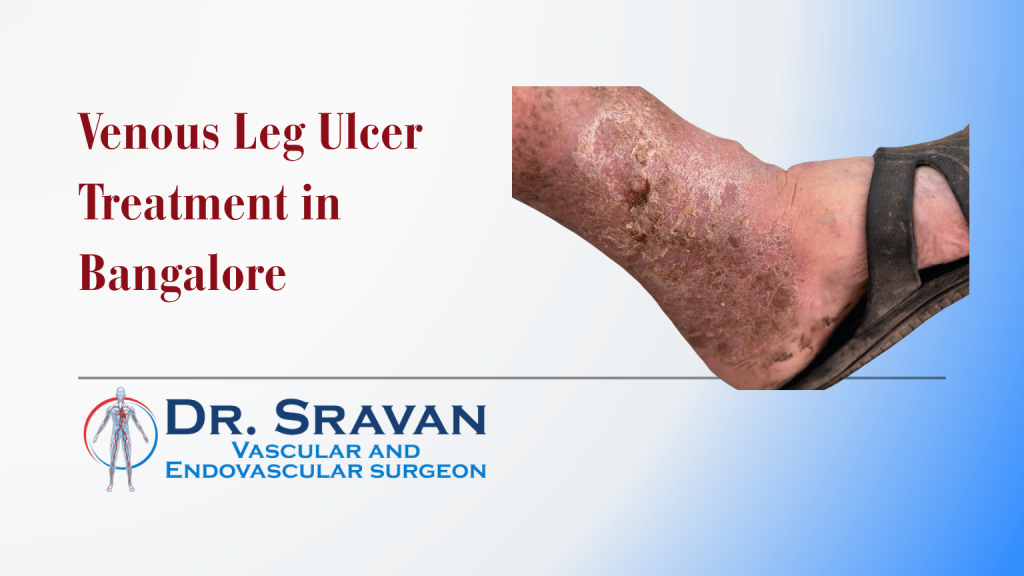
A venous leg ulcer is a wound that develops when long-standing problems with the leg veins create persistently high pressure around the ankle and lower leg. The wound may remain open for weeks or months, especially if the underlying venous problem has not been identified.
Venous leg ulcer treatment in Bangalore should therefore involve more than changing dressings. The first step is to confirm why the wound developed, check both venous and arterial circulation, assess for infection and then treat the wound together with the circulation problem. Compression is an important treatment for many venous ulcers, while selected patients may also benefit from treatment of abnormal superficial veins.
What Is a Venous Leg Ulcer?
A venous leg ulcer is an open wound associated with chronic venous disease.
Veins normally carry blood from the legs back towards the heart. Inside many leg veins are one-way valves that help prevent blood from falling backwards when a person is standing.
If these valves stop working properly, blood can move in the wrong direction and pressure builds up inside the veins of the lower leg.
This is called venous reflux.
Over time, persistent venous pressure can lead to:
- ankle swelling
- leg heaviness
- itching
- skin inflammation
- brown or dark skin discolouration
- hardening of the skin
- fragile skin
- eventually, an open wound
A venous ulcer commonly develops around the lower leg or ankle region.
However, not every wound near the ankle is venous.
Arterial disease, diabetes, pressure, infection, inflammatory conditions and other causes can also produce leg wounds. This is why a persistent ulcer should be assessed rather than diagnosed only from its appearance.
Why Does a Venous Ulcer Develop?
The immediate problem is the wound.
The deeper problem is usually venous hypertension, meaning abnormally high pressure within the veins of the leg.
This pressure can develop for several reasons.
Faulty superficial vein valves
Varicose veins and chronic venous insufficiency can allow blood to flow backwards when a person stands.
This backward flow increases pressure in the veins of the lower leg.
Patients who want to understand the broader condition can read the guide to varicose veins and chronic venous disorders.
Previous deep vein thrombosis
A previous DVT can damage valves inside the deep veins.
Some patients are left with long-term swelling, heaviness, skin changes and increased venous pressure after the clot has resolved.
This is sometimes called post-thrombotic venous disease.
You can read more about the relationship between clots and chronic venous problems on the Deep Vein Disorders page.
Obstruction of deeper veins
Blood may also have difficulty leaving the leg if there is narrowing or obstruction higher in the venous system.
This becomes particularly relevant when swelling is severe, affects one leg more than the other, or when there is a history of extensive DVT.
Reduced calf-muscle pump function
Walking helps the calf muscles squeeze blood upwards through the veins.
Limited ankle movement, reduced mobility or long periods of sitting can make this natural pumping mechanism less effective.
Often, more than one factor is present.
What Does a Venous Leg Ulcer Usually Look Like?
There are some patterns that can suggest venous disease, but appearance alone should not be used to diagnose the cause.
A venous ulcer may be associated with:
- an open wound around the ankle or lower leg
- an irregular wound edge
- swelling of the lower leg
- brown pigmentation around the ankle
- itchy or inflamed skin
- hardened or thickened skin
- visible varicose veins
- fluid leaking from the wound
- aching or heaviness in the leg
The skin around the ulcer can sometimes become fragile and irritated.
Some wounds are painful, while others cause less discomfort than expected.
That variation is another reason not to assume that pain level tells us how serious the circulation problem is.
How Can I Tell if My Leg Ulcer Is Venous or Arterial?
This is an important question because venous and arterial ulcers are treated differently.
A venous ulcer develops because blood has difficulty returning from the leg.
An arterial ulcer develops because insufficient blood is reaching the tissues through the arteries.
A person can also have both arterial and venous disease at the same time.
That mixed circulation problem is especially important because compression that is appropriate for a straightforward venous ulcer may need to be modified or avoided when arterial circulation is significantly reduced.
I therefore do not recommend deciding that a wound is venous simply because it is close to the ankle or because varicose veins are visible.
The circulation needs to be assessed.
Why Is a Venous Leg Ulcer Not Healing?
A non-healing ulcer often has more than one barrier to recovery.
Possible reasons include:
- persistent high venous pressure
- untreated superficial venous reflux
- inadequate or unsuitable compression
- arterial disease
- infection
- swelling
- repeated trauma
- reduced mobility
- diabetes
- poor nutrition
- pressure over the wound
- smoking
- an incorrect initial diagnosis
Sometimes the dressing is changed repeatedly while the underlying circulation problem remains untreated.
A dressing protects and manages the wound surface.
It does not correct faulty vein valves or a deep venous obstruction.
This distinction is central to venous ulcer treatment.
What Tests Are Needed for a Venous Leg Ulcer?
The investigation should answer two separate questions:
- Is poor venous circulation contributing to the ulcer?
- Is arterial blood flow adequate?
Both matter when planning treatment.
Clinical Examination
I first assess:
- where the ulcer is located
- how long it has been present
- whether it has healed and returned before
- leg swelling
- skin colour
- varicose veins
- surrounding inflammation
- pulses in the foot
- temperature of the foot
- pain pattern
- signs of infection
- previous DVT
- previous vein treatment
- diabetes and other medical conditions
The wound itself is also examined for its size, depth, tissue condition and surrounding skin.
Venous Duplex Ultrasound
A venous duplex ultrasound is an important investigation when chronic venous disease is suspected.
The scan can assess blood flow through the veins and look for abnormal backward flow caused by faulty valves.
Depending on the clinical question, it can help assess:
- superficial venous reflux
- deep venous function
- previous thrombosis
- relevant venous obstruction
- veins that may need treatment
A venous reflux study is different from a scan performed only to look for an acute DVT.
The correct Doppler study depends on what we are trying to find.
You can read more in the guide to vascular Doppler scans and the different studies used for vein and artery problems.
Arterial Circulation Assessment
Before applying strong compression, it is important to know whether the arteries are supplying enough blood to the foot.
Depending on the patient, this may involve:
- examination of foot pulses
- ankle pressure testing
- ankle-brachial index
- toe pressure testing
- arterial Doppler
- additional vascular imaging when required
This becomes particularly important in patients with:
- diabetes
- kidney disease
- smoking history
- foot pain at rest
- cold feet
- weak pulses
- toe discolouration
- suspected peripheral arterial disease
The purpose is not to make treatment unnecessarily complicated.
It is to avoid treating a mixed arterial and venous ulcer as though it were purely venous.
How Is a Venous Leg Ulcer Treated?
Treatment usually needs to address both the wound and the venous pressure that contributed to it.
The plan varies according to the circulation findings, wound condition and the patient’s general health.
Compression Therapy
Compression is one of the main treatments for suitable venous leg ulcers.
Bandages, wraps or compression garments apply controlled pressure to the lower leg.
This can help:
- reduce swelling
- improve venous return
- support the calf-muscle pump
- reduce venous pressure around the ankle
- create better conditions for wound healing
Compression is not simply a tight bandage.
The type and level should be chosen appropriately for the patient.
Is compression safe for every leg ulcer?
No.
This is why arterial circulation should be checked when clinically appropriate before significant compression is prescribed.
If arterial blood supply is substantially reduced, the compression strategy may need to be altered and the arterial problem may require treatment.
Patients should therefore avoid assuming that buying tight stockings is the correct treatment for every open leg wound.
Wound Care
The wound itself also needs proper care.
Depending on the ulcer, management may include:
- appropriate cleansing
- dressings that manage wound fluid
- protection of the surrounding skin
- removal of unhealthy tissue when clinically required
- treatment of excessive swelling
- management of eczema or skin inflammation
- pressure reduction where relevant
There is no single dressing that is best for every venous ulcer.
The dressing should be selected according to the wound’s condition, fluid level, surrounding skin and treatment plan.
Do Venous Leg Ulcers Need Antibiotics?
Not automatically.
A chronic wound can contain bacteria without being clinically infected.
Antibiotics are generally considered when there are signs that infection is present, rather than simply because an ulcer is open.
Features that may need medical assessment include:
- increasing redness around the wound
- spreading swelling
- increasing pain
- warmth
- pus or concerning discharge
- fever
- rapidly worsening wound condition
- systemic illness
A patient with diabetes or poor circulation may need particularly careful assessment if infection is suspected.
Antibiotics treat infection.
They do not correct venous reflux or high venous pressure.
Leg Elevation
Raising the leg while resting can help reduce venous pressure and swelling in some patients.
The practical approach depends on mobility, arterial circulation and other medical conditions.
Elevation is supportive care.
It should not replace compression or treatment of the underlying venous problem when those are required.
Walking and Calf-Muscle Activity
For many patients, appropriate walking and ankle movement help the calf muscles pump venous blood upwards.
However, activity advice should take the wound, balance, pain, arterial circulation and other medical problems into account.
A patient with an open ulcer does not necessarily need complete bed rest.
Equally, someone with significant pain or another circulation problem should not simply force themselves to walk without assessment.
Should the Veins Be Treated as Well as the Ulcer?
This is one of the most important modern questions in venous ulcer care.
If a duplex scan shows significant superficial venous reflux contributing to the problem, treating the faulty vein may form part of the treatment pathway.
Depending on the anatomy and individual case, options may include procedures such as:
- endovenous laser treatment
- radiofrequency ablation
- foam sclerotherapy
- treatment of selected varicose tributaries
- other venous procedures when clinically appropriate
The purpose is not cosmetic.
In an ulcer patient, the aim is to reduce the abnormal venous pressure contributing to the wound.
Evidence and venous-disease guidelines support early treatment of relevant superficial venous reflux in suitable patients with active venous ulceration, alongside appropriate compression and wound care.
Can Laser Treatment Be Done While the Ulcer Is Still Open?
In selected patients, treatment of superficial venous reflux does not necessarily need to wait until the ulcer has completely healed.
The decision depends on:
- confirming that the ulcer is venous
- arterial circulation
- duplex findings
- the vein involved
- infection status
- the wound condition
- the patient’s overall health
The important point is that an open ulcer does not automatically mean the underlying veins should be ignored until later.
The correct timing is decided after vascular assessment.
What if the Problem Is in the Deep Veins?
Not every venous ulcer is caused only by superficial varicose veins.
A patient may have:
- previous deep vein thrombosis
- damaged deep-vein valves
- chronic venous obstruction
- iliac-vein narrowing
- a combination of superficial and deep venous disease
In these situations, simply treating visible varicose veins may not solve the whole problem.
This is another reason why the duplex and clinical assessment should come before choosing a procedure.
What if I Have Both Artery and Vein Disease?
Some patients have mixed arterial and venous disease.
They may have features such as:
- swelling
- venous skin pigmentation
- an ulcer near the ankle
- weak foot pulses
- diabetes
- pain from reduced arterial circulation
These patients need a more individualised plan.
The arterial problem may change:
- how compression is used
- how strongly it is applied
- whether arterial imaging is needed
- whether revascularisation should be considered
- the expected wound-healing pathway
The label “venous ulcer” should never prevent us from checking whether the foot also has adequate arterial blood supply.
How Long Does a Venous Leg Ulcer Take to Heal?
There is no reliable single healing time.
Healing depends on factors such as:
- ulcer size
- how long it has been open
- severity of venous disease
- arterial circulation
- swelling
- infection
- diabetes
- mobility
- smoking
- compression
- whether significant venous reflux has been treated
- consistency of wound care
Some ulcers improve steadily.
Others take considerably longer.
Instead of promising that an ulcer will close within a fixed number of weeks, I prefer to monitor whether it is moving in the right direction.
A wound that is not improving should prompt reassessment of the diagnosis and the barriers to healing.
Why Do Venous Ulcers Come Back?
A healed skin wound does not always mean the venous disease that caused it has disappeared.
If high venous pressure continues, another ulcer can develop.
Recurrence prevention may involve:
- appropriate long-term compression
- management of venous reflux
- regular movement
- skin care
- swelling control
- weight management where appropriate
- avoiding repeated trauma
- follow-up when symptoms return
We will cover this in more depth in a separate patient guide on why venous leg ulcers recur after healing, because recurrence deserves its own discussion rather than being reduced to one FAQ.
What Are the Risks and Limitations of Venous Ulcer Treatment?
Venous ulcer care can involve several different treatments, so the risks depend on what is being recommended.
Compression
Possible problems include:
- discomfort
- pressure injury if incorrectly fitted
- difficulty tolerating the garment or bandage
- skin irritation
- inappropriate pressure when significant arterial disease has not been recognised
Endovenous treatment
Risks vary with the procedure and may include:
- bruising
- pain or tenderness
- inflammation
- bleeding
- infection
- nerve irritation
- blood clot
- incomplete vein closure
- recurrence of venous reflux
- need for further treatment
Wound treatment
The ulcer may also fail to heal despite appropriate care if there are additional problems such as arterial disease, deep venous obstruction, infection, pressure or another diagnosis.
Good treatment therefore includes reassessment rather than continuing the same approach indefinitely when the wound is not improving.
What Can I Do at Home While the Ulcer Is Being Treated?
Home care should support the treatment plan rather than replace vascular assessment.
Useful measures may include:
- follow the advised wound-care plan
- use compression exactly as prescribed
- keep compression clean and correctly positioned
- avoid picking at the wound
- protect the surrounding skin
- stay appropriately mobile
- elevate the leg when advised
- avoid long periods of standing still where possible
- stop smoking
- maintain diabetes control
- wear suitable footwear
- attend planned wound and vascular reviews
Do not apply very tight compression independently if the arterial circulation has not been assessed or if you have symptoms suggesting poor blood supply to the foot.
When Does a Venous Leg Ulcer Need More Urgent Assessment?
Seek prompt medical assessment if:
- redness is spreading around the ulcer
- swelling or pain suddenly worsens
- there is fever or systemic illness
- the wound rapidly becomes deeper
- tissue turns black
- the foot becomes cold or unusually pale
- new numbness or weakness develops
- the wound is associated with severe rest pain
- there is sudden major swelling of one leg
A sudden cold, pale or painful foot can indicate an arterial emergency rather than uncomplicated venous disease.
Sudden one-sided swelling can also require assessment for DVT.
Venous Leg Ulcer Treatment With Dr Sravan C.P.S
Dr Sravan C.P.S is a vascular and endovascular surgeon in Bangalore whose work includes chronic venous disease, varicose veins, deep venous disorders, vascular Doppler assessment and treatment planning for complex circulation problems.
His qualifications include MBBS, MS in General Surgery, MRCS from the Royal College of Edinburgh, DNB in Peripheral Vascular Surgery and FEVS from National University Hospital, Singapore. He has also served as an Assistant Professor of Vascular Surgery at Sri Jayadeva Institute of Cardiovascular Sciences and Research.
When I assess a non-healing leg ulcer, the first question is not simply:
“Which dressing should we use?”
I want to understand:
- Is this truly a venous ulcer?
- Are the arteries supplying enough blood?
- Is superficial venous reflux present?
- Has a previous DVT damaged the deep veins?
- Is there deeper venous obstruction?
- Is infection interfering with healing?
- Is compression safe and appropriate?
- Does the underlying vein disease need treatment?
That distinction matters because an ulcer can remain open if only the surface wound is treated while the vascular cause continues.
You can read more about Dr Sravan’s training and vascular surgery background.
When Should You See a Vascular Surgeon?
Consider a vascular evaluation if you have:
- a leg or ankle wound that has not been healing
- an ulcer that repeatedly closes and opens again
- an ulcer with significant leg swelling
- brown or hardened skin around the ankle
- visible varicose veins with a wound
- a history of DVT and new chronic skin changes
- an ulcer where the cause has not been clearly established
- a wound that has been treated with repeated dressings without steady improvement
- uncertainty about whether compression is safe
- a Doppler report showing significant venous reflux
- concern that poor arterial circulation may also be present
A proper vascular assessment can clarify whether the treatment needs to include compression, wound care, vein treatment, arterial assessment or another approach.
To discuss a persistent leg wound or venous circulation problem, book a vascular consultation with Dr Sravan in Bangalore.
Frequently Asked Questions About Venous Leg Ulcers
What is the main cause of a venous leg ulcer?
A venous leg ulcer usually develops because persistently high pressure in the leg veins damages the skin and tissues around the lower leg. Faulty vein valves, varicose veins, previous DVT or deeper venous obstruction may contribute. A vascular assessment helps determine which problem is present.
Can a venous leg ulcer heal with dressings alone?
Dressings are important for protecting and managing the wound, but they do not correct venous hypertension. Many patients also need appropriate compression, and some require treatment of underlying venous reflux. The exact plan depends on vascular assessment.
Is compression safe for every venous ulcer?
No. Compression is very useful in suitable venous ulcers, but arterial circulation should be considered first. Significant arterial disease can change the type or amount of compression that is safe. Patients should not assume that stronger stockings are automatically better.
Do I need a Doppler scan for a venous leg ulcer?
A vascular Doppler is commonly useful because it can assess venous reflux and other venous abnormalities. Arterial circulation may also need assessment, especially before significant compression or when poor arterial blood flow is suspected.
Do venous leg ulcers always need antibiotics?
No. An open ulcer does not automatically require antibiotics. Antibiotics are generally used when there are clinical signs of infection. Increasing redness, warmth, swelling, pain, discharge, fever or rapid deterioration should be medically assessed.
Can treating varicose veins help a venous ulcer?
It can in selected patients when abnormal superficial venous reflux is contributing to the ulcer. Duplex ultrasound helps identify whether relevant reflux is present and which veins are involved. Vein treatment is usually combined with wound care and appropriate compression rather than used as the only therapy.
Can an old DVT cause a venous leg ulcer years later?
Yes, it can contribute. A previous DVT may damage deep-vein valves or leave chronic obstruction, causing persistent venous pressure, swelling and skin changes. Some patients later develop post-thrombotic venous disease and ulceration, so the previous clot history is important during assessment.
Conclusion
A venous leg ulcer should not be viewed only as a skin wound.
In many patients, the ulcer is the visible result of a deeper circulation problem involving persistent high pressure in the leg veins.
Successful treatment therefore begins by confirming the cause, checking arterial blood flow, assessing the venous system and identifying the factors preventing healing.
Compression is an important part of treatment for many patients. Wound care, movement, swelling control and skin care also matter. When significant superficial venous reflux is contributing to the ulcer, treatment of the abnormal vein may become an important part of the healing and recurrence-prevention strategy.
Changing the dressing treats the surface.
Understanding why the wound is there, and what needs to change for it to heal, is the real work.

