Skip to content
Many men come to me after an ultrasound or a urology consultation with the same question: “Doctor, I have a varicocele. Do I need surgery?”
The first thing I explain is that having a varicocele does not automatically mean you need treatment. Some varicoceles cause no symptoms and never require a procedure. Others may cause a dull dragging pain, affect testicular size or become relevant during fertility evaluation.
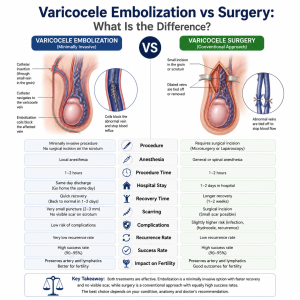
When treatment is needed, the usual options are varicocele embolization and varicocele surgery. Both aim to stop abnormal backward blood flow in the enlarged veins. They do it in different ways. Embolization treats the affected vein from inside through a catheter. Surgery closes the affected veins through an incision.
The right choice depends on why we are treating the varicocele in the first place.
What is a varicocele?
A varicocele is an enlargement of veins around the testicle. It is similar in principle to varicose veins in the leg, but it occurs in the scrotum.
It often develops on the left side because of the way the testicular veins drain. Some men notice a visible or palpable collection of veins. Others notice heaviness, discomfort after standing, a dull ache after exercise or a difference in testicular size.
In fertility evaluations, a varicocele may be relevant when semen parameters are abnormal. However, a varicocele is only one possible part of a couple’s fertility journey. It should not be blamed for every delay in conception without proper evaluation.
When do I advise treatment for a varicocele?
I do not advise treatment based on an ultrasound finding alone.
Treatment may be considered when there is:
- Persistent pain that is clearly linked to the varicocele
- A clinically detectable varicocele with infertility and abnormal semen parameters
- Testicular shrinkage or growth concerns in selected adolescents
- A recurrent varicocele after previous treatment
- Symptoms affecting comfort, exercise or day-to-day life
If you are trying to conceive, the evaluation should include more than one semen analysis when appropriate, along with urology or fertility input. The partner’s fertility assessment also matters. A procedure should be part of a clear fertility plan, not a promise of pregnancy.
What is varicocele embolization?
Varicocele embolization is a minimally invasive treatment performed through a small catheter.
I access a vein, usually through the groin, neck or arm depending on the planned route. Using X-ray guidance, I guide a small catheter into the vein causing the abnormal backward flow. Coils, a sclerosing agent or other embolic material may be used to close that vein.
Once the problematic vein is closed, blood is redirected through healthier veins.
There is no cut over the scrotum. Most patients have a small puncture site where the catheter was inserted.
If you want to understand how this treatment works before deciding, I have explained the varicocele embolization procedure in more detail here.
What is varicocele surgery?
Varicocele surgery is called varicocelectomy. It involves identifying and closing the enlarged veins through an incision.
There are different surgical approaches. Microsurgical varicocelectomy is commonly used because the surgeon can carefully preserve the artery and lymphatic channels while treating the affected veins. Laparoscopic and other approaches may also be considered in specific situations.
Surgery directly addresses the enlarged veins. Recovery, anaesthesia requirements and incision care depend on the surgical method used.
Is varicocele embolization better than surgery?
Neither option is automatically better.
Embolization may be particularly attractive for men who want a catheter-based procedure, prefer to avoid a scrotal incision, have a recurrent varicocele after surgery or are suitable based on vein anatomy.
Surgery may be preferred when fertility is the main concern, when microsurgical repair is recommended by the urology team, when the anatomy is not favourable for embolization or when the treating team feels surgery offers the more predictable option.
I am careful not to describe embolization as “better surgery.” It is a different approach. The right treatment is the one that fits the diagnosis, anatomy and goal.
How is recovery different after embolization and surgery?
Recovery matters, especially for men balancing work, travel, family responsibilities or sports.
After embolization, most patients have only a small access-site puncture. There may be mild soreness or bruising where the catheter entered. Some men notice temporary discomfort in the groin or scrotum. Light daily activity is often possible soon after the procedure, but exercise and sexual activity should resume only according to the treating team’s advice.
After surgery, there is an incision that needs time to heal. There may be scrotal swelling, bruising or discomfort during the early recovery period. The return to work, exercise and sexual activity depends on the surgical technique and individual healing.
A shorter initial recovery does not mean embolization is right for every patient. In the same way, a surgical recovery does not mean surgery is the wrong choice. The outcome we are aiming for matters more than the first few recovery days.
Which option is better for fertility?
Fertility is where careful counselling becomes especially important.
In men who are trying to conceive, have a palpable varicocele and abnormal semen parameters, varicocele treatment may be considered as part of the fertility plan. Microsurgical varicocelectomy has strong guideline support and a long track record in this setting.
Embolization can also be considered in selected cases, but it should not be presented as a guaranteed way to improve sperm count, sperm movement or pregnancy chances.
Sperm production takes time. If treatment improves semen parameters, this is usually assessed over months, not days or weeks. Some couples may still need fertility treatment such as IUI, IVF or ICSI, depending on both partners’ evaluation.
My advice is simple: if fatherhood is the main goal, involve a urologist or fertility specialist early. We should not choose a procedure without understanding the complete fertility picture.
Can either treatment help varicocele pain?
Both embolization and surgery can help selected men with varicocele-related discomfort.
Pain should be assessed carefully first. Not every groin or scrotal pain is caused by a varicocele. Infection, hernia, testicular conditions, nerve pain, kidney stones and musculoskeletal causes may need to be ruled out.
When pain is clearly related to the varicocele, treatment may help. But no procedure can honestly guarantee that pain will disappear completely. This is important to understand before deciding.
What are the risks of varicocele embolization?
Embolization is minimally invasive, but it is still a medical procedure.
Possible risks include:
- Bruising or bleeding at the catheter access site
- Temporary discomfort
- Contrast-related reactions
- Exposure to a small amount of X-ray radiation
- Incomplete closure of the vein
- Persistence or recurrence of the varicocele
- Rare movement of embolic material or treatment of a non-target vein
Careful imaging and catheter technique are important for reducing these risks.
What are the risks of varicocele surgery?
Surgical risks depend on the approach, but may include:
- Wound discomfort or infection
- Scrotal swelling or bruising
- Hydrocele, which is fluid around the testicle
- Varicocele recurrence or persistence
- Injury to nearby structures, including the artery in rare cases
- Anaesthesia-related risks
A microsurgical technique may help reduce some risks, but no procedure is completely risk-free.
What happens if a varicocele returns after treatment?
A recurrent varicocele can happen after either surgery or embolization.
When this occurs, I first review the original treatment, current symptoms, ultrasound findings and vein anatomy. A recurrence does not automatically mean the first treatment failed completely. Some men feel better even if a small residual vein remains.
Embolization can be useful in selected recurrent cases because it allows the veins to be mapped from inside. In other cases, surgery may be the more suitable next step. The decision should be individual.
How do I decide between embolization and surgery?
When I speak with a patient, I focus on the reason for treatment.
Are we treating pain? Are we evaluating infertility? Is the varicocele recurrent? Is the patient concerned about recovery time? What does the ultrasound show? Has a urologist recommended microsurgery? Is the vein anatomy suitable for a catheter approach?
These questions matter more than choosing a procedure based on a social-media claim or a friend’s experience.
Before making a decision, I encourage men to understand the common myths and facts around varicocele embolization. It helps patients separate realistic expectations from marketing promises.
My approach to varicocele embolization
As a vascular and endovascular surgeon, my role is to assess whether the catheter-based route is technically suitable and medically appropriate.
I explain what embolization can offer, where surgery may be stronger and when urology or fertility input is essential. If microsurgical varicocelectomy is likely to be the better path, I will say so clearly.
The aim is not to push a minimally invasive procedure. The aim is to help you make a confident decision with the right expectations.
About Dr. Sravan C.P.S
I am Dr. Sravan C.P.S, a Vascular & Endovascular Surgeon in Bangalore. I perform image-guided embolization procedures for carefully selected patients, including men with varicocele.
If varicocele pain, fertility concerns or a previous treatment result is worrying you, you can arrange a focused consultation to discuss your options. We will review your symptoms, scans, fertility goals and the most suitable next step.
Frequently Asked Questions
Is varicocele embolization better than surgery?
Neither is best for every man. Embolization may suit men who prefer a catheter-based procedure or have a recurrent varicocele. Surgery may be preferred when microsurgical repair is advised, especially in some fertility-focused cases.
Is varicocele embolization painful?
The procedure is usually performed with local anaesthesia and sedation when needed. Some men experience mild discomfort at the access site or temporary groin discomfort afterward.
How long does recovery take after varicocele embolization?
Many patients return to light routine activity soon after embolization. The timeline for exercise, sexual activity and strenuous work should follow the treating doctor’s advice.
Can varicocele embolization improve fertility?
Treatment may improve semen parameters in selected men with a clinical varicocele and abnormal semen tests. It cannot guarantee pregnancy, and fertility assessment should involve both partners.
Can varicocele embolization treat pain?
It may help when pain is clearly due to a varicocele. Other causes of groin or scrotal pain should be ruled out first, and no procedure can guarantee complete pain relief.
Can a varicocele come back after embolization?
Yes. Persistence or recurrence can occur after embolization or surgery. If symptoms return, ultrasound and specialist assessment can help decide the next step.
Is radiation used during varicocele embolization?
Yes. Embolization uses X-ray guidance. The team uses imaging carefully to keep radiation exposure as low as reasonably achievable.
Is surgery better for recurrent varicocele?
Not always. Embolization can be useful after previous surgery because it maps the veins from inside. In some cases, repeat surgery may be the better option. The decision depends on the anatomy and previous treatment.