Skip to content
If knee injections have given only short-term relief, or have stopped helping altogether, it does not automatically mean you need knee replacement. It does mean the cause of pain and the next treatment step should be reviewed carefully.
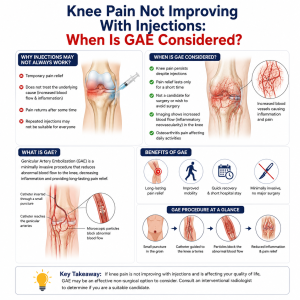
For selected people with knee osteoarthritis, Genicular Artery Embolization, called GAE, may be considered after structured non-surgical care has not provided enough relief. GAE is not another knee injection, and it does not rebuild damaged cartilage. It is an image-guided procedure that aims to reduce inflammation-related pain in carefully selected knees.
Why can knee injections stop helping?
Knee injections can be useful for some people, but they do not work the same way for every type or stage of knee pain.
Depending on the diagnosis, a doctor may consider steroid injections, hyaluronic acid injections, platelet-rich plasma or other treatments. Their role, expected duration and suitability are different.
An injection may give short-term relief but become less helpful when:
- Osteoarthritis has progressed.
- Pain is coming from more than one source.
- There is significant inflammation inside the joint.
- Muscles around the knee remain weak.
- Weight, walking pattern or repeated squatting continues to overload the joint.
- The pain is from a meniscus problem, ligament injury, spine issue or another condition rather than osteoarthritis alone.
- The knee has reached a stage where the treatment plan needs to change.
No knee injection can be promised to provide relief for three years. The response varies widely between patients. Repeating injections without reassessing the knee can delay the right diagnosis and the right treatment.
What should happen when injections are no longer helping?
The next step is not simply choosing the newest treatment. It is finding out why the knee still hurts.
A proper review may include:
- A discussion of where and when pain occurs
- Assessment of walking, stairs, sleep and daily activities
- Examination for swelling, tenderness, instability or deformity
- X-ray assessment of osteoarthritis severity
- MRI when the diagnosis is uncertain or another injury is suspected
- Review of physiotherapy, weight management, medicines and previous injections
- Orthopaedic input when knee replacement or another joint procedure may be needed
Knee pain has many causes. GAE should only be considered when osteoarthritis-related pain and inflammation are thought to be major contributors.
What is Genicular Artery Embolization?
GAE is a minimally invasive procedure performed through a small artery in the wrist or groin.
The genicular arteries are small blood vessels around the knee. In osteoarthritis, inflamed tissue around the joint can develop abnormal small blood vessels. These vessels may contribute to inflammation and pain.
During GAE, a catheter is guided under X-ray imaging to selected small arteries around the painful area of the knee. Tiny particles are used to reduce abnormal inflammatory blood flow.
The purpose is to reduce pain related to osteoarthritis. GAE does not remove bone, replace the knee or regrow cartilage.
Read about the procedure on the Genicular Artery Embolization treatment page.
When is GAE considered after failed injections?
GAE may be considered when a patient has:
- Knee pain from confirmed osteoarthritis
- Symptoms that continue despite physiotherapy, activity changes and appropriate medicines
- Temporary or insufficient relief after knee injections
- Pain that limits walking, stairs, sleep or daily independence
- A wish to delay knee replacement after proper orthopaedic assessment
- Medical concerns that make major surgery less suitable
- Imaging and examination findings that support an inflammation-related pain source
The strongest candidates are not chosen from one symptom alone. Suitability comes from the full picture of pain, imaging, joint structure, circulation and treatment goals.
Who may not be a suitable candidate for GAE?
GAE may not be the right next step when there is:
- Active knee or skin infection
- Unexplained swelling, fever or severe redness
- A recent major knee injury
- Suspected cancer or another serious cause of pain
- Advanced joint damage or fixed deformity that is more likely to require knee replacement
- Significant circulation problems in the leg
- Pain mainly coming from the hip, spine, nerves or another non-knee source
- Untreated medical issues that make an artery procedure unsafe
This is why GAE should not be offered simply because a patient wants to avoid surgery. Sometimes knee replacement is the more suitable and more durable option. A focused GAE versus knee replacement guide will be published separately to answer that decision in detail.
How successful is GAE for knee osteoarthritis?
GAE can reduce pain and improve function in selected people with osteoarthritis, but results vary.
Some patients notice meaningful improvement. Others may have less benefit, or may need a different treatment later. The response depends on osteoarthritis severity, the amount of inflammation, joint alignment, muscle strength, weight, activity level and whether the pain truly comes from the treated area.
The evidence for GAE is developing. It has shown encouraging results in selected patients, and current specialist guidance recognises it as an option after conservative care has failed. It should not be marketed as a cure for osteoarthritis or a guaranteed alternative to knee replacement.
How long does GAE take to work?
GAE does not usually create instant pain relief.
Some patients begin to notice improvement within a few weeks. For others, the response may develop more gradually over several weeks. The aim is to reduce inflammation-related pain while allowing the patient to return to movement, strengthening and healthier daily activity.
The knee may feel sore for a short period after the procedure. Your treating team will explain medicines, activity guidance and follow-up based on your individual situation.
Is GAE painful?
GAE is usually performed with local anaesthesia at the access site, with sedation if needed. Most patients do not experience the pain associated with an open operation.
However, it is important to be realistic. Some discomfort can occur during recovery, including:
- Mild pain or cramping around the knee
- Soreness or bruising at the wrist or groin access site
- Temporary fatigue
- A short-term pain flare before improvement develops
Pain control and post-procedure instructions are part of the treatment plan.
What are the risks of a GAE procedure?
Every procedure has risks, even when performed through a small catheter.
Possible risks include bruising or bleeding at the access site, temporary skin changes, pain flare, infection, reaction to contrast dye and unintended treatment of nearby tissues. Serious complications are uncommon but need to be discussed before treatment.
Careful imaging, correct patient selection and experienced catheter technique are essential for reducing risk.
Can GAE be repeated?
Repeat GAE is not a routine or automatic plan.
If symptoms return, the first step is to understand why. The osteoarthritis may have progressed, pain may be coming from a different structure, or another treatment may now be more appropriate.
A repeat procedure may be considered in selected cases, but there is no fixed schedule for repeating GAE. The decision should follow a new clinical and imaging review.
How is GAE different from another knee injection?
A knee injection is delivered directly into or around the joint. GAE is an artery procedure performed through a catheter under imaging guidance.
GAE is not simply a stronger injection. It addresses a different part of osteoarthritis-related pain by targeting selected abnormal blood vessels linked to inflammation. That is why it requires vascular expertise, careful imaging and suitability assessment.
What about GAE cost and insurance cover?
The cost of GAE depends on the hospital facility, imaging, medicines, consumables, procedure complexity and follow-up needs. A safe estimate should only be given after your evaluation.
Insurance approval also varies by policy and insurer. Patients should confirm pre-authorisation and coverage directly with their insurance provider and hospital billing team before scheduling a procedure.
What can still help alongside GAE?
GAE works best when it is part of a broader knee-care plan.
Depending on the patient, this may include:
- Supervised physiotherapy
- Quadriceps and hip-strengthening exercises
- Weight management where relevant
- Activity modification
- Comfortable supportive footwear
- Diabetes and inflammation control
- Medicine review with the treating doctor
- Orthopaedic review when joint replacement is indicated
A procedure may reduce pain, but long-term knee function also depends on movement, muscle strength and joint protection.
When should knee pain be assessed urgently?
Do not treat every painful knee as routine osteoarthritis.
Seek urgent medical assessment if there is:
- A red, hot and swollen knee
- Fever with knee pain
- Sudden inability to bear weight
- Severe pain after a fall or injury
- A locked knee
- Rapidly worsening swelling
- Calf swelling, breathlessness or chest pain
- A diabetic foot or skin infection near the knee
These symptoms may point to infection, injury, a blood clot or another problem that needs prompt care.
My approach to GAE assessment
When a patient says, “My injections are no longer working,” I do not begin by recommending a procedure. I begin by understanding the pain.
Is it osteoarthritis? Is the joint too damaged for GAE to be useful? Is the pain mainly inflammatory? Has physiotherapy been properly tried? Is knee replacement the better option now?
GAE can be a valuable option for the right patient. It should never be used to avoid the right treatment for the wrong reason.
For a broader overview of non-surgical knee care, read How to Reduce Knee Pain Without Surgery.
About Dr. Sravan C.P.S
Dr. Sravan C.P.S is a Vascular & Endovascular Surgeon in Bangalore who performs image-guided catheter procedures, including GAE for appropriately selected patients with knee osteoarthritis.
GAE assessment includes review of symptoms, imaging and conservative treatment history. Orthopaedic coordination is important when joint damage is advanced or knee replacement needs consideration.
If knee pain continues despite injections and structured non-surgical care, book a consultation with Dr. Sravan to assess whether GAE may be appropriate.
Frequently Asked Questions
Who is a candidate for GAE?
A candidate may have confirmed knee osteoarthritis, continuing pain despite physiotherapy, medicines or injections, and symptoms that affect walking or daily life. Imaging and clinical assessment are needed before deciding.
Is GAE better than knee replacement?
GAE and knee replacement serve different purposes. GAE may help selected osteoarthritis patients reduce pain when conservative treatment has failed. Knee replacement may be more suitable when joint damage is advanced or deformity is significant.
How successful is GAE for knees?
GAE can improve pain and function in selected patients, but results vary. It does not cure osteoarthritis or guarantee that knee replacement will never be needed.
How long does GAE take to work?
Some patients notice improvement within a few weeks. Others improve gradually over several weeks. Recovery and response differ from person to person.
What knee injection lasts three years?
No knee injection can reliably be promised to last three years. The duration depends on the injection type, diagnosis and the individual patient’s response.
Can GAE be repeated?
Repeat GAE may be considered in selected cases after a fresh assessment. It is not a routine treatment on a fixed schedule.
What are the side effects of GAE?
Possible side effects include temporary knee soreness, bruising at the access site, short-term fatigue, skin changes, infection or contrast-related reactions. Serious complications are uncommon but should be discussed before treatment.
Is GAE covered by insurance?
Coverage varies by insurer and policy. Confirm approval directly with your insurer and the hospital billing team after your treatment plan is finalised.