 Skip to content

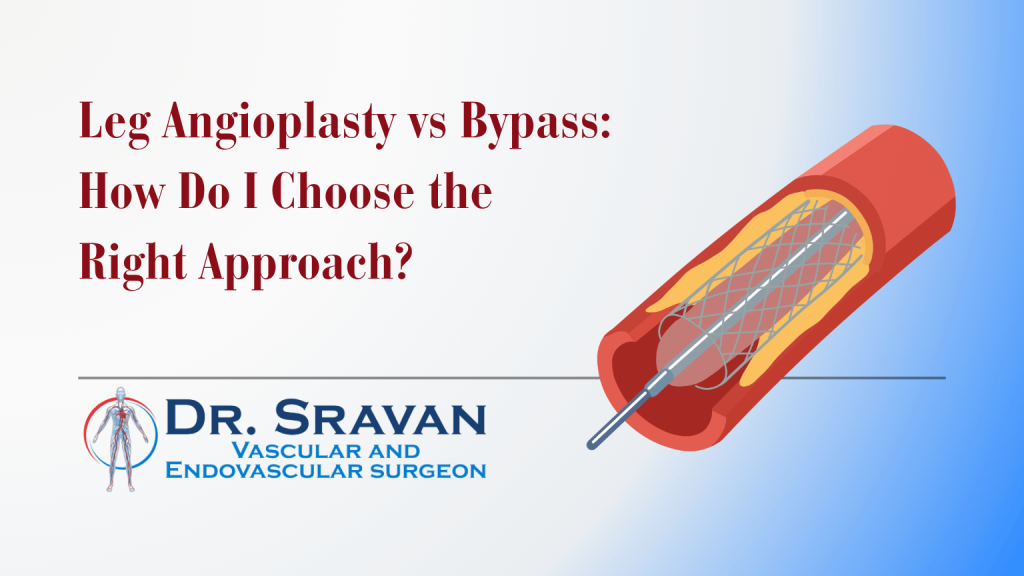
When comparing leg angioplasty vs bypass, both aim to improve blood flow around an arterial blockage, but neither is the right answer for every patient. I consider why treatment is needed, the pattern of blocked arteries, the condition of the foot, your general health and the likely durability of each option.
Angioplasty opens the artery from inside using a catheter, sometimes with a stent. Bypass creates another route for blood using a graft. Before weighing leg angioplasty vs bypass, I also ask whether a procedure is needed now. Stable walking pain and a threatened, non-healing foot require different decisions.
Leg Angioplasty vs Bypass: What Is the Main Difference?
Angioplasty
During angioplasty, the operator passes a wire and catheter into the arterial system and uses a balloon to open a narrowed or blocked segment. A stent may be needed in selected situations.
It treats the existing pathway from inside the vessel. My peripheral angioplasty guide explains that procedure in more detail.
Bypass
Bypass uses a graft to carry blood around the diseased segment. The graft can be a suitable vein from your body or another material, depending on the operation.
It requires surgical exposure and suitable arteries where the graft can connect.
The comparison concerns the best route to useful blood flow, not whether a small puncture is always better than an incision.
Do You Need Either Procedure Yet?
Not everyone with PAD needs angioplasty or bypass. I first assess symptoms, circulation and the effect on daily life.
For stable walking pain, treatment often includes medicines, smoking cessation and structured exercise. A procedure may be considered when symptoms remain functionally limiting despite an appropriate non-surgical plan.
The discussion changes when there is rest pain from inadequate circulation, a non-healing wound or tissue loss. These may indicate a threatened limb and require prompt vascular assessment.
My Peripheral Arterial Disease guide explains the broader condition.
A blockage on a scan is not, by itself, a complete indication for an intervention.
Why Does the Treatment Goal Matter?
I want to know what improved circulation is expected to achieve.
For someone with claudication, the goal may be better walking and daily function. For someone with a wound, it may be enough blood flow to support healing and preserve a useful foot.
These are different situations, with different urgency and risk-benefit considerations.
I would not use the same threshold for an elective walking problem as for a foot that is deteriorating from inadequate blood supply.
Agreeing the goal also helps with follow-up. Technical opening of an artery matters, but the patient still needs a useful clinical result.
Which Features of the Arteries Influence the Choice?
The assessment includes:
- The location and length of the narrowing or blockage.
- Whether there are several affected segments.
- The amount of calcium and difficulty of crossing the blockage.
- The arteries carrying blood beyond the diseased segment.
- The circulation reaching the ankle and foot.
- Previous stents, bypasses or other interventions.
A short, accessible narrowing and a long, complex blockage may require different plans. However, no single feature automatically determines the answer.
I review the whole route that blood needs to take. Opening one segment may not be enough if important disease remains further down.
Does a Long Blockage Automatically Need Bypass?
No. Length is important, but it is not a stand-alone rule. Some long blockages can be treated endovascularly; some patients may benefit more from a bypass.
The decision also depends on the available target artery, a suitable graft, expected durability and the patient’s ability to tolerate surgery.
Likewise, a shorter lesion does not automatically make angioplasty the best option if there are other anatomical or clinical concerns.
I would explain which findings support the recommendation rather than reduce the decision to a cut-off measurement.
Ask to see the relevant imaging and the proposed route for treatment. That helps make the reasoning clearer.
Why Does Having a Suitable Vein Matter for Bypass?
A bypass needs a conduit to carry blood. For some lower-limb operations, a suitable vein from the patient’s own body is an important part of the plan.
The team may use vein mapping to assess its availability and quality. A vein used for a previous procedure may no longer be available.
Whether an alternative graft is appropriate depends on the location and operation.
Research comparing revascularization strategies shows that the availability of suitable vein can influence outcomes in selected patients. It does not mean that bypass is best for everyone.
I consider the conduit together with the artery targets, limb condition, health and the benefits expected from surgery.
How Do Diabetes and a Foot Wound Change the Decision?
Diabetes can affect nerves, infection risk and healing as well as the arteries. A wound may therefore need several treatments at the same time.
If inadequate arterial supply is preventing healing, the revascularization plan needs to deliver useful flow towards the affected foot.
I also assess infection, pressure, tissue damage and the likely function of the foot. Opening an artery does not replace wound care or offloading.
My diabetic foot revascularization guide explains this combined approach.
The right decision may involve angioplasty, bypass or another strategy. It should follow the wound and arterial anatomy rather than a fixed preference for one technique.
Does Poor General Health Always Favour Angioplasty?
Angioplasty can be less invasive, which may be relevant for some patients. However, I would not assume it is suitable simply because major surgery carries a higher risk.
Heart disease, kidney disease, lung problems, mobility and frailty can influence both approaches. The likely benefit and the patient’s priorities also matter.
Kidney function needs particular attention when contrast-based imaging or treatment is planned. The team should explain the available precautions and alternatives.
Sometimes the most appropriate decision involves improving medical care, choosing a different intervention or discussing limits to what revascularization can achieve.
Being able to perform a procedure is not the same as showing that it will help the patient.
Leg Angioplasty vs Bypass: Which Treatment Lasts Longer?
There is no single durability figure that applies to every artery and patient.
A well-selected bypass can provide a durable route, particularly in some complex disease patterns. An angioplasty can also provide useful benefit, but a treated segment may narrow again.
Bypass grafts can develop narrowing or blockage too. Neither approach removes the underlying tendency to arterial disease.
Trials compare defined patient groups and techniques. I use that evidence alongside your anatomy and health, rather than promise that one treatment will remain open for a fixed number of years.
Ask what follow-up is needed and what the plan would be if the treated route develops a problem.
Can You Have Bypass After Angioplasty?
Sometimes, but the earlier procedure and current anatomy affect the options.
If symptoms persist or return after angioplasty, I would review what was treated, the current circulation and whether the initial goal was achieved.
A repeat endovascular procedure, bypass or another approach may be appropriate. Previous angioplasty does not automatically establish that bypass is now required.
Similarly, a previous bypass does not rule out later catheter treatment.
Bring operation notes and earlier angiograms if available. They help establish which arteries and grafts remain usable and prevent the discussion from relying only on a short scan summary.
Can Both Methods Form Part of One Plan?
Yes. Some patients benefit from a hybrid approach that combines an open surgical procedure with an endovascular treatment.
For example, different levels of arterial disease may be better addressed with different techniques.
This is another reason the consultation should focus on the whole limb rather than force every patient into a choice between two labels.
I would explain which part of the circulation each step treats, whether the steps happen together and what recovery may involve.
A combined plan should have a clear clinical purpose. More procedures or more devices do not automatically mean a better result.
How Do Recovery and Hospital Stay Differ in Leg Angioplasty vs Bypass?
Angioplasty often involves a smaller access wound and a shorter recovery than an open bypass. However, complexity, complications and the condition of the foot can extend either pathway.
Bypass generally requires recovery from surgical incisions and may involve a longer hospital stay. Walking, wound care and help at home need planning.
A diabetic foot wound can require ongoing care even after the arterial procedure has succeeded.
My leg angioplasty recovery guide covers that pathway separately.
Before choosing treatment, discuss the practical needs of your recovery rather than compare hospital stay alone.
What Risks Should We Discuss?
Angioplasty can involve bleeding, contrast-related problems, arterial injury, embolization, acute blockage and later narrowing.
Bypass can involve wound complications, graft problems, infection and the risks associated with a larger operation. Both approaches can carry serious cardiovascular complications.
The relevant risks depend on your health, anatomy and urgency. Published averages are not a personal prediction.
I would discuss the expected benefit, procedural risks, alternatives and the consequences of not intervening.
You should also understand the possibility of further procedures. Revascularization is a treatment pathway with follow-up, not a guarantee that circulation can never worsen again.
What Care Remains Important After Either Treatment?
Continue the medical plan prescribed for PAD. This may include antiplatelet or other antithrombotic treatment, cholesterol-lowering therapy and control of blood pressure and diabetes.
Do not start, stop or change these medicines yourself. The combination depends on the procedure, bleeding risk and other conditions.
Smoking cessation, appropriate exercise and foot care remain important. Follow-up may involve examination, circulation tests or ultrasound surveillance.
I want patients to understand that restoring flow and managing the underlying disease are connected tasks. A successful procedure does not remove the need for long-term vascular care.
When Is This an Emergency?
Seek emergency care if a leg or foot suddenly becomes severely painful, cold, pale, numb or weak.
This can indicate an acute loss of blood flow. It is different from a routine comparison of elective angioplasty and bypass.
A deteriorating wound, spreading infection or blackening tissue also needs prompt assessment. Do not wait to collect several outpatient opinions while the foot worsens.
If a sudden change occurs after previous angioplasty or bypass, tell the emergency team about the procedure and when it took place.
Urgency depends on the current limb findings, not only the date of your last scan.
What Should You Ask During a Second Opinion?
Ask:
- Why do I need revascularization now?
- What is the goal for walking, pain or wound healing?
- What makes angioplasty or bypass suitable for my arteries?
- Is there a usable vein for bypass?
- What are the recovery needs and important risks?
- What happens if the first treatment does not achieve the goal?
Bring imaging, procedure records, medicines and wound-care details. You can read my vascular and endovascular background before visiting.
For a vascular treatment discussion in Bangalore, book a consultation with your records. I would assess the limb and explain the reasoning behind the options before recommending a route.
The Society for Vascular Surgery’s patient guide to surgical bypass explains how a bypass graft works and what recovery usually involves.
Frequently Asked Questions
Is angioplasty always safer than bypass?
No. It is often less invasive, but the overall risk-benefit balance depends on the anatomy, health and treatment goal. A smaller access wound does not establish suitability.
Does a completely blocked artery always need bypass?
No. Some complete blockages can be treated with endovascular techniques. Others may be better suited to surgery or another plan after detailed assessment.
Can bypass cure PAD?
No. It creates another route for blood around disease. Medicines, risk-factor management and follow-up remain necessary.
Does every diabetic foot ulcer need angioplasty?
No. The assessment must establish whether poor arterial flow is contributing. Infection, pressure and neuropathy can also require treatment.
Can angioplasty and bypass both need repeat treatment?
Yes. A treated artery or bypass graft can narrow or block. Surveillance and prompt review of changing symptoms help guide further care.
Should I try exercise before every procedure?
Structured exercise is important for appropriate stable claudication. It should not delay assessment of rest pain, a threatened foot or a vascular emergency.
Can I choose based only on the recovery time?
Recovery matters, but it is one part of the decision. The procedure also needs to offer an appropriate chance of achieving the clinical goal with acceptable risks.

