Skip to content
One of the most common questions I hear from patients with long-standing knee pain is, “Doctor, can I avoid knee replacement?”
It is a fair question. Knee pain affects much more than walking. It changes how confidently you climb stairs, sit on the floor, go to work, travel or even sleep. But avoiding surgery should not be the only goal. The real goal is to choose the treatment that gives you the best chance of getting back to a comfortable, active life.
For some people, Genicular Artery Embolization, or GAE, can be a useful step before knee replacement. For others, knee replacement may be the treatment that makes more sense. These procedures are very different, and choosing between them starts with understanding what is actually causing your pain.
Is GAE better than knee replacement?
Neither is better for everyone.
GAE is a minimally invasive artery procedure. It may help selected patients whose knee pain is related to osteoarthritis and inflammation around the joint. It does not replace the knee, remove bone or repair damaged cartilage.
Knee replacement is an orthopaedic operation that replaces badly damaged joint surfaces with an implant. It is usually considered when arthritis is advanced and pain has become difficult to manage despite appropriate non-surgical treatment.
I do not advise a patient to avoid knee replacement simply because it is surgery. Likewise, I do not advise knee replacement just because an X-ray shows arthritis. The decision should be based on how much the knee is damaged, how much pain is affecting life and what treatment is likely to help that particular person.
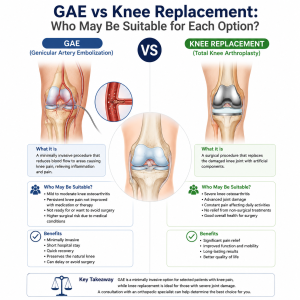
What is GAE, and how can it help knee pain?
GAE stands for Genicular Artery Embolization. It is an image-guided procedure performed through a small catheter inserted through an artery in the wrist or groin.
In osteoarthritis, the knee joint does not only suffer from cartilage wear. Inflammation inside and around the joint can become an important pain driver. Tiny abnormal blood vessels may form around this inflamed tissue and contribute to persistent pain.
During GAE, I use live imaging to identify selected blood vessels around the painful part of the knee. Tiny particles are delivered through the catheter to reduce abnormal inflammatory blood flow.
The aim is to reduce pain and help mobility in suitable patients. It is not a cure for arthritis, and it does not make a severely damaged knee normal again.
If you would like to understand how I assess and perform the procedure, you can read more about the GAE treatment process here.
When do I consider GAE?
I consider GAE only after understanding the full story of the knee.
A person may be suitable when:
- Knee osteoarthritis has been confirmed.
- Pain has continued despite physiotherapy, medicines, activity changes or injections.
- The pain is affecting walking, sleep, work or daily independence.
- There is no severe fixed deformity or advanced joint damage that clearly needs replacement surgery.
- The patient wishes to explore a less invasive option after proper evaluation.
- Surgery may be difficult because of age, medical conditions or recovery concerns.
- The pattern of pain and imaging suggests inflammation is contributing to the problem.
Many patients reach this stage after injections have stopped giving useful relief. If that is what you are experiencing, I have explained what it may mean when knee injections stop helping.
When is knee replacement the better choice?
Knee replacement may be the right answer when the problem is no longer mainly inflammation. In some knees, the structure of the joint has become too damaged for a pain-focused procedure to provide enough benefit.
I would encourage an orthopaedic opinion when there is:
- Severe bone-on-bone arthritis
- Major bowing or deformity of the knee
- Significant difficulty walking even short distances
- Pain that continues despite good conservative care
- A knee that is unstable, severely stiff or no longer functioning well
- Imaging that shows joint damage unlikely to respond to GAE
- A patient who is fit for surgery and wants a more definitive structural solution
There is no prize for delaying a knee replacement that is genuinely needed. Delaying the right treatment for too long can affect confidence, mobility, sleep and overall health.
How is recovery different after GAE and knee replacement?
GAE is a small-catheter procedure. Most patients walk on the same day, although there may be knee soreness or mild pain for a few days. Improvement in pain generally develops over the following weeks rather than immediately after the procedure.
Knee replacement involves surgery, a hospital stay based on the clinical plan and a more structured rehabilitation period. Physiotherapy is essential. Recovery takes longer, but the procedure directly addresses the damaged joint surfaces.
I tell patients not to choose only based on which recovery sounds easier. A shorter recovery is useful only when the procedure is likely to address the source of pain.
How successful is GAE for knee pain?
GAE can reduce pain and improve function in selected patients, but I do not promise the same result to everyone.
The outcome depends on several things:
- The stage of arthritis
- Whether inflammation is a major part of the pain
- Knee alignment and structural damage
- Muscle strength around the joint
- Body weight and activity pattern
- Whether pain is actually coming from the knee rather than the hip, spine or nerves
Some patients experience significant improvement. Others may improve less than expected or may later need another treatment. GAE is an evolving option with growing clinical evidence, but it should never be presented as a guaranteed alternative to knee replacement.
Is knee replacement always successful?
No medical treatment is 100 percent successful.
Many people have substantial pain relief and better daily function after knee replacement. At the same time, it is major surgery. Recovery requires effort, rehabilitation and patience. Some patients may have stiffness, persistent discomfort or complications such as infection, blood clots or problems related to the implant.
Most knee replacements are designed to last many years. But there is no single lifespan that applies to every implant or every person. Age, weight, activity level, surgical technique and overall health all matter.
What are the disadvantages of GAE?
GAE is less invasive than knee replacement, but it has limitations.
It does not repair cartilage. It does not correct a severely bent knee. It does not remove damaged bone. It may not help if pain is coming mainly from a torn ligament, hip arthritis, spine problem, nerve pain or advanced joint destruction.
Possible risks include:
- Bruising or bleeding at the wrist or groin access site
- Temporary soreness or a pain flare
- Skin changes near the treated area
- Infection
- Contrast-related reactions
- Rare unintended treatment of nearby tissues
A patient can also have a technically successful procedure but less improvement than expected. That is why careful selection matters more than simply offering the procedure.
Can GAE be done after knee replacement?
GAE may be considered in very selected situations after knee replacement, but it is not a routine answer for a painful replaced knee.
When someone has pain after knee replacement, the first step is always to understand why. Infection, implant loosening, instability, stiffness or a mechanical issue must be ruled out by the orthopaedic team.
Only after that assessment can a specialist decide whether there is any role for an artery procedure.
Can GAE be repeated?
There is no fixed schedule for repeating GAE.
If pain returns, I first reassess the knee. Arthritis may have progressed, the pain source may have changed or knee replacement may now be a better option. Repeat GAE may be considered in selected patients, but it should never be automatic.
What happens if I do not get knee replacement?
Some people can manage knee arthritis without replacement for years. Strengthening exercises, weight management, activity changes, medicines, injections and selected procedures may help.
But if pain is stopping you from walking, sleeping, working or caring for yourself, waiting indefinitely may reduce quality of life. The decision should be reviewed regularly with the right specialists.
For many people, the first step is still conservative care. I have covered practical ways to reduce knee pain without surgery for patients who are earlier in their treatment journey.
My approach to this decision
When someone comes to me asking about GAE, I do not begin by saying that it is the right answer. I begin by asking what has changed in their daily life.
Can you walk to the shop? Can you climb stairs? Are you waking up because of pain? Have injections helped at all? Is the knee swelling? What does the X-ray show? Has an orthopaedic surgeon advised replacement?
Once I understand those answers, I can explain whether GAE is worth considering or whether another treatment is likely to help more.
The aim is not to avoid surgery at any cost. The aim is to avoid the wrong treatment.
About Dr. Sravan C.P.S
I am a Vascular & Endovascular Surgeon in Bangalore and perform image-guided procedures, including GAE for carefully selected patients with knee osteoarthritis.
My role is to assess whether a patient’s pain pattern and imaging suggest that GAE may help. When knee replacement is likely to offer a better result, I coordinate with orthopaedic care rather than pushing a procedure that is not right for the patient.
If you are unsure whether GAE or knee replacement may suit your knee, you can book a consultation to review your symptoms and scans.
Frequently Asked Questions
Is GAE better than knee replacement?
GAE may suit selected patients with osteoarthritis-related pain who want to delay surgery. Knee replacement may be more suitable for severe structural joint damage or deformity. The better option depends on the knee and the patient’s goals.
Who is a good candidate for GAE?
A possible candidate has knee osteoarthritis, continuing pain despite non-surgical treatment and imaging that does not show advanced joint damage better treated with replacement surgery.
Who is not a good candidate for GAE?
GAE may not be suitable for people with active infection, unexplained knee pain, severe deformity, advanced joint destruction, major circulation problems or pain mainly caused by another condition.
How successful is GAE for knees?
GAE can improve pain and function in selected patients, but results vary. It does not cure osteoarthritis or guarantee that knee replacement will never be needed.
How long does GAE pain relief last?
There is no fixed duration. Some patients have sustained improvement, while others may have symptoms return or need another treatment later.
Can GAE be done after knee replacement surgery?
It may be considered in selected specialist situations, but infection, implant loosening, instability and other mechanical causes must be ruled out first.
What are the disadvantages of GAE?
GAE does not repair cartilage or correct severe joint damage. It may not provide enough relief for every patient. Risks include bruising, temporary pain flare, skin changes, infection and rare unintended treatment of nearby tissue.
What happens if you never get knee replacement?
Some people manage symptoms without replacement for years. However, if pain severely limits walking, sleep and independence, delaying an appropriate replacement may reduce quality of life.