
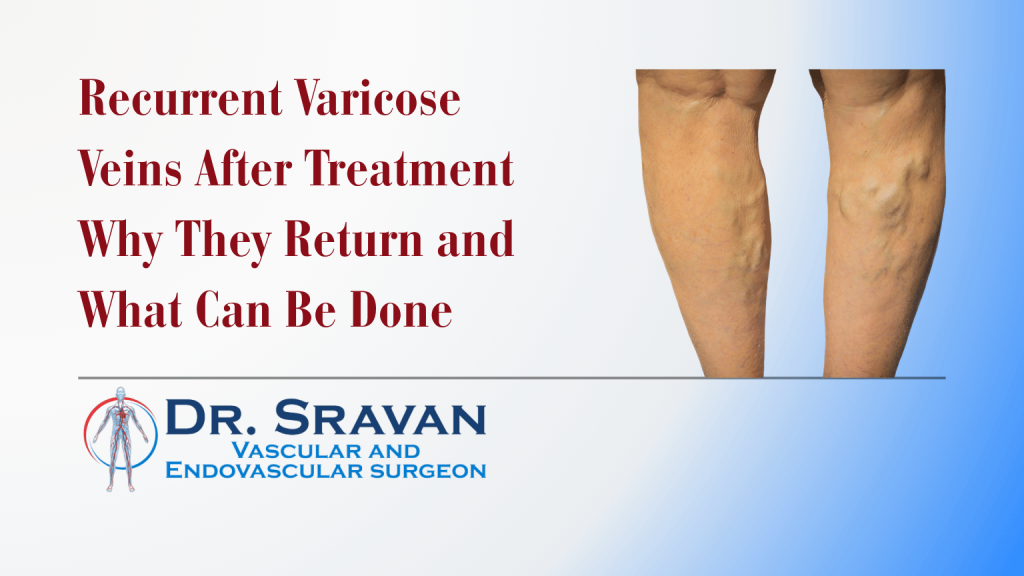
Varicose veins can return after laser treatment, radiofrequency ablation, sclerotherapy or surgery. This does not always mean the original procedure failed. Sometimes a treated vein reopens. In other patients, a different vein develops reflux, an untreated branch becomes more prominent, or venous disease progresses over time.
The important step is not to repeat the previous treatment automatically. I first reassess the leg and perform a duplex ultrasound to identify where abnormal venous pressure is coming from now. Treatment may involve repeat endovenous ablation, foam sclerotherapy, phlebectomy, treatment of another refluxing vein or, in selected complex cases, a different venous approach.
Can Varicose Veins Really Come Back After Treatment?
Yes.
Treatment can successfully close or remove the vein causing a problem at that time, but varicose-vein disease can continue to evolve.
That means a patient may later notice:
- new bulging veins
- returning heaviness
- aching
- ankle swelling
- itching
- night discomfort
- pigmentation
- skin inflammation
- a recurrent venous wound
Current NICE guidance specifically advises patients that new varicose veins can develop after treatment and that some people require more than one treatment session.
The important question is therefore not simply:
“Did my varicose veins come back?”
It is:
“Which vein is causing the problem now, and is it the same problem that was treated before?”
For an introduction to the underlying condition, read the guide to varicose veins and chronic venous disease.
Is Recurrence the Same as a Failed Varicose Vein Treatment?
Not always.
There are at least three different situations that patients may describe as “the veins have come back.”
Residual veins
Some visible branch veins may still be present soon after treatment.
The main refluxing vein may have been treated correctly, while smaller surface veins still need time to reduce or may require an additional procedure.
That is different from true recurrence.
Recanalisation
A vein that was previously closed can sometimes develop an open channel again.
Blood may begin flowing through part or all of the treated segment.
If significant reflux returns and matches the patient’s symptoms, further treatment may be considered.
New venous disease
The original treatment may remain successful, but another vein can later become incompetent.
This is progression of venous disease rather than failure of the original procedure.
These distinctions matter because they lead to different treatments.
Why Do Varicose Veins Return?
Recurrent varicose veins do not have one universal cause.
European venous guidelines describe recurrence as potentially resulting from technical or tactical problems at the original treatment, recanalisation, neovascularisation and progression of disease in other veins.
In practical terms, I look for several possibilities.
1. The Treated Vein Has Reopened
A vein treated with endovenous laser, radiofrequency or another closure technique is intended to remain closed.
In some patients, part of that vein can reopen.
This is called recanalisation.
If reflux is again present, the pressure may feed visible branch veins and cause symptoms to return.
Recanalisation does not automatically mean another procedure is required.
The Doppler result needs to be matched with:
- symptoms
- size of the reopened segment
- reflux pattern
- skin changes
- other abnormal veins
2. A Different Saphenous Vein Has Become Incompetent
The superficial venous system contains more than one major vein.
A previous procedure may have successfully treated one refluxing vein while another vein later develops valve failure.
For example, recurrence may arise from another saphenous pathway or an accessory vein.
From the patient’s perspective, this may look like “the same varicose veins have returned.”
From the vascular perspective, it may actually be a new source of reflux.
3. Branch Varicose Veins Remain or Become More Prominent
Large surface veins are called tributaries.
Treating the main refluxing trunk does not always make every visible tributary disappear immediately.
Some branches reduce over time.
Others remain symptomatic or become more prominent.
Selected residual or recurrent tributaries may be treated using:
- foam sclerotherapy
- phlebectomy
- another appropriate technique
But the main reflux source should be identified first.
Treating only visible surface veins while ignoring a deeper refluxing trunk can lead to disappointing recurrence.
4. Perforator Veins May Be Contributing
Perforator veins connect superficial veins with deeper veins.
In selected patients, abnormal perforator flow can contribute to local venous hypertension and recurrent varicosities.
This may be particularly relevant around areas of:
- recurrent clusters of veins
- skin damage
- previous venous ulceration
Not every visible perforator requires treatment.
Its clinical importance needs to be demonstrated.
5. New Small Veins Can Develop After Previous Surgery
After older open varicose-vein surgery, some patients develop networks of new small veins around the previously treated junction.
This process is called neovascularisation.
These new veins can create another pathway for reflux and contribute to recurrent varicosities.
Modern endovenous treatment has changed the pattern of recurrence seen in many patients, but previous surgical history still matters during assessment.
6. The Original Source of Reflux May Not Have Been Fully Identified
Varicose veins can have complex anatomy.
If the original Doppler did not identify the important reflux pathway, or treatment did not address the relevant source, symptoms may persist or recur.
This is one reason a good duplex ultrasound before treatment is so important.
NICE recommends duplex ultrasound to confirm the diagnosis and map truncal reflux in patients with suspected primary or recurrent varicose veins.
A treatment plan should follow the venous map.
The map should not be made to fit a preferred procedure.
7. Deeper Venous Disease May Be Present
Not every recurrent varicose vein problem begins in the superficial veins.
A patient may also have:
- previous deep vein thrombosis
- damaged deep-vein valves
- chronic venous obstruction
- post-thrombotic disease
- iliac-vein obstruction
These problems can increase pressure within the venous system.
If significant deep venous disease is present, simply closing another superficial vein may not answer the whole problem.
A history of DVT, persistent one-sided swelling or severe venous skin changes should therefore be considered during reassessment.
8. Venous Disease Can Progress Over Time
Varicose veins are part of chronic venous disease.
Treatment corrects the abnormal veins identified at the time.
It does not permanently change every vein in both legs.
Over years, other veins can develop valve failure.
Factors associated with venous disease may include:
- family tendency
- increasing age
- pregnancy
- prolonged standing
- excess body weight
- previous thrombosis
- progression of underlying venous valve dysfunction
A newly abnormal vein years later does not necessarily mean the earlier treatment was unsuccessful.
Can Varicose Veins Return After Laser Treatment?
Yes.
Endovenous laser ablation is designed to close an incompetent superficial vein using heat delivered from inside the vessel.
Possible reasons for later symptoms include:
- partial or complete recanalisation
- reflux in another vein
- recurrent branch veins
- perforator reflux
- progression of venous disease
The first question should not be:
“Can I have laser again?”
The first question is:
“What does the new duplex scan show?”
The answer determines whether repeat laser treatment, another endovenous method, sclerotherapy, phlebectomy or no intervention is appropriate.
Can Varicose Veins Return After Radiofrequency Ablation?
Yes.
Radiofrequency ablation also closes an incompetent vein using thermal energy.
Like EVLA, it can provide effective treatment in suitable patients, but recurrence can occur later through:
- recanalisation
- another refluxing vein
- tributary disease
- progression of venous insufficiency
A recurrent visible vein should not automatically be assumed to mean that the previously treated trunk has reopened.
Repeat mapping is needed.
Can Varicose Veins Return After Sclerotherapy?
Yes.
Sclerotherapy works by injecting a sclerosant into selected abnormal veins to cause them to close.
It is particularly useful in certain tributaries and recurrent venous patterns.
Some veins require more than one treatment session.
Later recurrence may result from:
- reopening of a treated vein
- incomplete closure
- continued reflux from another vein
- development of new varicosities
The source matters more than the fact that sclerotherapy was performed previously.
Why Do Varicose Veins Return After Surgery?
Previous surgery may have involved:
- ligation
- stripping
- phlebectomy
- treatment around the saphenofemoral or saphenopopliteal junction
Recurrence after surgery can result from several mechanisms, including:
- residual refluxing veins
- progression in another venous pathway
- incompetent perforators
- neovascularisation
- deep venous problems
Repeat open surgery is not automatically required just because the first procedure was surgical.
Modern duplex assessment may identify a recurrent pattern that can be managed with an endovenous or ultrasound-guided approach.
How Do I Know if My Varicose Veins Have Truly Recurred?
Visible veins alone are not enough.
Some patients have surface veins without significant symptoms.
Others have relatively few visible veins but significant venous reflux and swelling.
Reassessment becomes more important if you develop:
- returning heaviness
- aching
- swelling
- itching
- night discomfort
- new clusters of bulging veins
- ankle pigmentation
- eczema
- hardening of the skin
- superficial thrombophlebitis
- bleeding
- a venous ulcer
The combination of symptoms, examination and Doppler determines whether clinically important recurrence is present.
Do I Need Another Doppler if I Already Had One Before My First Treatment?
Usually, yes, if meaningful symptoms have returned.
The venous anatomy may no longer be the same.
A new duplex ultrasound can answer questions such as:
- Is the previously treated vein still closed?
- Has it reopened?
- Is another saphenous vein refluxing?
- Are accessory veins involved?
- Are recurrent tributaries present?
- Is there an important perforator?
- Are the deep veins functioning normally?
- Are there signs of an old DVT?
- Is another venous source contributing?
You can read more about what venous ultrasound assesses in the Vascular Doppler Scan guide.
What Happens During a Duplex Scan for Recurrent Varicose Veins?
The scan needs to do more than confirm that visible veins exist.
It maps blood flow through the superficial and deep venous systems.
The sonographer or vascular specialist assesses whether blood is flowing backwards when the vein valves should be preventing reflux.
Special attention may be given to:
- previously treated vein segments
- junctions in the groin or behind the knee
- accessory saphenous veins
- tributaries
- perforator veins
- deep veins
Previous procedure records are useful.
If available, bring:
- old Doppler reports
- procedure notes
- discharge summaries
- details of previous laser, RFA, glue, foam or surgery
Knowing exactly what was treated previously can make recurrent-vein mapping more informative.
Can Recurrent Varicose Veins Be Treated Again?
Yes, many recurrent varicose veins can be treated again when they are causing clinically significant symptoms or complications and a treatable reflux source is identified.
However, repeat treatment is not one standard procedure.
The correct option depends on the new venous anatomy.
Repeat Endovenous Laser or Radiofrequency Ablation
If a suitable refluxing vein is present, endovenous thermal treatment may be considered.
This might involve:
- a recanalised previously treated segment
- another incompetent saphenous vein
- an accessory vein suitable for catheter treatment
The vein must be anatomically suitable for the technique.
Ultrasound-Guided Foam Sclerotherapy
Foam sclerotherapy can be useful in selected recurrent patterns, particularly when veins are:
- tortuous
- difficult to treat with a catheter
- residual tributaries
- part of a recurrent superficial network
Ultrasound guidance can help target the intended vein accurately.
Phlebectomy
Selected bulging surface veins can be removed through very small skin openings.
Phlebectomy may be performed alone in particular cases or combined with treatment of an underlying reflux source.
Treating visible tributaries alone is not appropriate if an important untreated trunk is continuing to feed them.
Open Surgery
Repeat open surgery is sometimes required, but it is not automatically the first choice for recurrent varicose veins.
It may be considered when:
- anatomy is unsuitable for endovenous treatment
- the recurrent pattern is surgically accessible
- another technique is unlikely to provide a useful result
- previous procedures have created complex anatomy
Modern treatment planning aims to choose the procedure according to the venous map rather than repeat the original surgery simply because it was used before.
Can More Than One Treatment Be Needed?
Yes.
Recurrent varicose veins can be anatomically more complex than primary varicose veins.
A patient may have:
- one main refluxing trunk
- multiple recurrent tributaries
- an abnormal perforator
- previous scarring
- deep venous disease
One procedure may address the principal source while another session deals with remaining branches.
NICE advises patients that more than one treatment session may sometimes be required and that recurrence after treatment of recurrent varicose veins is more likely than after treatment of primary disease.
This should be explained before treatment rather than presented as a surprise afterwards.
Is Repeat Treatment More Difficult?
Sometimes.
Previous procedures can alter the anatomy.
There may be:
- scar tissue
- short residual vein segments
- tortuous recurrent veins
- multiple reflux pathways
- previous surgical changes
- deep venous disease
But complexity does not automatically mean open surgery is required.
Good duplex mapping often allows the recurrent anatomy to be broken down into specific treatable components.
Can Recurrent Varicose Veins Cause Skin Damage?
Yes.
If significant venous hypertension persists or returns, a patient can develop manifestations of chronic venous disease such as:
- ankle pigmentation
- eczema
- swelling
- hardening of the skin
- inflammation
- ulceration
A patient with skin changes should not wait until another open wound develops before reassessment.
Can Recurrent Varicose Veins Cause a Venous Leg Ulcer?
They can contribute when significant superficial reflux creates chronic high venous pressure.
However, a venous ulcer may also involve:
- deep venous disease
- previous DVT
- perforator reflux
- arterial disease
A non-healing wound therefore needs a wider circulation assessment rather than simply another cosmetic vein procedure.
The dedicated Venous Leg Ulcer Treatment page planned in this September cluster will cover this wound pathway separately once its final URL is live.
Can an Old DVT Cause Varicose Veins to Return?
A previous DVT can contribute to chronic venous hypertension.
The clot may leave:
- damaged deep-vein valves
- residual obstruction
- scar tissue
- post-thrombotic changes
If blood cannot leave the leg normally through the deep system, superficial veins may become more prominent or symptomatic.
That does not mean every recurrent varicose vein is caused by an old DVT.
It means the deep venous history needs to be considered when recurrence is complex.
Can Pelvic Veins Cause Recurrent Varicose Veins?
In selected patients, yes.
Some recurrent varicose-vein patterns may receive abnormal flow from veins higher in the pelvis.
This is not the most common explanation for every recurrent vein.
Pelvic sources become more relevant when:
- recurrence has an unusual distribution
- previous leg-vein treatment has not explained the pattern
- veins recur repeatedly despite apparently successful treatment
- symptoms and imaging suggest another venous source
Additional imaging is not required for every patient.
The clinical pattern and duplex findings should determine whether deeper investigation is useful.
Are Compression Stockings Enough for Recurrent Varicose Veins?
Compression stockings can help control symptoms such as:
- swelling
- aching
- heaviness
They may be appropriate when a patient is not suitable for intervention or does not want a procedure.
But stockings do not remove venous reflux.
For symptomatic varicose veins with confirmed truncal reflux, NICE recommends interventional treatment where appropriate rather than using compression hosiery as definitive treatment when intervention is suitable.
The choice still needs to be individualised.
Can I Prevent Varicose Veins From Returning?
No strategy can guarantee that new varicose veins will never develop.
Venous disease can progress over time.
However, general measures that support leg health include:
- regular walking
- avoiding prolonged immobility
- maintaining an appropriate body weight
- using compression when specifically advised
- keeping follow-up appointments after treatment
- seeking review if symptoms begin returning
- managing swelling rather than ignoring progressive skin changes
The most important prevention principle after previous treatment is not to assume that recurrence has only one cause.
Early reassessment can identify a new reflux pathway before disease progresses to more advanced skin damage.
What Should I Ask Before Repeat Varicose Vein Treatment?
Patients who have already undergone treatment should understand why the veins have returned before agreeing to another procedure.
Useful questions include:
What did my previous treatment actually treat?
Was it:
- great saphenous vein ablation
- small saphenous vein ablation
- foam sclerotherapy
- phlebectomy
- open surgery
- another technique?
Is the old treated vein still closed?
If it is still closed, recurrence may be coming from somewhere else.
Which vein is refluxing now?
A new duplex should identify the current source.
Is the deep venous system normal?
This becomes particularly relevant after DVT or in patients with significant chronic swelling.
What exactly will the new procedure treat?
The treatment should correspond to a defined anatomical problem.
Is more than one session likely?
Complex recurrent tributaries may need staged treatment.
These questions make the consultation about the underlying circulation rather than simply the visible veins.
What Are the Risks of Repeat Varicose Vein Treatment?
The risks depend on the procedure and anatomy.
Possible risks across different treatments can include:
- bruising
- tenderness
- skin irritation
- superficial inflammation
- pigmentation
- bleeding
- infection
- nerve irritation
- blood clot
- incomplete closure
- persistence of symptoms
- recurrence
- need for additional treatment
Repeat treatment can sometimes be technically more complex because previous procedures alter normal anatomy.
The expected benefit and limitations should therefore be discussed before proceeding.
When Are Recurrent Varicose Veins Urgent?
Most recurrent varicose veins can be assessed through a planned vascular consultation.
Some situations need faster evaluation.
Bleeding from a varicose vein
Bleeding can occasionally be significant.
If a varicose vein is actively bleeding:
- lie down
- elevate the leg
- apply firm direct pressure over the bleeding point
- seek urgent medical care if bleeding is heavy, does not stop or returns
NICE recommends immediate referral for bleeding varicose veins.
Sudden painful hard vein
A red, hard and tender superficial vein may represent superficial vein thrombosis and should be assessed.
Sudden major swelling
New marked swelling of one leg, especially with pain or warmth, requires assessment for DVT.
Chest pain or breathlessness
Sudden breathlessness, chest pain, coughing blood or collapse in someone with possible venous thrombosis requires emergency medical assessment.
Recurrent Varicose Vein Treatment With Dr Sravan C.P.S
Dr Sravan C.P.S is a vascular and endovascular surgeon in Bangalore whose work includes varicose veins, chronic venous disease, deep venous disorders and vascular ultrasound assessment.
His verified qualifications include:
- MBBS
- MS in General Surgery
- MRCS from the Royal College of Edinburgh, UK
- DNB in Peripheral Vascular Surgery
- FEVS from National University Hospital, Singapore
He has also served as an Assistant Professor of Vascular Surgery at Sri Jayadeva Institute of Cardiovascular Sciences and Research.
For recurrent varicose veins, I would not begin by asking:
“Which treatment did you have last time?”
and then automatically repeat it.
I would first want to know:
- What was treated previously?
- Is that vein still closed?
- Where is reflux coming from now?
- Is another superficial vein responsible?
- Is a perforator contributing?
- Is there evidence of previous DVT?
- Is deep venous obstruction present?
- Are the recurrent veins causing symptoms or complications?
- Which treatment addresses the current venous anatomy with the least unnecessary intervention?
That approach matters particularly in people who have already undergone more than one vein procedure.
Read more about Dr Sravan’s vascular and endovascular training.
When Should You See a Vascular Surgeon for Recurrent Varicose Veins?
Arrange a vascular reassessment if:
- visible veins have returned after previous treatment
- heaviness or aching has returned
- swelling is increasing again
- a previously treated leg is developing new pigmentation
- the skin around the ankle is becoming itchy or hard
- you have recurrent superficial thrombophlebitis
- a venous ulcer has developed or returned
- a vein has bled
- symptoms continue despite previous laser, RFA, sclerotherapy or surgery
- you are being advised to repeat a procedure without a new venous Doppler
- you want to understand why your previous treatment did not give the expected result
A fresh clinical examination and duplex ultrasound can identify whether the problem is recanalisation, new reflux, tributary disease, deep venous disease or another cause.
For non-emergency symptoms, book a vascular consultation with Dr Sravan in Bangalore.
Frequently Asked Questions About Recurrent Varicose Veins
Why do varicose veins return after treatment?
Varicose veins can return because a treated vein reopens, another vein develops reflux, untreated or new tributaries become prominent, perforator veins contribute, or venous disease progresses over time. Previous surgery can also produce different recurrent vein patterns. A new duplex scan helps identify the current source.
Can the same vein reopen after laser treatment?
Yes. A previously closed vein can sometimes recanalise partly or completely. However, returning visible veins do not prove that the treated vein reopened. Another vein may have become incompetent, so repeat duplex mapping is important before choosing treatment.
Do I need another Doppler before repeat varicose-vein treatment?
A new duplex ultrasound is usually important when symptoms or varicose veins recur because the venous anatomy may have changed since the first procedure. It can show whether the treated vein remains closed and identify new reflux in other veins. NICE recommends duplex assessment for suspected recurrent varicose veins.
Can recurrent varicose veins be treated with laser again?
Sometimes. Repeat endovenous treatment may be possible if a suitable refluxing vein is identified. Other recurrent patterns may be better treated with foam sclerotherapy, phlebectomy or another technique. The procedure should be selected according to the new Doppler findings rather than simply repeating the previous treatment.
Are recurrent varicose veins harder to treat?
They can be more complex because previous procedures may leave scar tissue, altered anatomy or multiple reflux pathways. NICE also advises that recurrence after treatment of recurrent veins is higher than after treatment of primary varicose veins. Careful mapping and realistic expectations are therefore important.
Can stockings stop varicose veins from returning?
Compression can help control symptoms such as swelling and heaviness, but it cannot guarantee that new venous reflux or varicose veins will not develop. When clinically important recurrent reflux is present and intervention is suitable, treatment options should be discussed rather than relying on stockings alone.
When should recurrent varicose veins be treated again?
Repeat treatment is generally considered when recurrent veins are causing significant symptoms or complications and the responsible reflux source can be identified. Treatment should not be based only on appearance or on the fact that a previous procedure was performed.
Conclusion
Varicose veins can return after laser treatment, radiofrequency ablation, sclerotherapy or surgery.
But “recurrence” does not describe one single problem.
The previously treated vein may have reopened. A different superficial vein may now be refluxing. Branch veins or perforators may be contributing. Previous DVT or deeper venous disease may also change the pressure in the leg.
That is why repeat treatment should begin with repeat diagnosis.
A clinical examination and properly performed duplex ultrasound can show where the abnormal blood flow is coming from now.
Once that is clear, treatment may involve repeat endovenous ablation, foam sclerotherapy, phlebectomy, another venous procedure or conservative management when intervention is not appropriate.
Removing visible veins again is not the aim by itself.
Identifying why they returned, and treating the venous source behind the current problem, is what actually prevents the next recurrence.
