If you are searching for varicose veins treatment near Jayanagar, the first thing I want you to understand is simple. Varicose veins are not always just a cosmetic problem. They can be a sign of faulty vein valves and poor blood return from the legs.
In many patients, the symptoms start slowly. A little heaviness. Mild swelling by evening. Visible blue or bulging veins. Night cramps. Later, the skin near the ankle may become dark, itchy, dry, or wounded.
I usually advise patients not to decide treatment based only on how the veins look. A proper vascular examination and Doppler scan are important before choosing medicines, stockings, laser treatment, sclerotherapy, or surgery.
Quick Answer
The best treatment for varicose veins depends on the Doppler result.
If the veins are mild, compression stockings and lifestyle changes may help symptoms. If there is significant venous reflux, laser treatment, radiofrequency ablation, sclerotherapy, or selected surgical procedures may be needed. The decision depends on the vein size, reflux pattern, symptoms, skin changes, and whether one or both legs are affected.
For patients near Jayanagar, I usually focus on three things:
- Finding the source of reflux
- Checking whether deep veins and arteries are healthy
- Choosing the least invasive treatment that gives stable long-term relief
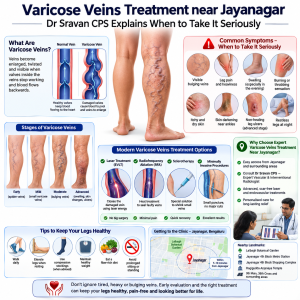
What Are Varicose Veins?
Varicose veins are enlarged, twisted veins that usually appear in the legs. They happen when the one-way valves inside the veins stop working properly.
Normally, leg veins carry blood upward toward the heart. When the valves become weak, blood starts flowing backward and pools inside the vein. Over time, the vein becomes enlarged, visible, painful, or swollen.
Some patients come only because the veins look bad. Some come because their legs feel heavy after standing. Some come late with skin blackening, eczema, or ulcers near the ankle.
That is why I tell patients: do not wait for pain to become unbearable. If visible veins are increasing or swelling is recurring, get a Doppler evaluation.
Common Symptoms I See in Varicose Vein Patients
Varicose veins do not present the same way in every patient.
Some common symptoms include:
- Visible bulging veins: Rope-like veins seen on the calf, thigh, or behind the knee.
- Leg heaviness: Usually worse by evening or after long standing.
- Swelling near the ankle: Often improves after leg elevation.
- Night cramps: Cramping or pulling sensation in the calf.
- Burning or itching: Especially around visible veins or the ankle.
- Skin darkening: Brownish pigmentation near the ankle.
- Dry or eczema-like skin: A sign of chronic venous pressure.
- Non-healing wound: Usually near the ankle in advanced cases.
- Bleeding from a vein: Needs urgent attention.
- Sudden painful swelling: Must be checked to rule out clot-related problems.
If you have only spider veins, the treatment may be different. If you have swelling, pain, or skin changes, the condition needs a deeper vascular assessment.
Why Varicose Veins Happen
In my practice, I commonly see varicose veins in people who stand or sit for long hours.
Common risk factors include:
- Family history of varicose veins
- Long standing jobs
- Desk work with very little walking
- Pregnancy-related vein changes
- Weight gain
- Age-related valve weakness
- Previous blood clots
- Lack of calf muscle activity
- Recurrent leg swelling
- Untreated venous reflux
Teachers, chefs, security staff, nurses, retail workers, IT professionals, drivers, and homemakers often ignore early symptoms because the pain comes and goes. That delay is where the problem starts.
Why a Doppler Scan Matters Before Treatment
I do not advise treatment only by looking at the surface veins.
A venous Doppler scan helps identify:
- Which vein is leaking
- Whether the saphenous vein is involved
- Whether reflux is present
- Whether deep veins are normal
- Whether there is clot history
- Whether laser or sclerotherapy is suitable
- Whether the patient has advanced venous disease
This is important because visible veins are often only the result. The actual source may be higher up in the leg.
If only the visible veins are treated and the source reflux is missed, symptoms can return.
Treatment Options for Varicose Veins near Jayanagar
The treatment plan changes from patient to patient. I usually explain the options after reviewing symptoms, examination findings, and Doppler results.
1. Lifestyle Changes and Compression Stockings
In early or mild cases, symptoms may improve with conservative care.
This may include:
- Walking regularly
- Avoiding long standing without breaks
- Calf exercises
- Leg elevation
- Weight control
- Hydration
- Compression stockings if advised
Compression stockings can reduce swelling and heaviness. But they do not remove faulty veins. They are useful in selected patients, especially when symptoms are mild or when a procedure is not immediately required.
2. Sclerotherapy
Sclerotherapy is useful for spider veins, smaller veins, and selected branch veins.
A medicine is injected into the affected vein to close it. It is usually considered when the veins are small and Doppler findings are suitable.
Sclerotherapy may not be enough if the main source vein has significant reflux. In such cases, treating only small surface veins can give incomplete results.
3. Endovenous Laser Treatment
Endovenous laser treatment is a minimally invasive treatment used for suitable refluxing veins.
A laser fibre is passed inside the faulty vein under guidance. Laser energy closes the vein from inside. Blood then redirects through healthier veins.
Laser treatment may be considered when:
- Doppler shows reflux in a major superficial vein
- Symptoms are affecting daily life
- Leg heaviness or swelling is recurring
- Skin changes have started
- Conservative care is not enough
- The vein anatomy is suitable
Many patients prefer laser treatment because it avoids large cuts and usually allows faster recovery compared with traditional open surgery. Suitability must still be decided after Doppler.
4. Radiofrequency Ablation
Radiofrequency ablation is another minimally invasive heat-based treatment. It closes the faulty vein using radiofrequency energy.
The choice between laser and radiofrequency depends on the patient’s vein anatomy, vein diameter, reflux pattern, and clinical suitability.
The goal is not to choose the fanciest treatment. The goal is to choose the correct treatment for that patient.
5. Phlebectomy or Surgical Vein Removal
Some large bulging veins may need removal through small incisions. This may be combined with laser or radiofrequency treatment depending on the case.
This is usually considered when:
- Surface veins are very large
- Branch veins remain prominent
- Veins are twisted or bulky
- The patient has recurrent veins
- Sclerotherapy is not ideal
6. Open Surgery
Open surgery is not the first choice for every patient today, but it still has a role in selected cases.
It may be considered when:
- Vein anatomy is not suitable for laser or RFA
- There is recurrence after previous treatment
- The disease pattern is complex
- Other treatment options are not appropriate
A vascular surgeon should decide this after a complete evaluation.
Treatment Comparison
| Treatment | Best suited for | Main benefit | Limitation |
|---|---|---|---|
| Compression stockings | Mild symptoms, support care | Reduces heaviness and swelling | Does not remove faulty veins |
| Sclerotherapy | Spider veins, smaller veins | Useful for small visible veins | May not treat main reflux |
| Laser treatment | Larger refluxing superficial veins | Minimally invasive, faster recovery | Needs Doppler suitability |
| Radiofrequency ablation | Refluxing veins | Minimally invasive closure | Not suitable for every vein |
| Phlebectomy | Large surface veins | Removes bulky veins | May be combined with other treatment |
| Open surgery | Complex or unsuitable cases | Useful in selected patients | Longer recovery than minimally invasive options |
What Is the Cost of Varicose Vein Treatment in Bangalore?
The cost of varicose vein treatment in Bangalore depends on the treatment method and disease severity.
Cost can vary based on:
- Doppler findings
- One leg or both legs
- Laser, RFA, sclerotherapy, phlebectomy, or surgery
- Number of veins involved
- Consumables used
- Hospital setup
- Anaesthesia requirement
- Day-care or admission need
- Compression stockings
- Follow-up care
- Previous recurrence history
I do not advise patients to choose treatment only by cost. If the main reflux source is not treated correctly, symptoms can return. The right approach is to understand the Doppler report first, then choose the most suitable option.
Which Doctor Should You Consult for Varicose Veins?
For varicose veins, the right specialist is a vascular surgeon or vascular and endovascular surgeon.
This is important because leg vein symptoms may overlap with:
- Deep vein thrombosis
- Chronic venous insufficiency
- Peripheral artery disease
- Diabetic foot circulation issues
- Non-healing wounds
- Lymphedema
- Previous clot-related damage
A vascular surgeon looks at the complete circulation of the leg, not just the visible vein.
Why Patients near Jayanagar Choose Dr Sravan CPS
I treat varicose veins as part of a broader vascular condition, not as a surface-level vein problem.
My vascular and endovascular work includes:
- Varicose vein treatment
- Chronic venous insufficiency care
- Venous reflux evaluation
- Sclerotherapy
- Endovenous laser-based treatment planning
- Deep vein thrombosis evaluation
- Peripheral arterial disease care
- Diabetic foot and limb salvage
- AV fistula and dialysis access surgery
- Angioplasty and stenting
- Aneurysm and aortic disease evaluation
- Varicocele embolization
- Genicular artery embolization
- Uterine fibroid embolization
- Prostate artery embolization
- Other minimally invasive vascular procedures
Patients from Jayanagar, JP Nagar, Basavanagudi, BTM Layout, Banashankari, Wilson Garden, and nearby South Bangalore areas often consult for leg swelling, visible veins, pain, and venous reflux problems.
Dr. Sravan C.P.S has also been recognized by Outlook in its Best Doctors listing under vascular surgery. This recognition supports the trust patients place in his vascular and endovascular expertise.
Are Varicose Veins 100% Curable?
I avoid using the word “100% cure” for varicose veins because the condition is related to valve weakness and long-term venous pressure.
Existing faulty veins can be treated effectively. Symptoms can improve. Skin progression can be reduced. Ulcer risk can come down when treatment is done at the right time.
But new veins can appear later if the patient has strong risk factors such as:
- Genetics
- Long standing work
- Obesity
- Pregnancy-related changes
- Poor calf muscle activity
- Previous clot history
The realistic goal is long-term control, symptom relief, prevention of progression, and proper follow-up.
Which Oil Is Best for Blood Circulation in Legs?
No oil can open blocked veins or cure varicose veins.
Massage may temporarily relax the leg, but it does not correct valve reflux. If there is DVT, infection, skin ulcer, or severe swelling, aggressive massage can be unsafe.
For circulation support, I advise safer steps:
- Walk daily
- Move ankles often
- Do calf raises
- Avoid standing continuously
- Elevate legs when resting
- Use compression stockings if prescribed
- Control weight
- Get Doppler testing if swelling or pain persists
If leg symptoms are frequent, do not depend only on oils or home remedies.
Can Daflon 500 Cure Varicose Veins?
Daflon or similar medicines may reduce heaviness or swelling in selected patients. They may help symptom control.
But they do not remove varicose veins. They do not repair faulty valves. They do not close refluxing veins.
If symptoms continue despite medicines, stockings, or lifestyle changes, a Doppler scan is needed.
What Is Stage 4 Varicose Veins?
Stage 4 usually means the disease has started affecting the skin.
Patients may notice:
- Brownish pigmentation near the ankle
- Dry skin
- Itching
- Eczema-like changes
- Skin hardening
- Swelling
- Pain or heaviness
This stage should not be ignored because it can progress to venous ulcers.
If skin changes have started, treatment is no longer only cosmetic. It becomes medically important.
What Is the Most Successful Treatment for Varicose Veins?
The most successful treatment is the one that matches the patient’s Doppler findings.
For some patients, stockings and lifestyle changes are enough. For others, sclerotherapy works well. Many suitable patients benefit from laser or radiofrequency treatment. Some need phlebectomy or surgery.
Good results depend on:
- Correct diagnosis
- Doppler-guided planning
- Treating the source of reflux
- Managing branch veins
- Following recovery instructions
- Using compression when advised
- Follow-up when needed
When Should You Consult Dr Sravan CPS?
You should consult a vascular specialist if you have:
- Visible bulging veins
- Leg heaviness
- Pain after standing
- Ankle swelling
- Night cramps
- Itching around veins
- Skin darkening
- Dry or thickened skin near the ankle
- Non-healing wound
- Bleeding from veins
- Recurrent varicose veins
- Varicose veins with diabetes
- Sudden swelling or calf pain
Patients near Jayanagar should not wait for ulcers or bleeding before getting evaluated. Early Doppler testing helps decide whether the condition is mild, moderate, or advanced.
FAQs
What is the cost of varicose vein treatment in Bangalore?
The cost depends on Doppler findings, one leg or both legs, treatment method, hospital setup, anaesthesia, consumables, and whether laser, RFA, sclerotherapy, phlebectomy, or surgery is needed.
Which doctor is best for varicose veins?
A vascular and endovascular surgeon is the right specialist because varicose veins involve vein valve failure, reflux, circulation assessment, and sometimes deep vein or arterial evaluation.
Are varicose veins 100% curable?
Existing faulty veins can be treated effectively, but new veins may develop later due to genetics, pregnancy, obesity, long standing, or ongoing valve weakness.
Which oil is good for varicose veins?
No oil can cure varicose veins or open blocked veins. Oils may give temporary comfort, but Doppler evaluation is needed if pain, swelling, or visible veins persist.
Can Daflon 500 cure varicose veins?
Daflon may reduce symptoms in selected patients, but it does not cure valve reflux or remove varicose veins. Persistent symptoms need vascular evaluation.
What is stage 4 varicose veins?
Stage 4 usually refers to skin changes such as pigmentation, eczema, thickening, dryness, or swelling near the ankle. It should be treated before ulcers develop.
What is the most successful treatment for varicose veins?
The most successful treatment depends on Doppler findings. Laser, RFA, sclerotherapy, phlebectomy, or surgery may be advised based on the vein pattern and symptoms.
Conclusion
Varicose veins should not be judged only by appearance. If you have leg heaviness, swelling, cramps, skin darkening, itching, or visible bulging veins, the first step is a proper vascular evaluation and Doppler scan.
For patients looking for varicose veins treatment near Jayanagar, Dr. Sravan C.P.S provides vascular and endovascular evaluation for varicose veins, venous reflux, chronic venous insufficiency, leg swelling, DVT concerns, diabetic foot circulation issues, and related vascular conditions.
Early diagnosis helps choose the right treatment and prevents the condition from progressing silently.
