Exercise can help reduce varicose vein symptoms like leg heaviness, swelling, cramps, and discomfort, but it cannot repair damaged vein valves or remove visible veins.
As a vascular surgeon, I usually advise patients to choose exercises that activate the calf muscles without adding excessive pressure on the leg veins. Walking, cycling, swimming, calf raises, ankle pumps, and leg elevation are usually helpful. Heavy weightlifting with breath-holding, high-impact jumping, and long static standing workouts should be modified or avoided if symptoms worsen.
Why Exercise Matters in Varicose Veins
To understand exercise, you must first understand how veins work.
Veins in your legs carry blood upward toward the heart. Because blood has to move against gravity, your body relies on:
-
One-way vein valves
-
Calf muscle pump
-
Healthy vein walls
When the calf muscles contract during walking or movement, they squeeze the veins and push blood upward. This mechanism reduces pooling.
In varicose veins, the valves weaken. Blood flows backward and accumulates in the lower leg. This increases pressure, leading to swelling, heaviness, and visible veins.
Exercise does not fix the valve. But it strengthens the calf pump and reduces venous pressure temporarily and repeatedly. That is why it is helpful.
My Clinical View on Exercise and Varicose Veins
Exercise is useful for varicose veins because it improves the calf muscle pump. Every time the calf muscles contract, they help push blood upward toward the heart. This reduces pooling and may improve heaviness, swelling, and evening discomfort.
But exercise does not close leaking vein valves. If the main vein valves are damaged, symptoms may keep returning even if the patient walks daily. That is why exercise should be seen as supportive care, not a cure.
The best exercise plan is one that improves movement without increasing strain.
What I Commonly See in Practice
Many patients with varicose veins tell me:
-
“My legs feel heavy after standing.”
-
“Swelling improves when I walk.”
-
“Symptoms worsen when I sit too long.”
This pattern clearly shows how movement influences venous return.
Movement activates circulation. Prolonged immobility increases venous pressure.
That is the foundation of exercise-based management.
Best and Worst Exercise Choices for Varicose Veins
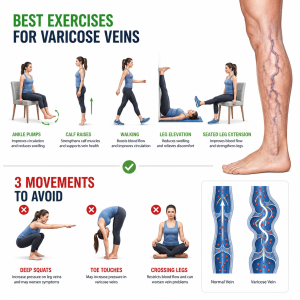
| Exercise Type | Usually Helpful | Modify or Avoid |
|---|---|---|
| Walking | Yes | Avoid very long standing breaks without movement |
| Cycling | Yes | Avoid excessive resistance if symptoms worsen |
| Swimming | Yes | Usually safe and low pressure |
| Calf raises | Yes | Start slowly if calf pain is present |
| Ankle pumps | Yes | Useful for desk workers |
| Heavy squats/deadlifts | Modify | Avoid breath-holding and very heavy loads |
| Jumping/plyometrics | Modify or avoid | Especially in advanced swelling |
| Static yoga holds | Modify | Avoid long strain without movement |
Best Exercises for Varicose Veins
1. Walking – The Most Effective and Safest Exercise
Walking is the single most recommended activity.
Why?
-
Activates calf muscle pump
-
Improves venous return
-
Low impact
-
Sustainable long term
A brisk 30-minute walk daily can significantly reduce leg heaviness and swelling.
For beginners, even 15 minutes twice daily helps.
2. Cycling – Controlled Calf Activation
Cycling provides rhythmic muscle contraction without excessive joint stress.
Benefits include:
-
Improves circulation
-
Strengthens lower limb muscles
-
Minimal gravitational stress
Stationary cycling is particularly useful for elderly individuals or overweight patients.
3. Swimming – Natural Compression Support
Swimming offers a unique advantage.
Water pressure acts like external compression stockings. It supports venous return while reducing gravitational pooling.
Patients with advanced swelling often feel immediate relief in water.
Swimming is one of the safest full-body exercises for venous health.
4. Calf Raises – Strengthening the Pump
Calf strength directly influences venous return.
How to perform:
-
Stand upright
-
Slowly raise heels
-
Hold 2–3 seconds
-
Lower gradually
Repeat 15 times, 3 sets.
This improves muscle efficiency over time.
5. Ankle Pumps – Ideal for Desk Workers
For those who sit long hours:
-
Flex and extend ankles repeatedly
-
Rotate ankles clockwise and anticlockwise
This stimulates microcirculation and prevents stagnation.
Even small movements prevent prolonged pooling.
6. Leg Elevation Exercises
While lying down:
-
Raise legs above heart level
-
Hold for 30–60 seconds
-
Repeat multiple times
This reduces venous pressure and relieves swelling.
It is especially helpful after long standing hours.
7. Gentle Yoga
Certain yoga postures improve venous return without excessive abdominal pressure.
Helpful poses:
-
Legs up the wall
-
Mountain pose
-
Mild forward bends
Avoid prolonged static strain.
Why Moderate Exercise Is Better Than Intense Gym Training
Consistency is more important than intensity.
Exercise improves:
-
Endothelial function
-
Nitric oxide production
-
Vascular tone
-
Weight control
But excessive straining increases intra-abdominal pressure, which can worsen venous reflux temporarily.
I often advise patients: focus on rhythm, not force.
3 Movements to Avoid or Modify
Exercise is not dangerous — improper strain is.
1. Heavy Weightlifting With Breath Holding
Exercises like heavy squats or deadlifts can:
-
Increase abdominal pressure
-
Temporarily increase venous pressure
-
Worsen symptoms in severe cases
If lifting weights:
-
Avoid holding your breath
-
Use moderate weights
-
Focus on controlled breathing
2. High-Impact Jumping
Repeated high-impact activities:
-
Increase leg pressure
-
May worsen swelling in advanced cases
Individuals with severe varicose veins or chronic venous insufficiency should avoid aggressive plyometrics.
3. Prolonged Static Standing Workouts
Exercises that require holding one position for long periods without movement allow pooling.
Movement is always better than stillness.
Can Exercise Prevent Varicose Veins?
Exercise helps reduce risk but does not eliminate genetic predisposition.
If you have:
-
Strong family history
-
Prolonged standing job
-
Hormonal risk factors
You may still develop varicose veins despite fitness.
But symptoms may be milder and progression slower.
How to Structure a Weekly Exercise Plan
A simple routine:
-
Walking – 5 days a week
-
Calf raises – 3-4 times weekly
-
Cycling or swimming – 2-3 times weekly
-
Leg elevation daily
Regularity matters more than intensity.
Signs Your Workout Is Too Strenuous
Watch for:
-
Increased swelling after exercise
-
Persistent heaviness
-
Pain along visible veins
-
Skin tightness
Temporary mild discomfort is normal. Persistent worsening requires reassessment.
Should You Wear Compression Stockings While Exercising?
Compression stockings may help some patients exercise more comfortably, especially if they have heaviness, swelling, or symptoms that worsen after standing.
They may help by:
- Reducing blood pooling: External pressure supports venous return.
- Controlling ankle swelling: Especially during walking or long working hours.
- Improving comfort: Some patients feel lighter legs during activity.
- Supporting the calf pump: Compression works best when combined with movement.
Compression stockings do not cure varicose veins or repair valve leakage. They should also be properly fitted, especially in patients with diabetes, wounds, severe leg pain, or possible artery disease.
Can Exercise Reverse Varicose Veins?
No.
Once valve damage occurs, it does not reverse naturally.
Exercise can:
-
Reduce symptom severity
-
Improve quality of life
-
Slow progression
But if Doppler ultrasound shows significant reflux, procedural treatment may be required.
When Exercise Is Not Enough for Varicose Veins
Exercise may not be enough if you have:
- Daily leg heaviness: Especially by evening or after work.
- Ankle swelling: Repeated swelling that improves with elevation but returns.
- Large bulging veins: Veins that are increasing over time.
- Skin darkening near the ankle: A sign of chronic venous pressure.
- Itching or eczema-like skin changes: Often seen in long-standing venous disease.
- Pain along visible veins: Especially if the vein feels hard or tender.
- Non-healing wounds near the ankle: This needs vascular evaluation.
In these cases, a venous Doppler scan helps check whether the vein valves are leaking and whether exercise alone is enough.
When to Consult Your Doctor
Seek consultation if you notice:
-
Increasing bulging veins
-
Daily ankle swelling
-
Skin darkening near ankles
-
Non-healing wounds
-
Recurrent cramps
If you are in Bangalore or nearby areas and symptoms interfere with daily life, a Doppler scan can determine whether conservative management is sufficient.
Timely assessment prevents complications.
Frequently Asked Questions
Can exercise cure varicose veins?
No. Exercise can reduce heaviness, swelling, cramps, and discomfort, but it cannot repair damaged vein valves or remove visible varicose veins.
What is the best exercise for varicose veins?
Walking is usually the safest and most useful exercise because it activates the calf muscle pump and supports blood flow from the legs back toward the heart.
Is cycling good for varicose veins?
Yes. Cycling gives rhythmic calf and leg movement without heavy impact. Stationary cycling is often useful for elderly or overweight patients.
Is yoga good for varicose veins?
Gentle yoga may help circulation and flexibility. Avoid long static holds, intense strain, or positions that worsen leg heaviness or swelling.
Can gym workouts worsen varicose veins?
Moderate gym workouts are usually safe. Heavy lifting with breath-holding, very heavy squats, deadlifts, or high-pressure movements may worsen symptoms in some patients.
Should I wear compression stockings during exercise?
Some patients feel better wearing compression stockings during walking or work-related activity. They should be properly fitted and used under medical advice if symptoms are moderate or severe.
When should I see a doctor for varicose veins?
Consult a vascular specialist if you have large bulging veins, daily swelling, skin darkening, itching, pain along veins, cramps, or non-healing wounds near the ankle.
Consult Dr. Sravan for Varicose Vein Evaluation
If walking, cycling, compression stockings, and leg elevation are not controlling your symptoms, the problem may be more than lifestyle-related heaviness. Damaged vein valves may need proper evaluation.
Dr. Sravan C.P.S evaluates varicose veins using clinical examination and venous Doppler assessment to decide whether conservative care, compression, lifestyle changes, laser treatment, or another option is suitable.
