
Recovery after Thyroid Artery Embolization is usually faster than open thyroid surgery because it is a pinhole, catheter-based procedure without a neck incision. Most patients are monitored for a few hours or a short hospital stay, then recover gradually at home with medicines, hydration, rest and follow-up thyroid testing.
As a vascular and endovascular surgeon, I explain to patients that TAE recovery is not just about the puncture site healing. The thyroid gland changes slowly after the blood supply is reduced. Neck pressure, visible swelling or hormone-related symptoms may improve over weeks to months, depending on the original thyroid condition, nodule size, hormone levels and overall health.
How Long Does Recovery Take After TAE?
Most patients start basic recovery within a few days after Thyroid Artery Embolization. Neck discomfort, mild pain, tiredness or local puncture-site soreness may occur for a short period.
However, thyroid size reduction and symptom improvement usually happen gradually.
Expected recovery pattern:
- First 24 hours: Observation, rest, hydration and puncture-site care.
- First few days: Mild neck discomfort or tiredness may be present.
- First 1 to 2 weeks: Most routine activities may resume depending on comfort.
- Next few weeks to months: Thyroid swelling, pressure symptoms or hormone imbalance may improve gradually.
- Follow-up period: Thyroid function tests and imaging help track response.
Recovery varies. Patients with large multinodular goitre or hyperthyroidism may need closer follow-up than patients with smaller benign hypervascular nodules.
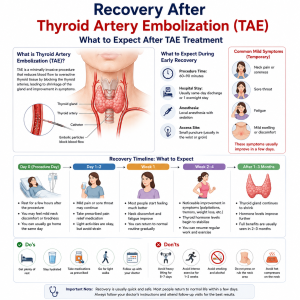
What Is Thyroid Artery Embolization?
Thyroid Artery Embolization, also called TAE, is a minimally invasive procedure used in selected thyroid conditions.
The thyroid gland receives blood supply from thyroid arteries. In some conditions, such as multinodular goitre, benign hypervascular thyroid nodules or selected hyperthyroid states, abnormal thyroid tissue receives increased blood flow.
In TAE, a thin catheter is guided through an artery, usually from the wrist or groin. The doctor reaches the thyroid-feeding arteries under imaging guidance and injects tiny embolic particles to reduce blood supply to the target tissue.
As blood flow reduces, the enlarged or overactive thyroid tissue may gradually shrink. Symptoms may improve over time.
TAE is not a routine treatment for every thyroid patient. It is considered only after proper evaluation.
Who May Need Thyroid Artery Embolization?
TAE may be considered for selected patients who have thyroid enlargement, pressure symptoms or hormone-related problems where surgery or radioactive iodine may not be preferred.
It may be discussed in cases such as:
- Multinodular goitre: Enlarged thyroid with multiple nodules causing visible swelling or pressure.
- Benign hypervascular thyroid nodules: Nodules with increased blood supply and symptoms.
- Selected hyperthyroidism cases: Especially when linked to nodules or goitre.
- High surgical risk: Patients who may not tolerate open thyroid surgery well.
- Surgery avoidance preference: Patients who strongly wish to avoid neck incision after medical review.
- Recurrent or difficult thyroid disease: Cases needing a targeted vascular approach.
TAE should usually be planned with input from endocrinology, ENT or thyroid surgery teams where needed. Cancerous thyroid nodules need a different decision pathway.
Why Recovery After TAE Is Different From Thyroid Surgery
Recovery after Thyroid Artery Embolization is different because the thyroid gland is not removed through an open neck operation.
In thyroidectomy, the surgeon removes part or all of the thyroid gland through a neck incision. Recovery includes wound healing, scar care, voice monitoring, calcium monitoring and thyroid hormone replacement planning.
In TAE, the target is the blood supply of the thyroid tissue. The procedure uses arterial access and image guidance. There is no large neck incision.
| Recovery Factor | Thyroid Artery Embolization | Thyroid Surgery |
|---|---|---|
| Neck incision | Usually no neck incision | Yes |
| Access point | Wrist or groin puncture | Neck incision |
| Hospital stay | Often short, depending on case | Usually longer than pinhole procedures |
| Scar | No major neck scar | Neck scar possible |
| Thyroid tissue | Usually preserved partly | Part or full gland may be removed |
| Symptom improvement | Gradual over weeks to months | Depends on surgery and diagnosis |
| Follow-up | Thyroid tests + imaging | Thyroid tests + wound and hormone monitoring |
This does not mean TAE is better for everyone. It means the recovery pathway is different and may be suitable for selected patients.
First 24 Hours After Thyroid Artery Embolization
The first 24 hours focus on observation, comfort and puncture-site safety.
After the procedure, the medical team monitors:
- blood pressure
- pulse
- oxygen level
- neck discomfort
- swallowing comfort
- puncture site bleeding
- pain level
- thyroid-related symptoms
- allergic reaction if contrast was used
Patients are usually advised to rest and avoid sudden movement for a short period, especially if the groin was used for access.
If wrist access was used, the hand and pulse may be monitored.
Some patients may go home the same day. Others may need an overnight stay depending on age, thyroid condition, comorbidities and hospital protocol.
Common Symptoms During Early Recovery
Some symptoms can happen during early recovery and are usually manageable with medicines and observation.
Common early symptoms may include:
- Mild neck pain: Due to reduced blood supply and tissue reaction.
- Throat discomfort: Some patients feel pressure or irritation.
- Tiredness: The body needs time to adjust after the procedure.
- Low-grade fever: Can occur as part of post-embolization response.
- Puncture-site soreness: Usually near the wrist or groin.
- Mild swelling sensation: May occur temporarily before gradual improvement.
- Body ache: Some patients feel mild inflammatory discomfort.
These symptoms should reduce with time.
However, worsening pain, breathing difficulty, swallowing difficulty, increasing neck swelling, high fever, severe bleeding from puncture site or sudden weakness should be reviewed urgently.
How to Recover Faster After TAE Treatment
Recovery after TAE depends on proper aftercare.
Patients should follow the treatment plan given by the doctor. Do not compare recovery with another patient because thyroid size, hormone status and embolization extent may differ.
Helpful recovery steps include:
- Take medicines as prescribed: Pain-relief medicines, anti-inflammatory medicines or thyroid-related medicines should be taken correctly.
- Stay hydrated: Good hydration supports recovery and helps after contrast-based procedures.
- Rest properly: Avoid unnecessary exertion during the first few days.
- Avoid heavy lifting: Especially if groin access was used.
- Monitor the puncture site: Watch for swelling, bleeding, bruising or increasing pain.
- Eat soft foods if needed: If swallowing feels uncomfortable, start with easier foods.
- Attend follow-up visits: Recovery must be tracked through symptoms, thyroid tests and imaging.
- Do not stop thyroid medicines suddenly: Endocrine medicines should be changed only after medical advice.
The goal is steady recovery, not rushed recovery.
Diet After Thyroid Artery Embolization
There is no special “TAE diet” that works for every patient. Diet depends on thyroid function, general health, diabetes, BP, weight and other medical issues.
In general, recovery diet should support healing and energy.
Useful diet habits include:
- soft, easy-to-swallow foods for the first few days if throat discomfort is present
- enough fluids unless restricted by another doctor
- protein through dal, eggs, curd, paneer, fish or lean meat based on preference
- fruits and vegetables for micronutrients
- controlled salt if BP is high
- controlled sugar if diabetic
- avoiding alcohol during early recovery
- avoiding unnecessary supplements without medical advice
Patients with hyperthyroidism, hypothyroidism, diabetes or kidney disease should follow a disease-specific diet plan advised by their treating doctor.
When Can You Return to Work?
Many patients can return to light routine work within a few days, depending on comfort and the doctor’s advice.
Return to work depends on:
- access site used
- pain level
- thyroid swelling
- job type
- hormone-related symptoms
- need for follow-up observation
- overall fitness
Desk-based work may resume earlier than physically demanding work.
If your job involves lifting, long travel, field work, factory work or strenuous activity, ask the doctor before restarting.
What Activities Should You Avoid?
During early recovery, avoid activities that increase strain or bleeding risk at the puncture site.
Avoid:
- heavy lifting
- intense gym workouts
- running too early
- bending repeatedly if groin access was used
- long travel immediately after discharge
- alcohol during early recovery
- skipping medicines
- self-adjusting thyroid medicines
- ignoring new neck swelling or breathing discomfort
Light walking may be allowed, depending on your condition.
Your doctor will give activity instructions based on your procedure details.
How Will You Know TAE Is Working?
TAE does not work like painkiller medicine. It does not make the thyroid shrink overnight.
Improvement usually happens gradually.
Signs of improvement may include:
- reduced neck pressure
- easier swallowing
- less visible neck swelling
- reduced tightness sensation
- improvement in breathing discomfort if pressure was the cause
- better control of hormone-related symptoms
- gradual reduction in thyroid or nodule size on imaging
- improved thyroid function trends in selected patients
Follow-up tests are important because symptoms alone cannot confirm the full response.
Follow-Up Tests After Thyroid Artery Embolization
Follow-up after TAE is mandatory.
The doctor may advise:
- thyroid function tests
- TSH, T3 and T4 monitoring
- ultrasound of thyroid
- Doppler assessment if needed
- CT or other imaging in selected cases
- clinical examination
- medication review with endocrinology
The timing depends on your thyroid condition and treatment response.
Some patients need thyroid medicines adjusted after the procedure. This must be done carefully.
Can Thyroid Problems Fully Recover After TAE?
Some patients improve significantly after TAE, especially if the thyroid swelling or overactive nodule responds well. But “full recovery” depends on the original diagnosis.
TAE may reduce thyroid size, pressure symptoms and hormone output in selected patients. It may help avoid or delay open surgery in suitable cases.
However, some patients may still need:
- thyroid medicines
- endocrinology follow-up
- repeat imaging
- additional treatment
- surgery if response is inadequate
- radioactive iodine in selected situations
TAE is a treatment option, not a universal cure for every thyroid disorder.
TAE vs Medicines: Which Helps Recovery Better?
Medicines are often the first step for thyroid hormone control. They can reduce symptoms like palpitations, tremors, sweating or high thyroid hormone levels.
But medicines may not shrink a large goitre enough if the main problem is neck pressure or visible swelling. Some patients cannot tolerate long-term medicines or do not get adequate control.
TAE may help selected patients by reducing blood flow to the thyroid tissue responsible for enlargement or overactivity.
| Factor | Medicines | Thyroid Artery Embolization |
| Main role | Hormone and symptom control | Reduces blood supply to target thyroid tissue |
| Works on large goitre pressure | Limited in many cases | May help selected cases |
| Neck incision | No | No neck incision |
| Speed of effect | Varies by medicine | Gradual over weeks to months |
| Follow-up | Thyroid tests | Thyroid tests + imaging |
| Best for | Hormone control | Selected nodules, goitre or hypervascular thyroid tissue |
The right treatment depends on the disease type, hormone levels, gland size and patient risk.
TAE vs Thyroid Surgery: Recovery Difference
Thyroid surgery can be necessary and effective in many patients, especially when cancer is suspected or confirmed, when compressive disease is severe, or when surgery is clearly the best option.
TAE may be considered when a minimally invasive, organ-preserving, vascular approach is suitable.
Potential TAE recovery advantages in selected patients include:
- no large neck incision
- no visible neck scar from the procedure
- shorter early recovery in many cases
- less surgical wound care
- targeted reduction in blood flow
- possible thyroid tissue preservation
- useful option for high-risk surgical patients
But if cancer is suspected, biopsy results are concerning, or the thyroid condition needs removal, surgery may remain the right choice.
This is why proper case selection is critical.
Possible Risks During Recovery
TAE is minimally invasive, but it is not risk-free.
Possible risks may include:
- neck pain
- fever or inflammatory response
- puncture-site bleeding or bruising
- contrast-related allergy or kidney concern in selected patients
- non-target embolization
- voice-related irritation or nerve-related concern
- swallowing discomfort
- thyroid hormone imbalance
- need for additional treatment
These risks are reduced through careful planning, imaging guidance, vascular anatomy knowledge and follow-up.
Recovery differs from patient to patient. Thyroid Artery Embolization should be planned only after proper thyroid evaluation, imaging, and discussion of alternatives.
Red Flags After TAE: When to Call the Doctor
Do not wait if symptoms feel unusual or severe.
Contact your doctor urgently if you notice:
- increasing neck swelling
- breathing difficulty
- severe swallowing difficulty
- high fever
- severe neck pain not improving with medicines
- bleeding from puncture site
- rapidly increasing groin or wrist swelling
- sudden voice change
- chest pain
- fainting
- severe weakness
- allergic reaction symptoms
These are not routine recovery symptoms and need medical attention.
Why Choose Dr Sravan C.P.S for Thyroid Artery Embolization in Bangalore
TAE is a vascular, catheter-based treatment. It is not a standard tablet-based thyroid treatment or routine neck surgery. It requires detailed understanding of arterial anatomy, catheter navigation, embolic materials and image-guided safety.
Dr Sravan C.P.S is a vascular and endovascular surgeon with experience in advanced embolization and minimally invasive vascular procedures.
For thyroid patients, his approach focuses on:
- proper case selection
- thyroid ultrasound and Doppler review
- thyroid function test review
- coordination with thyroid/endocrine care where needed
- explaining medicines, radioactive iodine, surgery and TAE clearly
- planning the embolization target carefully
- follow-up after treatment
Patients looking for a minimally invasive option can read the detailed service page on thyroid artery embolization treatment in Bangalore here:
https://www.vasculardoctorsravan.com/thyroid-artery-embolization-treatment-bangalore/
When to Consult Dr Sravan C.P.S
You can consult Dr Sravan C.P.S if you have:
- multinodular goitre
- benign hypervascular thyroid nodules
- neck swelling due to thyroid enlargement
- pressure while swallowing
- thyroid-related breathing pressure
- hyperthyroidism linked to nodules or goitre
- high surgical risk
- concern about open neck surgery
- recurrence after previous thyroid treatment
- need to understand whether TAE is suitable
For patients in Bangalore, especially around Basavanagudi, Jayanagar, JP Nagar, Banashankari and South Bangalore, early evaluation helps decide whether medicines, surgery, radioactive iodine or Thyroid Artery Embolization is the right path.
Conclusion
Recovery after Thyroid Artery Embolization is usually smoother than open thyroid surgery for suitable patients because it avoids a neck incision and uses a pinhole vascular route. However, the thyroid responds gradually. Symptoms, gland size and hormone levels need follow-up over weeks to months.
TAE is not for every thyroid condition. It works best when the patient is selected carefully after thyroid tests, imaging and specialist review. If you have a large goitre, hypervascular nodule, thyroid pressure symptoms or difficulty with standard treatment options, Dr Sravan C.P.S can evaluate whether Thyroid Artery Embolization is appropriate for you.
FAQs
How long does it take to recover after Thyroid Artery Embolization?
Early recovery may take a few days, but thyroid swelling and symptoms usually improve gradually over weeks to months. Follow-up thyroid tests and imaging help track the response.
Is Thyroid Artery Embolization painful?
Most patients have manageable discomfort. Mild neck pain, throat discomfort or puncture-site soreness may occur after the procedure and is usually controlled with medicines.
Can I go home the same day after TAE?
Many patients may go home the same day or after a short hospital stay, depending on age, symptoms, thyroid condition, access site and hospital protocol.
What should I eat after thyroid embolization?
Soft, easy-to-swallow food may help if throat discomfort is present. Hydration, protein and balanced meals support recovery. Patients with diabetes, BP or thyroid hormone issues need personalised diet advice.
Does TAE cure thyroid problems permanently?
TAE can reduce thyroid tissue blood supply and may improve swelling, pressure symptoms or hormone-related problems in selected patients. It is not a guaranteed permanent cure for every thyroid disorder.
Will I need thyroid tablets after TAE?
Some patients may still need thyroid medicines or dose adjustments after TAE. Thyroid function tests are needed during follow-up to decide this safely.
Who is not suitable for Thyroid Artery Embolization?
Patients with suspected thyroid cancer, unsuitable vascular anatomy, uncontrolled illness, active infection or conditions better treated with surgery may not be suitable. A specialist evaluation is required.