Skip to content
If an AV fistula that was working well starts giving poor dialysis flow, becomes difficult to needle, causes arm swelling or develops a noticeable change in its usual thrill, there may be a narrowing somewhere in the dialysis access.
In selected patients, AV fistula angioplasty, also called fistuloplasty, can be used to widen that narrowed segment and help preserve the existing dialysis access.
I do not recommend angioplasty simply because a scan shows some narrowing. The important question is whether that narrowing is actually affecting how the fistula works. My aim is to identify the problem early and, where possible, maintain a useful existing access rather than allowing it to fail completely.
What Is AV Fistula Angioplasty?
An AV fistula is created by connecting an artery to a vein so that the vein receives stronger blood flow and becomes suitable for repeated haemodialysis.
Over time, a narrowing called stenosis can develop somewhere along the fistula or the veins draining it.
When that narrowing becomes significant, it can interfere with blood flow through the access.
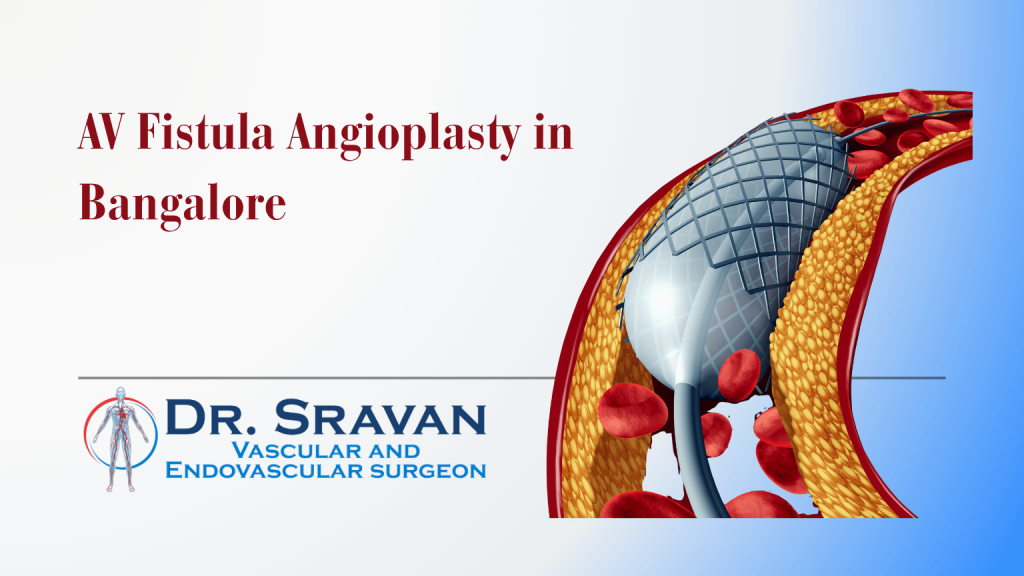
AV fistula angioplasty is a catheter-based procedure used to open an appropriate narrowed area.
A thin catheter is guided into the dialysis access. After the narrowing is identified, a balloon is positioned across the stenosis and inflated to widen it.
The procedure is commonly called:
- AV fistula angioplasty
- fistuloplasty
- balloon angioplasty of the fistula
- dialysis-access angioplasty
The purpose is the same: to improve blood flow through a fistula that has developed a clinically important narrowing.
How Is This Different From AV Fistula Surgery?
These are two different stages of dialysis-access care.
AV fistula creation
This is the surgery in which an artery and vein are joined to create a new dialysis access.
You can read about fistula creation and other access options on the Dialysis Access Surgery page.
AV fistula angioplasty
This is performed after a fistula already exists and develops a problem such as significant narrowing.
So a patient looking for their first dialysis fistula should go to the dialysis-access parent page.
A patient whose existing fistula is becoming difficult to use belongs on this fistula-salvage page.
Why Does an AV Fistula Become Narrow?
A fistula carries a large amount of blood through a vein that was originally designed for much lower flow.
Over time, changes can develop within the vessel wall.
Scar-like tissue can build up and narrow the channel through which blood is flowing.
A narrowing can occur:
- close to the artery-vein connection
- within the needling segment
- further along the draining vein
- near the shoulder or central veins
- at more than one level
The exact location matters because treatment is not identical for every stenosis.
Some lesions are well suited to angioplasty.
Some may require another endovascular approach.
Others may be better treated with surgical revision.
What Are the Signs That an AV Fistula May Be Failing?
One thing I encourage dialysis patients to know is what their own fistula normally feels like.
A functioning access usually has a vibration called a thrill.
When that familiar pattern changes, it may be an early clue that something has changed in the blood flow.
Change in the thrill
You may notice that the vibration:
- feels weaker
- has become unusually strong or pulsatile
- is present only over one part of the fistula
- has disappeared
A change does not tell us the exact diagnosis, but it deserves assessment.
Difficult needle insertion
A dialysis team that previously had no problem cannulating the fistula may suddenly find the access difficult to needle.
Repeated difficulty at dialysis should not simply be accepted as “bad veins” without considering whether the access has developed a problem.
Poor blood flow during dialysis
If the dialysis machine repeatedly cannot achieve the required blood-flow rate, an inflow or outflow problem may be present.
The cause needs to be identified rather than assuming every flow problem is due to stenosis.
Prolonged bleeding after dialysis needles are removed
If the needle sites are taking much longer than usual to stop bleeding after dialysis, this can sometimes be a sign of increased pressure within the access due to an outflow problem.
Arm swelling
Swelling of the access arm, particularly if it is persistent or increasing, may suggest difficulty with venous drainage.
Sometimes the narrowing can be located in a larger vein deeper in the shoulder or chest rather than directly in the visible fistula.
Reduced dialysis efficiency
In some patients, the first clue comes from the dialysis unit noticing inadequate dialysis or access-flow concerns.
The fistula may still be working, but not working as effectively as before.
What If the Thrill Suddenly Disappears?
A sudden loss of the usual fistula thrill should be assessed promptly.
It can occur when blood flow has become severely reduced or the access has thrombosed.
Do not repeatedly squeeze, massage or manipulate the fistula in an attempt to reopen it yourself.
Contact your dialysis team or vascular specialist promptly.
The longer an access remains completely thrombosed, the more difficult salvage may become in some situations.
Does Every Narrowing Need Angioplasty?
No.
This is an important distinction.
A Doppler may occasionally identify some narrowing in a fistula that is otherwise working well.
I do not recommend treating every imaging abnormality simply because it exists.
I look for evidence that the stenosis is clinically significant.
That means asking whether it is associated with problems such as:
- poor dialysis blood flow
- difficult cannulation
- arm swelling
- prolonged bleeding
- an abnormal thrill
- inadequate dialysis
- access dysfunction
- recurrent thrombosis
We should treat the access problem, not just the scan image.
How Do I Evaluate a Failing AV Fistula?
The assessment starts with the patient and the fistula.
I want to know:
When did the problem start?
What has changed during dialysis?
Has the thrill changed?
Is cannulation becoming difficult?
Is there prolonged bleeding?
Has the arm started swelling?
Has the fistula clotted before?
I then examine the access.
The feel of the pulse and thrill at different points can give useful information about where the problem may be located.
Depending on the situation, further assessment may include Doppler ultrasound or fistulography.
Role of Doppler Ultrasound in AV Fistula Problems
Doppler ultrasound can help assess:
- blood flow through the fistula
- areas of narrowing
- vessel size
- blood-flow velocities
- thrombosis
- selected maturation problems
- blood flow before and after an intervention
The Doppler finding is interpreted together with what is happening during dialysis.
A scan report saying “stenosis” is more meaningful when it matches a clinical problem such as poor access flow or difficult cannulation.
This is the same principle I use throughout vascular practice.
The test identifies the abnormality. The patient’s clinical problem tells us whether we need to treat it.
What Is a Fistulogram?
A fistulogram, or fistulography, is an angiographic study of the dialysis access.
Contrast is introduced into the access while X-ray imaging is used to visualise the fistula and its draining veins.
It can show:
- where a narrowing is located
- how severe it is
- whether more than one stenosis is present
- how the fistula drains into the larger veins
- selected central-vein problems
One advantage of fistulography is that when an appropriate stenosis is identified, angioplasty can often be performed as part of the same endovascular treatment pathway.
How Is AV Fistula Angioplasty Performed?
The procedure is performed using catheter-based endovascular techniques.
The exact steps vary depending on the fistula and the location of the narrowing.
Broadly, the process involves:
1. Accessing the fistula
A small access is made into an appropriate part of the dialysis circuit.
2. Imaging the fistula
Contrast imaging helps identify the narrowing and understand the surrounding vascular anatomy.
3. Passing a guidewire
A thin guidewire is carefully passed across the narrowed area.
4. Positioning the balloon
An angioplasty balloon is placed across the stenosis.
5. Widening the narrowing
The balloon is inflated to stretch the narrowed segment and improve the channel for blood flow.
Some dialysis-access stenoses are quite resistant and may require specialised or higher-pressure balloons.
6. Rechecking blood flow
After angioplasty, the access is reassessed to see how well the narrowing has responded.
The aim is to improve functional blood flow through the fistula.
Is AV Fistula Angioplasty Open Surgery?
No.
Fistuloplasty is an endovascular procedure.
It is performed through a small vascular access rather than a large surgical incision over the whole fistula.
However, “minimally invasive” should not be interpreted as “risk-free”.
It is still a vascular procedure and should be recommended only when there is a clear indication.
Is a Stent Always Needed During Fistula Angioplasty?
No.
Balloon angioplasty alone is commonly used for many dialysis-access stenoses.
A stent or covered stent may be considered in selected situations depending on:
- the location of the lesion
- how the vessel responds to balloon angioplasty
- recurrence
- vessel injury
- the type of dialysis access
- future access planning
Placing a stent unnecessarily can complicate future dialysis-access options.
That is why the decision should consider not only today’s narrowing, but also the patient’s long-term access plan.
What If the AV Fistula Has Already Clotted?
A completely thrombosed fistula is a different problem from a fistula that is still flowing but has a stenosis.
When thrombosis occurs, we need to consider two questions.
Can the clot be cleared?
and
Why did the fistula clot in the first place?
If we remove a clot but leave the underlying critical stenosis untreated, the access can thrombose again.
Depending on the situation, management may involve catheter-based clot removal, thrombolytic techniques, angioplasty, surgical thrombectomy or surgical revision.
Not every clotted fistula can be salvaged.
The decision depends on the anatomy, duration and extent of thrombosis, condition of the access and the patient’s remaining dialysis-access options.
What Does “Fistula Salvage” Mean?
Fistula salvage means trying to restore a dysfunctional dialysis access so that it can continue to be used.
This may involve:
- angioplasty of a stenosis
- treatment of thrombosis
- correction of an underlying outflow problem
- surgical revision
- a combination of endovascular and surgical treatment
The goal is not to preserve every fistula indefinitely.
Sometimes an access has reached a stage where another solution is safer or more durable.
The purpose of salvage is to maintain a useful existing access when doing so makes clinical sense.
Why Try to Preserve an Existing AV Fistula?
Creating dialysis access is not only about today’s dialysis session.
Patients may require haemodialysis for years.
That means we have to think about the available arteries and veins as a long-term resource.
If an existing fistula develops a correctable narrowing, treating the problem may allow that access to continue functioning and may help preserve other sites for future use.
This is one reason I prefer timely assessment when dialysis teams first notice access dysfunction rather than waiting until the fistula is completely unusable.
Can Angioplasty Help a Fistula That Has Not Matured Properly?
Sometimes.
A newly created fistula has to enlarge and develop enough blood flow before it can be used reliably for dialysis.
If it does not mature properly, one possible cause is a significant stenosis.
Depending on where the problem is located, angioplasty may be considered in selected patients.
But not every immature fistula needs angioplasty.
Other problems can also affect maturation, including the underlying vessel anatomy and competing veins.
The treatment should address the actual reason for maturation failure.
Can AV Fistula Narrowing Come Back After Angioplasty?
Yes.
Restenosis can occur.
Angioplasty opens the narrowed area, but it does not permanently remove the biological process that caused the vessel to narrow.
Some patients may need another intervention in the future.
How likely this is depends on factors including:
- lesion location
- vessel characteristics
- access type
- previous interventions
- response to angioplasty
- underlying dialysis-access anatomy
I prefer to explain this before treatment.
Fistuloplasty is an attempt to restore function and prolong the usefulness of an access. It is not a guarantee that the fistula will never narrow again.
What Are the Risks of Fistuloplasty?
Any vascular procedure can have complications.
Potential risks can include:
- bleeding or bruising at the access site
- haematoma
- thrombosis
- injury to the vein
- rupture of the treated segment
- infection
- reaction to contrast
- recurrence of the narrowing
- failure to restore adequate fistula function
- need for further endovascular or surgical treatment
The individual risk depends on the access anatomy, the lesion being treated and the patient’s overall condition.
The reason to perform the procedure should therefore be clear.
What Happens After AV Fistula Angioplasty?
After treatment, the access is reassessed.
I want to know whether:
- the thrill has improved
- blood flow is better
- the treated narrowing has responded
- dialysis can use the access effectively
- there is any bleeding or swelling around the procedure site
When the fistula can next be used for dialysis depends on what procedure was performed and the condition of the access.
The dialysis unit should follow the post-procedure instructions provided by the treating team.
What Should I Watch for After the Procedure?
Seek medical advice if there is:
- significant or persistent bleeding
- rapidly increasing swelling
- severe arm pain
- new hand numbness or weakness
- a cold or pale hand
- loss of the fistula thrill
- fever or increasing redness around the access
- another sudden problem with dialysis flow
Do not ignore a major change simply because angioplasty was recently performed.
How Should I Protect My Fistula After Treatment?
The basic principles of dialysis-access care remain important.
Check the thrill
Become familiar with how your usual fistula feels.
If there is a major new change, inform your dialysis team.
Avoid blood pressure measurements on the fistula arm
A blood pressure cuff compresses the access.
Avoid routine blood draws or IV lines from the access arm
The fistula should be protected for dialysis.
Avoid tight clothing or prolonged pressure
Do not put unnecessary pressure over the access.
Keep the dialysis site clean
Proper access hygiene remains important for reducing infection risk.
For the broader day-to-day access pathway, read the Dialysis Access Surgery and AV Fistula Care page.
When Should a Dialysis Patient See a Vascular Surgeon?
I would recommend vascular-access assessment if:
- the fistula thrill has clearly changed
- the thrill suddenly disappears
- dialysis staff repeatedly struggle to insert the needles
- the machine cannot achieve the expected blood flow
- dialysis adequacy is becoming difficult
- needle sites bleed much longer than before
- the access arm has become swollen
- the fistula repeatedly clots
- Doppler has shown a significant stenosis
- a fistulogram has shown narrowing
- a previously working fistula is becoming unreliable
- a new fistula is not maturing as expected
I would rather assess a fistula while it is still functioning poorly than first see it after complete access failure.
AV Fistula Angioplasty in Basavanagudi, Bangalore
Dr Sravan C.P.S evaluates dialysis-access problems in Basavanagudi, Bangalore, including failing AV fistulas, access stenosis and thrombosis.
Assessment may involve clinical examination, Doppler evaluation and, when required, catheter-based imaging of the dialysis access.
For selected patients with a clinically significant narrowing, angioplasty can be performed through an endovascular approach in the cath lab.
The treatment decision is based on the access anatomy and the dialysis problem rather than performing angioplasty for every narrowing detected on imaging.
How I Approach a Failing AV Fistula
When a dialysis patient comes to me because the fistula is not working properly, I first want to understand exactly what has changed.
Is the thrill weaker?
Is dialysis flow dropping?
Is the access difficult to needle?
Is the arm swelling?
Is there prolonged bleeding?
Has the fistula already thrombosed?
Once we understand the pattern, we assess where the problem is.
If there is a significant stenosis that can be treated with angioplasty, fistuloplasty may help restore blood flow and preserve the access.
If there is thrombosis, we need to address both the clot and the reason it formed.
And if the fistula cannot be salvaged reliably, then we need to discuss the next dialysis-access option rather than repeatedly performing procedures without a clear long-term plan.
For me, the goal is not just:
“Can I open this narrowing?”
The more useful question is:
“Can we keep this access functioning safely and reliably for dialysis?”
Dr Sravan C.P.S is a vascular and endovascular surgeon in Bangalore. His qualifications include MBBS, MS in General Surgery, MRCS from the Royal College of Edinburgh, DNB in Peripheral Vascular Surgery and FEVS from National University Hospital, Singapore.
His practice includes dialysis access, AV fistula surgery, arterial and venous disease, vascular Doppler assessment and endovascular procedures where clinically appropriate.
Frequently Asked Questions About AV Fistula Angioplasty
What is fistuloplasty?
Fistuloplasty is balloon angioplasty performed on a dialysis AV fistula that has developed a clinically important narrowing. A catheter and balloon are used to widen the stenosis and improve blood flow through the existing access.
How do I know if my AV fistula is narrowing?
Possible signs include a change in the usual thrill, difficult needle insertion, low dialysis blood flow, prolonged bleeding after dialysis, arm swelling or inadequate dialysis. These findings need assessment because not every fistula problem is caused by stenosis.
Is loss of the thrill an emergency?
A sudden disappearance of the usual fistula thrill can indicate severe reduction in blood flow or thrombosis. The access should be assessed promptly rather than waiting for the next routine appointment.
Can a blocked AV fistula be reopened?
Some thrombosed fistulas can be salvaged using endovascular or surgical treatment. Whether salvage is possible depends on the anatomy, underlying stenosis, extent of thrombosis and condition of the fistula. Not every blocked access can be successfully reopened.
Does every fistula stenosis need angioplasty?
No. Angioplasty is generally considered when a significant narrowing is associated with clinical access dysfunction. Treating an imaging abnormality without evidence that it is affecting the access is not automatically beneficial.
Can fistula narrowing return after angioplasty?
Yes. Restenosis can occur and some patients require repeat intervention. The likelihood depends on the location and nature of the stenosis, access anatomy and previous treatment history.
Will I need a new fistula if angioplasty does not work?
Not necessarily in every case. Surgical revision or another salvage strategy may sometimes be possible. If the existing access cannot be maintained safely and reliably, planning a new dialysis access may become necessary.
Consultation for a Failing AV Fistula in Bangalore
If your AV fistula has become difficult to use, the thrill has changed, dialysis flow is repeatedly poor, the arm is swelling or you have been told that the fistula has developed a stenosis, the next step is to understand where the access is failing and whether it can be salvaged.
You can consult Dr Sravan C.P.S for evaluation of dialysis-access dysfunction and AV fistula angioplasty in Bangalore.
The aim is not to perform angioplasty on every fistula.
The aim is to identify a correctable access problem early and preserve reliable dialysis access wherever clinically appropriate.
Book an appointment for AV fistula and dialysis-access evaluation with Dr Sravan C.P.S.