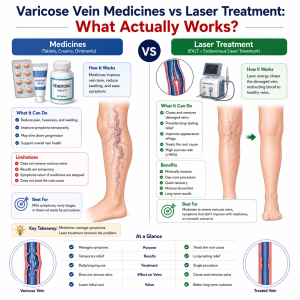
Medicines can reduce discomfort from varicose veins, but they usually do not remove the faulty vein or correct the damaged valve causing the problem. Laser treatment, on the other hand, closes the diseased vein so blood can reroute through healthier veins.
As a vascular and endovascular surgeon, I often meet patients who have tried tablets, creams, stockings or home remedies for months before asking why the veins are still visible. The answer is simple: varicose veins are usually a structural vein problem, not just a pain or swelling problem. This blog explains where medicines help, where laser treatment works better, and when you should move from symptom control to proper vein treatment.
Quick Answer: Which Works Better for Varicose Veins?
For mild symptoms, medicines, compression stockings, walking, leg elevation and weight control may help reduce heaviness, swelling or discomfort.
For moderate to severe varicose veins caused by valve failure and venous reflux, laser treatment is usually more effective because it treats the source of the problem.
Medicines may help with symptoms.
Laser treatment targets the faulty vein.
Compression supports blood flow.
Doppler ultrasound confirms the right treatment plan.
The right choice depends on your symptoms, vein size, Doppler findings, skin changes and daily discomfort.
Why Varicose Veins Happen
Varicose veins develop when the valves inside leg veins stop working properly. These valves normally push blood upward toward the heart. When they become weak, blood flows backward and pools inside the vein.
This creates pressure inside the vein. Over time, the vein becomes enlarged, twisted and visible on the skin.
Common symptoms include:
- Leg heaviness: A tired, dragging feeling, especially after standing for long hours.
- Swelling: Usually around the ankle or lower leg by evening.
- Aching pain: Often worse after prolonged sitting or standing.
- Burning or itching: Common around visible veins.
- Night cramps: Some patients feel calf tightness or cramping at night.
- Skin darkening: A sign that venous pressure is affecting the skin.
- Non-healing wounds: In advanced cases, ulcers may appear near the ankle.
If you are in Bangalore and have leg heaviness, swelling or visible veins that keep returning despite medicines, a vascular evaluation helps identify whether the root cause is venous reflux.
What Do Varicose Vein Medicines Actually Do?
Varicose vein medicines are usually given to reduce symptoms. They may include venotonic medicines, pain-relief medicines, anti-inflammatory medicines or supplements that support vein tone.
These medicines may help with:
- Pain reduction: They may reduce aching or discomfort.
- Swelling control: Some patients feel less evening swelling.
- Heaviness relief: Medicines may make the legs feel lighter.
- Inflammation control: They may help when veins feel tender.
- Short-term comfort: Useful during early symptoms or while waiting for treatment.
However, medicines usually do not close the damaged vein. They also do not repair a faulty valve inside the vein.
That is why many patients say, “I took tablets and felt better for some time, but the veins came back.” In reality, the veins did not come back. The underlying reflux was never corrected.
Can Tablets Cure Varicose Veins?
No, tablets usually cannot cure established varicose veins caused by valve failure.
They can support symptom control, but they cannot reverse the mechanical failure of vein valves. If a vein has become enlarged because blood is flowing backward inside it, tablets alone cannot make that vein function normally again.
This is one of the biggest misunderstandings patients have. They expect tablets to work like antibiotics. But varicose veins are not an infection. They are a circulation and valve problem.
Medicines may be useful when:
- symptoms are mild
- there is no major reflux on Doppler ultrasound
- the patient is not ready for a procedure
- surgery or laser is temporarily not suitable
- supportive care is needed after treatment
But when the vein is enlarged, refluxing and causing repeated symptoms, medicines alone usually delay proper care.
What Is Laser Treatment for Varicose Veins?
Laser treatment for varicose veins is a minimally invasive procedure where laser energy is used to close the diseased vein from inside.
The medical term is Endovenous Laser Ablation, also called EVLA or EVLT.
During the procedure, a thin laser fibre is inserted into the faulty vein under ultrasound guidance. Heat from the laser closes the vein. Once the diseased vein is closed, blood naturally moves through healthier veins.
This does not harm circulation. In fact, it improves the efficiency of blood flow because the unhealthy refluxing vein is removed from the circulation pathway.
Laser treatment is commonly used for larger varicose veins linked to reflux in major superficial veins.
Medicines vs Laser Treatment: Clear Comparison
| Factor | Medicines | Laser Treatment |
|---|---|---|
| Main role | Symptom relief | Treats faulty refluxing vein |
| Works on damaged valve? | No | Yes, by closing the diseased vein |
| Reduces visible veins? | Usually no | Often yes, depending on vein pattern |
| Useful for mild symptoms? | Yes | May not be needed immediately |
| Useful for severe reflux? | Limited | Usually more effective |
| Recovery time | No recovery needed | Usually quick, often same-day discharge |
| Recurrence risk | Symptoms may return | New veins can occur, but treated vein usually closes |
| Best for | Early or supportive care | Moderate to severe varicose veins with reflux |
Is Laser Treatment Better Than Surgery for Varicose Veins?
For many suitable patients, laser treatment is preferred over traditional open surgery because it is less invasive.
Traditional surgery usually involves tying and removing the vein through incisions. Laser treatment closes the vein from inside through a small puncture.
Laser treatment may offer:
- Smaller entry point: Usually no large cuts.
- Less tissue trauma: The vein is closed internally.
- Faster walking: Most patients are encouraged to walk soon after the procedure.
- Shorter hospital stay: Often done as a day-care procedure.
- Less scarring: Since large incisions are avoided.
- Quicker routine recovery: Many patients return to normal non-strenuous activity early.
However, laser is not automatically the best choice for every patient. Some patients may need sclerotherapy, radiofrequency ablation, glue ablation, phlebectomy or surgery depending on the vein anatomy.
The correct treatment starts with Doppler ultrasound, not guesswork.
When Are Medicines Preferred Over Laser?
Medicines or conservative treatment may be preferred when the condition is early, mild or not causing major reflux.
This may apply when:
- symptoms are occasional
- veins are small
- there is no significant reflux
- the patient has medical reasons to avoid a procedure
- the patient prefers a trial of conservative treatment
- symptoms are mainly related to lifestyle or prolonged standing
In such cases, I usually focus on practical measures first:
- walking regularly
- avoiding long standing without movement
- using compression stockings when advised
- keeping legs elevated when resting
- maintaining healthy weight
- treating associated swelling or inflammation
- reviewing symptoms after a defined period
Conservative care should not become endless waiting. If symptoms progress, the treatment plan must be reviewed.
When Is Laser Treatment Usually Recommended?
Laser treatment may be recommended when varicose veins are causing significant symptoms or when Doppler ultrasound shows reflux in a major superficial vein.
It may be considered when you have:
- visible bulging veins
- repeated leg heaviness
- swelling by evening
- pain after standing or sitting
- skin darkening near the ankle
- itching or eczema around veins
- bleeding from a vein
- venous ulcer or non-healing wound
- symptoms returning despite medicines and stockings
Laser treatment is not chosen just because a vein is visible. It is chosen when the diseased vein is responsible for symptoms or future risk.
Can Laser Remove Varicose Veins Completely?
Laser treatment closes the main faulty vein that causes reflux. Once that vein is closed, the pressure in connected branches reduces. Some visible veins shrink over time. Others may need additional treatment such as sclerotherapy or phlebectomy.
So, the practical answer is this:
Laser treats the main source of the problem, but some patients may need staged treatment for smaller branch veins.
This is why vein mapping matters. A vascular specialist should identify:
- which vein is leaking
- how severe the reflux is
- whether deep veins are healthy
- whether branch veins need additional care
- whether skin changes indicate advanced disease
Without this mapping, treatment can become incomplete.
Recovery After Varicose Vein Laser Treatment
Most patients walk soon after laser treatment. Walking is encouraged because it helps blood flow and reduces stiffness.
General recovery expectations include:
- Walking: Usually started the same day.
- Daily activity: Many patients resume light routine activities quickly.
- Work: Desk-based work may resume early, depending on comfort.
- Exercise: Strenuous workouts are usually delayed based on medical advice.
- Compression: Stockings may be advised for a short period.
- Follow-up scan: A Doppler review may be done to confirm closure and healing.
Recovery depends on the size of veins treated, additional procedures done, pain tolerance and overall health.
Possible Side Effects: Medicines vs Laser
Every treatment has limitations. The goal is to choose the safest and most useful option for the right patient.
Medicines may cause:
- stomach discomfort
- acidity
- allergy in some patients
- temporary relief without long-term correction
- false confidence that the disease is controlled
Laser treatment may cause:
- mild bruising
- tightness along the treated vein
- temporary discomfort
- skin sensitivity
- rare nerve irritation
- rare clot-related complications
These risks are reduced when the procedure is done after proper Doppler evaluation, with ultrasound guidance and correct follow-up.
Symptoms and recovery vary from person to person. A treatment plan should be based on clinical examination and Doppler ultrasound findings.
Why Doppler Ultrasound Is Important Before Deciding
Choosing between medicine and laser without Doppler ultrasound is incomplete.
Doppler ultrasound shows:
- whether reflux is present
- which vein is faulty
- how long the diseased segment is
- whether deep veins are normal
- whether clots are present
- whether laser is suitable
- whether another treatment is better
In my practice, I do not advise laser simply because a patient has visible veins. The decision is based on symptoms, examination and vein mapping.
This helps avoid both undertreatment and overtreatment.
My Practical Advice as a Vascular Surgeon
If your symptoms are mild and Doppler does not show significant reflux, medicines and lifestyle measures may be enough for now.
If you have visible bulging veins, swelling, skin changes, pain, heaviness or symptoms despite tablets, you should not keep repeating medicines without evaluation.
The key question is not “medicine or laser?”
The better question is: “Is my varicose vein problem only symptomatic, or is there a faulty vein that needs correction?”
Once that is clear, treatment becomes easier to decide.
When to Consult Dr Sravan C.P.S
You should consult a vascular specialist if you notice:
- leg heaviness that worsens by evening
- visible bulging veins
- swelling near the ankle
- itching or skin darkening around veins
- pain after standing for long periods
- bleeding from a vein
- repeated cramps
- non-healing wounds near the ankle
- symptoms returning after medicines
Patients looking for structured evaluation can read more about varicose veins treatment in Bangalore and related vascular conditions managed by Dr Sravan C.P.S.
Why Patients Consult Dr Sravan C.P.S for Varicose Veins
Dr Sravan C.P.S is a vascular and endovascular surgeon with focused experience in vein disorders, diabetic foot circulation problems, deep vein disorders, peripheral arterial disease and minimally invasive vascular procedures.
His approach is simple: understand the root cause first, explain the condition clearly, and choose a treatment that fits the patient’s vein anatomy, symptoms and long-term needs.
For varicose veins, this means proper Doppler evaluation, treatment planning and follow-up instead of only giving temporary symptom relief.
Dr Sravan has also been recognized by Outlook Magazine among the Best Doctors in South India for vascular surgery, which reflects his continued work in advanced vascular care.
Conclusion
Medicines may help reduce pain, swelling and heaviness in varicose veins, but they usually do not cure the faulty vein. Laser treatment works differently. It closes the diseased refluxing vein and helps redirect blood through healthier veins.
If your symptoms are mild, conservative treatment may be enough. But if your veins are bulging, painful, swollen, causing skin changes or not improving with tablets, it is time to check the root cause with a vascular specialist. For patients in Basavanagudi and South Bangalore, Dr Sravan C.P.S provides focused evaluation and treatment planning for varicose veins and venous disorders.
FAQs
Can varicose veins be cured with medicines?
Medicines may reduce symptoms like heaviness, swelling or pain, but they usually do not cure varicose veins caused by valve failure. If Doppler ultrasound shows reflux, a procedure may be needed to treat the faulty vein.
Is laser treatment better than medicines for varicose veins?
Laser treatment is usually more effective when varicose veins are caused by reflux in a superficial vein. Medicines can help with symptoms, but laser treatment targets the diseased vein itself.
When is non-surgical treatment preferred over laser?
Non-surgical care may be preferred for mild symptoms, small veins, patients not fit for procedures, or those who want a trial of conservative treatment. It should be reviewed if symptoms continue or worsen.
Can I walk after varicose vein laser treatment?
Yes. Most patients are encouraged to walk soon after laser treatment. Walking supports circulation and helps recovery. Strenuous activity should be restarted only after medical advice.
How many days of rest are needed after laser treatment for varicose veins?
Many patients return to light routine activity within a short time, but recovery varies. The exact rest period depends on the vein treated, additional procedures, symptoms and your doctor’s advice.
Can varicose veins come back after laser treatment?
The treated vein usually remains closed when the procedure is successful, but new varicose veins can develop over time due to genetics, lifestyle, prolonged standing, pregnancy or untreated branch veins.
What is the safest treatment for varicose veins?
The safest treatment is the one chosen after Doppler ultrasound and specialist evaluation. For some patients, conservative care is enough. For others, laser, radiofrequency, glue ablation, sclerotherapy or surgery may be more suitable.
