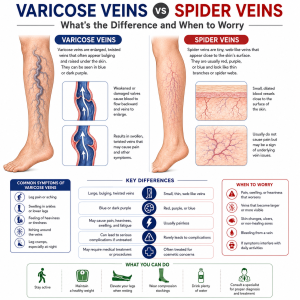
Varicose veins and spider veins are both visible vein problems, but they are not the same. Spider veins are usually thin, flat, web-like lines seen on the skin surface, while varicose veins are larger, raised, twisted veins that may cause heaviness, swelling, pain, itching, cramps, or skin changes. Spider veins are often cosmetic, but varicose veins can point to deeper valve dysfunction and poor venous circulation.
As a vascular and endovascular surgeon, I do not assess veins only by appearance. I look at symptoms, swelling pattern, skin changes, circulation, valve function, and Doppler findings before deciding whether the concern is cosmetic or medical.
Quick answer: varicose veins vs spider veins
The main difference is depth, size, symptoms, and medical risk. Spider veins are small surface vessels that usually look like red, blue, or purple web-like lines. Varicose veins are enlarged veins caused by weak vein valves, where blood flows backward and pools inside the vein. Varicose veins are more likely to cause discomfort and complications than spider veins.
| Factor | Varicose Veins | Spider Veins |
|---|---|---|
| Size | Large and bulging | Small and thin |
| Appearance | Raised, twisted, rope-like | Flat, web-like or branch-like |
| Common location | Legs, calves, ankles | Legs, face, hands |
| Colour | Blue, purple, greenish | Red, blue, purple |
| Symptoms | Pain, heaviness, swelling, cramps, itching | Usually painless, sometimes mild burning or itching |
| Main cause | Weak vein valves and blood pooling | Small damaged surface blood vessels |
| Medical risk | Can indicate venous insufficiency | Usually cosmetic, but symptoms need evaluation |
| Diagnosis | May need Doppler ultrasound | Often clinical check; Doppler if symptoms exist |
| Treatment goal | Correct circulation issue and reduce symptoms | Improve appearance and symptoms |
What are varicose veins?
Varicose veins are swollen, enlarged veins that commonly appear in the legs, feet, or ankles. They develop when vein valves do not work properly. Normally, these valves help blood move upward toward the heart. When the valves weaken, blood flows backward and collects inside the vein. This creates pressure, swelling, and visible bulging.
Common signs include:
- Bulging veins: Raised, twisted veins under the skin
- Leg heaviness: A dragging feeling after standing or sitting
- Pain or aching: Often worse by evening
- Swelling: Usually around the ankle or lower leg
- Skin changes: Darkening, itching, dryness, or thickening in advanced cases
Varicose veins can be only cosmetic in some people, but they can also cause discomfort or progress to more serious problems. Mayo Clinic notes that varicose veins may cause aching pain and, in some cases, lead to more serious health problems.
What are spider veins?
Spider veins are tiny visible blood vessels close to the skin surface. They often look like red, blue, or purple lines in a web-like or tree-branch pattern. They are commonly seen on the legs and face.
Common signs include:
- Fine visible lines: Usually flat and close to the skin
- Web-like pattern: Thin branches or clusters
- Minimal symptoms: Many people have no pain
- Mild discomfort: Some may feel burning, itching, or cramping
Spider veins are usually not dangerous. However, if they appear with heaviness, swelling, cramps, itching, or visible varicose veins, they may need medical evaluation. Cleveland Clinic notes that spider veins are usually cosmetic but can sometimes cause burning, itching, or cramping.
Are spider veins as bad as varicose veins?
No. Spider veins are usually not as serious as varicose veins.
Spider veins mostly affect smaller surface vessels and are commonly treated for cosmetic reasons. Varicose veins are larger and may reflect deeper venous reflux, where blood is not moving efficiently through the leg veins.
You should be more careful if visible veins come with:
- Leg pain
- Swelling around the ankle
- Heaviness after standing
- Night cramps
- Itching or burning
- Skin darkening
- Non-healing wounds
These symptoms suggest that the issue may not be only cosmetic.
How do I know if I have varicose veins or spider veins?
You can often identify the difference by appearance and symptoms.
If the vein is thin, flat, and looks like a small red or blue web, it is more likely to be a spider vein. If the vein is raised, bulging, twisted, or rope-like, it is more likely to be a varicose vein.
However, appearance alone is not enough when symptoms are present. A person may have spider veins on the surface and deeper vein reflux underneath. This is why a vascular evaluation becomes important when visible veins are associated with pain, heaviness, swelling, or skin changes.
Do spider veins mean poor circulation?
Not always.
Spider veins do not automatically mean poor circulation. In many people, they are limited to small surface vessels and do not indicate a serious problem. However, spider veins can sometimes appear along with venous insufficiency, especially when they are present with symptoms.
Spider veins need closer evaluation if you also have:
- Aching legs
- Swollen ankles
- Leg heaviness
- Skin itching
- Brown skin patches near the ankle
- Bulging veins nearby
In my practice, I do not dismiss symptomatic spider veins without checking the full clinical picture.
Can spider veins turn into varicose veins?
Spider veins do not usually “turn into” varicose veins directly. They are different types of visible vein changes. However, both may occur because of underlying vein weakness.
This means a person with spider veins may later develop varicose veins, especially if risk factors are present.
Common risk factors include:
- Family history of vein disease
- Long standing hours
- Sitting for long periods
- Pregnancy
- Hormonal changes
- Excess body weight
- Age-related vein weakening
The right question is not only “Will spider veins become varicose veins?” The better question is “Are my spider veins isolated, or are they part of a deeper vein problem?”
What causes varicose veins vs spider veins?
Both conditions can develop due to vein wall weakness, pressure changes, and genetic tendency. But the main mechanism is different.
| Cause / Factor | Varicose Veins | Spider Veins |
|---|---|---|
| Weak valves | Common cause | Less direct |
| Surface vessel damage | May coexist | Common cause |
| Family history | Strong role | Strong role |
| Prolonged standing | Common trigger | Common trigger |
| Pregnancy | Common trigger | Common trigger |
| Hormonal changes | Can worsen | Can worsen |
| Obesity | Increases pressure | Can contribute |
| Ageing | Weakens veins | Weakens vessels |
Varicose veins usually involve valve failure in larger leg veins. Spider veins involve smaller surface vessels. This difference is why varicose veins are more likely to cause symptoms and complications.
Which is worse, spider veins or varicose veins?
Varicose veins are usually worse from a medical point of view.
Spider veins are usually smaller and less risky. Varicose veins can lead to progressive symptoms if left untreated, especially when venous reflux is present.
Possible complications of untreated varicose veins include:
- Chronic swelling
- Skin darkening around the ankle
- Itching and eczema-like skin changes
- Hardening of skin
- Venous ulcers
- Bleeding from superficial veins
- Superficial thrombophlebitis
NHS guidance highlights symptoms such as pain, heaviness, swollen legs, itching, skin changes, and ulcers as reasons a patient may need specialist assessment and treatment.
What is stage 4 of varicose veins?
Stage 4 usually refers to skin changes caused by long-standing venous disease. This may include brown pigmentation, eczema-like itching, dryness, or thickened skin around the lower leg and ankle.
This stage should not be ignored. It means the vein problem has started affecting the skin and tissues. At this point, treatment is not just cosmetic. The goal is to prevent further progression and reduce the risk of ulcer formation.
How are varicose veins and spider veins diagnosed?
Diagnosis begins with a clinical examination. I assess the visible veins, swelling, skin condition, pain pattern, and risk factors. If symptoms suggest deeper vein reflux, a Doppler ultrasound is usually advised.
A Doppler scan helps check:
- Direction of blood flow
- Valve function
- Reflux in leg veins
- Blockage or clot suspicion
- Depth and source of diseased veins
This is important because the visible vein may not be the root problem. Treating only what is seen on the surface can lead to incomplete results if deeper reflux is missed.
How do you get rid of spider veins on your legs?
Spider veins can be treated, but treatment depends on whether they are isolated or linked to a deeper circulation issue.
Common options include:
- Lifestyle changes for symptom control
- Compression stockings where advised
- Sclerotherapy
- Laser-based treatment
- Evaluation for venous reflux if symptoms are present
Many people search for natural ways to remove spider veins. Lifestyle changes may reduce symptoms and prevent worsening, but they usually do not remove established spider veins completely.
How are varicose veins treated?
Varicose vein treatment depends on symptoms, Doppler findings, vein size, and patient condition.
Treatment may include:
- Compression therapy
- Exercise and leg elevation for symptom relief
- Endovenous laser treatment
- Radiofrequency ablation
- Foam sclerotherapy
- VenaSeal or glue-based treatment where suitable
- Other minimally invasive endovascular options
Modern varicose vein treatments are often outpatient procedures, meaning many patients go home the same day. Mayo Clinic also notes that varicose vein procedures are often done as outpatient treatments.
Treatment comparison: varicose veins vs spider veins
| Treatment Need | Varicose Veins | Spider Veins |
|---|---|---|
| Only visible veins, no symptoms | Observation may be enough | Cosmetic treatment optional |
| Pain or heaviness | Doppler scan recommended | Evaluate if symptoms persist |
| Swelling | Needs vascular assessment | Look for deeper reflux |
| Skin darkening | Medical treatment may be needed | Not typical for isolated spider veins |
| Main treatment goal | Improve circulation and symptoms | Improve appearance and mild symptoms |
| Common procedures | Laser, RFA, foam, glue treatment | Sclerotherapy, laser |
Can I remove varicose veins or spider veins myself?
You cannot safely remove varicose veins or spider veins yourself.
Home measures can help symptoms but cannot correct damaged valves or remove established visible veins. Avoid applying strong chemicals, unverified creams, aggressive massage, or heat-based home remedies. These can irritate the skin and may worsen symptoms in some people.
Helpful self-care includes:
- Walking regularly
- Avoiding long standing
- Elevating legs
- Maintaining healthy weight
- Wearing compression stockings if advised
- Avoiding tight clothing around the legs and waist
These steps support circulation but do not replace proper evaluation when symptoms are present.
Should I get rid of spider veins?
You may consider treatment for spider veins if they bother you cosmetically or cause symptoms such as burning, itching, or discomfort.
You should seek medical evaluation before cosmetic treatment if spider veins are associated with:
- Leg heaviness
- Swelling
- Pain
- Cramps
- Skin discoloration
- Nearby varicose veins
This helps rule out deeper venous insufficiency before surface treatment.
When to consult your doctor
You should consult a vascular specialist if you notice:
- Bulging leg veins
- Pain or heaviness after standing
- Swelling near the ankle
- Skin darkening or itching
- Burning or cramps around visible veins
- Non-healing wounds near the ankle
- Sudden tenderness, redness, or warmth over a vein
If you are in Bangalore, especially around Basavanagudi, Jayanagar, Banashankari, or nearby South Bangalore areas, timely vascular evaluation can help identify whether the vein concern is cosmetic or circulation-related.
Conclusion
Spider veins and varicose veins may look similar to many people, but they are different in size, depth, symptoms, and medical importance. Spider veins are usually small surface vessels and often cosmetic. Varicose veins are larger, raised veins that may indicate valve weakness and poor venous circulation.
If visible veins are only cosmetic, they may not need urgent treatment. But if you have pain, heaviness, swelling, itching, cramps, skin darkening, or wounds, do not ignore them. A proper vascular evaluation can identify the cause early and help prevent progression.
FAQs
What is the difference between varicose veins and spider veins?
Varicose veins are larger, raised, twisted veins that may cause pain, heaviness, or swelling. Spider veins are smaller, flat, web-like surface veins that are usually cosmetic.
Are spider veins as bad as varicose veins?
Usually no. Spider veins are mostly cosmetic, while varicose veins may indicate deeper valve dysfunction and poor venous circulation.
Do spider veins mean you have bad circulation?
Not always. Spider veins can be harmless, but if they appear with swelling, heaviness, cramps, itching, or varicose veins, deeper circulation problems should be checked.
Do all spider veins become varicose veins?
No. Spider veins do not usually turn into varicose veins directly. However, both can occur due to underlying vein weakness or family tendency.
How do I know if I have varicose veins or spider veins?
Spider veins are usually thin, flat, and web-like. Varicose veins are raised, twisted, and bulging. Symptoms like pain, heaviness, or swelling are more common with varicose veins.
How do you get rid of spider veins on your legs?
Spider veins may be treated with sclerotherapy or laser-based procedures. If symptoms are present, a vascular evaluation may be needed before cosmetic treatment.
Which is worse, spider veins or varicose veins?
Varicose veins are usually worse medically because they can cause pain, swelling, skin changes, ulcers, or bleeding if the underlying vein disease progresses.