
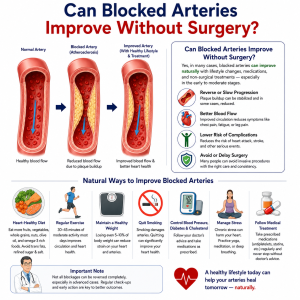
Blocked arteries can improve without surgery in some early or stable cases, especially when the blockage is mild to moderate and blood flow is still adequate. Medicines, walking exercise, smoking cessation, diabetes control, cholesterol control and blood pressure management can slow progression and improve symptoms.
But a severely blocked artery does not usually “open completely” on its own. If the blockage is causing rest pain, non-healing wounds, blackening of toes, gangrene or severe walking difficulty, medical treatment alone may not be enough. In those cases, angioplasty, stenting or bypass may be needed to restore blood flow and protect the limb.
First, Which Arteries Are We Talking About?
When patients ask about blocked arteries, they usually mean plaque or narrowing inside blood vessels. This can happen in different parts of the body.
For a vascular surgeon, the common concern is blocked arteries in the legs, also called peripheral artery disease or PAD. This affects blood flow to the lower limbs.
Blocked arteries may affect:
- Leg arteries: Can cause calf pain while walking, foot wounds, cold feet or gangrene.
- Neck arteries: Can increase stroke risk if carotid arteries are severely narrowed.
- Heart arteries: Can cause chest pain or heart attack and needs cardiology evaluation.
- Kidney arteries: Can affect blood pressure and kidney function in selected cases.
This blog mainly explains blocked arteries in the legs and vascular circulation. If you have chest pain, sweating, breathlessness or pain spreading to the left arm or jaw, treat it as an emergency and seek immediate cardiac care.
What Happens When an Artery Gets Blocked?
Arteries carry oxygen-rich blood from the heart to different parts of the body. When fatty deposits, calcium and plaque build up inside the artery wall, the channel becomes narrow.
This reduces blood supply.
In the legs, reduced blood flow may first appear only during walking. The muscles demand more oxygen, but the narrowed artery cannot supply enough blood. That is why many patients feel calf pain after walking a fixed distance.
As the blockage worsens, symptoms may happen even at rest.
Common signs include:
- Leg pain while walking: Pain improves after stopping for a few minutes.
- Cold feet: One foot may feel colder than the other.
- Weak pulses: Foot pulses may become difficult to feel.
- Numbness or tingling: Reduced circulation can affect nerve comfort.
- Delayed wound healing: Small wounds may take too long to heal.
- Skin colour change: The foot may look pale, bluish or dark.
- Rest pain: Pain even while lying down, often worse at night.
- Black toes or gangrene: A serious sign of critical blood flow loss.
The stage of disease decides whether non-surgical treatment is enough.
Can Blocked Arteries Improve Naturally?
Blocked arteries can improve in function, but plaque usually does not disappear completely naturally.
This means walking capacity, blood flow efficiency and symptoms can improve with the right treatment plan. However, the actual plaque inside the artery may remain or progress if risk factors are not controlled.
Non-surgical treatment can help by:
- slowing plaque growth
- stabilising existing plaque
- reducing clot risk
- improving walking capacity
- improving oxygen use by muscles
- supporting collateral blood vessels
- reducing heart attack and stroke risk
But if the artery is almost fully blocked and the limb is at risk, lifestyle changes alone may not act fast enough.
This is why a vascular assessment is important. The goal is not just to reduce pain. The goal is to understand whether the limb is safe.
When Can Blocked Arteries Be Managed Without Surgery?
Blocked arteries may be managed without surgery when symptoms are mild, stable and not limb-threatening.
This is more likely when:
- leg pain happens only after walking longer distances
- pain improves quickly with rest
- there is no wound on the foot
- there is no blackening of toes
- there is no severe night pain
- Doppler or CT angiogram shows manageable narrowing
- diabetes, BP and cholesterol can be controlled
- the patient can follow a structured walking plan
In such cases, the treatment goal is to reduce risk and improve walking ability.
Non-surgical management is not “doing nothing.” It is active treatment. It requires discipline, monitoring and follow-up.
What Non-Surgical Treatment Includes
Non-surgical treatment for blocked arteries usually has five parts.
1. Walking Exercise
Walking is one of the strongest tools for stable leg artery blockage.
A structured walking programme helps the leg muscles use oxygen better. It may also improve walking distance over time.
The usual approach is:
- walk until moderate leg pain starts
- rest until pain reduces
- start walking again
- repeat in cycles
- continue regularly as advised
This is not casual walking. It must be consistent.
Patients should not start aggressive walking if they have rest pain, foot wounds or suspected limb-threatening disease. In those cases, walking without evaluation can delay urgent care.
2. Cholesterol Control
Cholesterol management is central to artery blockage treatment.
Many patients say, “My leg is the problem. Why are you focusing on cholesterol?”
The answer is simple. The leg artery blockage is often one visible sign of a body-wide artery disease process. If cholesterol remains uncontrolled, plaque can progress in the legs, heart, brain and other arteries.
Doctors may prescribe statins or other lipid-lowering medicines depending on risk.
3. Blood Thinners or Antiplatelet Medicines
In many patients with peripheral artery disease, doctors prescribe medicines to reduce clot-related risk.
These medicines do not melt the blockage. They reduce the chance of clot formation over narrowed arteries and help lower major vascular event risk.
They must be taken only under medical advice, especially if there is bleeding risk, stomach ulcer history, kidney disease or other medical conditions.
4. Diabetes and Blood Pressure Control
Diabetes is one of the most important reasons leg artery disease becomes severe.
In diabetic patients, blocked arteries may combine with nerve problems and infection. This can lead to non-healing wounds, foot ulcers and gangrene.
Good diabetes control helps protect blood vessels, nerves and wound healing.
Blood pressure control also matters because uncontrolled BP damages artery walls and increases cardiovascular risk.
5. Smoking Cessation
Smoking is one of the strongest risk factors for artery blockage.
Even a good angioplasty or bypass can fail faster if the patient continues smoking. For patients trying to avoid surgery, quitting smoking is not optional. It is part of treatment.
Stopping smoking improves long-term artery health and reduces the risk of progression.
Can Diet Reduce Artery Blockage?
Diet can help reduce the risk of progression, but it cannot rapidly clear a severe artery blockage.
A good diet supports cholesterol control, diabetes control, blood pressure control and weight management.
Useful dietary habits include:
- more vegetables and fibre
- controlled oil intake
- reduced fried foods
- limited processed foods
- less sugar and refined carbohydrates
- enough protein for wound healing
- salt control if BP is high
- regular hydration
There is no single juice, supplement or herbal product that safely dissolves artery plaque.
This is important because many patients delay treatment while trying “artery-cleansing” remedies. If a foot wound or rest pain is present, that delay can be dangerous.
Can a 100% Blocked Artery Be Treated Without Surgery?
Sometimes, yes. But it depends on the artery, symptoms, collateral circulation and limb status.
Some patients have a chronic total occlusion, meaning an artery is fully blocked for a long time. The body may develop small bypass-like natural channels called collateral vessels. If these collaterals supply enough blood, the patient may have manageable symptoms.
But if a 100% blockage causes severe walking limitation, rest pain, wounds or gangrene, treatment is usually needed to restore blood flow.
Treatment may include:
- angioplasty
- stenting
- atherectomy in selected cases
- bypass surgery
- hybrid vascular procedures
The decision depends on imaging and patient condition. No one should decide based only on a percentage.
A 70% blockage in one patient may be stable. A similar blockage in another patient may be dangerous if blood flow to the foot is poor.
When Is Angioplasty Needed for Blocked Arteries?
Angioplasty is a minimally invasive procedure used to open narrowed or blocked arteries.
A small balloon is passed inside the artery and inflated at the blocked segment. In some cases, a stent is placed to keep the artery open.
Angioplasty may be needed when:
- walking pain remains severe despite medicines and exercise
- Doppler or CT angiogram shows a treatable blockage
- foot wounds are not healing
- rest pain is present
- blood flow to the foot is critically reduced
- gangrene risk is increasing
This is not open surgery. It is an endovascular procedure done through a small puncture, usually in the groin or arm, depending on the case.
As a vascular and endovascular surgeon, Dr Sravan C.P.S evaluates whether angioplasty, stenting, bypass or medical treatment is the right path. The safest plan is the one based on symptoms, scan findings and limb risk.
When Is Surgery Needed?
Bypass surgery may be needed when angioplasty is not suitable, has failed, or the blockage pattern requires surgical rerouting of blood flow.
Bypass surgery creates a new path for blood to reach the leg or foot beyond the blocked artery.
Surgery may be considered when:
- blockage is long and complex
- endovascular treatment is unlikely to work well
- there is severe limb-threatening disease
- wounds need stronger blood flow to heal
- prior angioplasty has failed
- anatomy is better suited for bypass
The goal is not to “do surgery.” The goal is to restore blood flow in the safest and most durable way possible.
How Do Doctors Check Blocked Arteries Without Angiography?
Not every patient needs angiography as the first test.
Doctors may start with simpler tests.
Common tests include:
- Pulse examination: The doctor checks pulses in the groin, knee, ankle and foot.
- Ankle-Brachial Index: Compares blood pressure in the ankle and arm.
- Arterial Doppler ultrasound: Shows blood flow and narrowing in leg arteries.
- CT angiogram: Gives a detailed artery map when intervention may be needed.
- MR angiogram: Used in selected patients where suitable.
- Blood tests: Check diabetes, cholesterol, kidney function and overall risk.
Angiography is usually considered when a procedure is planned or when detailed artery mapping is required.
Can Plaque in Arteries Go Away?
Plaque may stabilise and sometimes reduce slightly with strong medical treatment and risk control, but patients should not expect a blocked artery to become completely normal only through diet or supplements.
This is why symptom monitoring matters.
If symptoms improve, walking distance improves and scans show stable disease, medical treatment may continue.
If symptoms worsen, a wound appears or pain starts at rest, treatment must be escalated.
The artery does not need to look perfect. It needs to deliver enough blood to keep the limb healthy.
Red Flags: When You Should Not Wait
You should not rely only on medicines or lifestyle changes if you have signs of critical blood flow reduction.
Consult a vascular specialist urgently if you notice:
- foot pain even while resting
- pain that wakes you at night
- blackening of toes
- non-healing wound
- pus or infection in a diabetic foot wound
- sudden coldness of one leg
- sudden loss of movement or sensation
- severe pain with pale or bluish foot
- walking distance becoming shorter quickly
These symptoms may indicate severe artery disease or acute limb risk.
Waiting too long can reduce treatment options.
My Practical Advice as a Vascular Surgeon
If your artery blockage is early and your symptoms are stable, there is a good chance that medicines, walking exercise and risk-factor control can help you avoid or delay a procedure.
But if the blockage is severe, the foot is at risk, or symptoms are progressing, non-surgical treatment alone may not be enough.
The correct question is not “Can I avoid surgery?”
The better question is: “Is my blood flow enough to keep my leg safe?”
Once that is clear, the treatment plan becomes more accurate.
When to Consult Dr Sravan C.P.S
You should consult Dr Sravan C.P.S if you have walking-related leg pain, weak pulses, cold feet, diabetes-related foot wounds, rest pain, black toes or a diagnosis of peripheral artery disease.
Patients in Basavanagudi, South Bangalore and nearby areas can seek vascular evaluation early to understand whether blocked arteries can be managed with medicines or need angioplasty, stenting or surgery.
You may also internally link this blog to the website’s peripheral artery disease, angioplasty and diabetic foot care service pages for better patient routing and SEO authority flow.
Why Patients Consult Dr Sravan C.P.S for Blocked Arteries
Dr Sravan C.P.S is a vascular and endovascular surgeon focused on artery and vein conditions, including peripheral artery disease, diabetic foot circulation problems, leg artery blockages, angioplasty, stenting, vascular screening and limb-salvage planning.
His approach is investigation-led and practical. The aim is to identify the level of blockage, assess limb risk, explain the available options clearly and choose the least invasive effective treatment whenever possible.
This is especially important for diabetic patients, elderly patients, smokers and people with non-healing wounds, where delayed circulation care can lead to serious complications.
Conclusion
Blocked arteries can improve without surgery when the disease is early, symptoms are stable and blood flow is still enough to protect the limb. Medicines, walking exercise, diabetes control, cholesterol control, BP control and smoking cessation can make a major difference.
But severe blockages, rest pain, non-healing wounds, black toes or gangrene need urgent vascular evaluation. In such cases, angioplasty, stenting or bypass may be required to restore blood flow. The safest decision comes after proper examination and artery imaging, not guesswork.
FAQs
Can blocked arteries improve without surgery?
Yes, some blocked arteries can be managed without surgery if symptoms are mild and blood flow is adequate. Medicines, walking exercise, cholesterol control, diabetes control and smoking cessation can improve symptoms and slow progression.
Can artery blockage be reduced naturally?
Lifestyle changes can reduce progression and improve artery health, but they usually do not fully clear a severe blockage. Diet, exercise and quitting smoking work best when combined with medical treatment.
What dissolves plaque in arteries?
No food, drink or supplement reliably dissolves artery plaque. Medicines can stabilise plaque, reduce cholesterol and lower clot risk, but severe blockages may still need angioplasty or surgery.
Is 70% artery blockage serious?
It can be serious, but the percentage alone is not enough. Doctors also check symptoms, artery location, blood flow, Doppler findings and whether the limb or organ is at risk.
Can a 100% blocked artery be stented?
Some 100% blockages can be treated with angioplasty and stenting, depending on the artery, blockage length, calcium, symptoms and imaging findings. Some cases may need bypass instead.
How do doctors check blockage without angiography?
Doctors may use pulse examination, Ankle-Brachial Index, arterial Doppler ultrasound, CT angiogram or MR angiogram. Angiography is usually done when detailed planning or treatment is needed.
When should I see a vascular surgeon for blocked arteries?
You should see a vascular surgeon if you have leg pain while walking, rest pain, cold foot, weak pulses, non-healing wounds, black toes, diabetic foot problems or known peripheral artery disease.
