
Varicocele embolization is a minimally invasive treatment for enlarged veins in the scrotum. It is commonly considered when a varicocele causes pain, swelling, testicular discomfort, or fertility-related concerns. Many men avoid consultation because they believe varicocele treatment always means surgery, long recovery, or risk to sexual function. These are common myths.
As a vascular and endovascular surgeon, I see many patients who delay treatment because of fear or incomplete information. This blog explains the most common myths and facts about varicocele embolization so you can understand what the procedure does, when it is needed, and how it differs from surgery.
What is varicocele embolization?
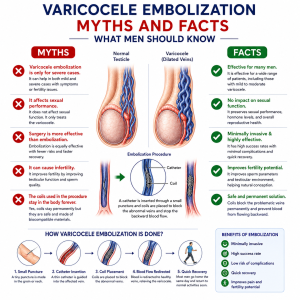
Varicocele embolization is a non-surgical, image-guided procedure used to treat varicocele. A varicocele is a group of enlarged veins in the scrotum. It usually develops when the valves inside the testicular veins do not work properly, causing blood to pool around the testicle.
During embolization, a thin catheter is guided through a small puncture, usually through a vein in the neck or groin. The affected testicular vein is then blocked using coils, foam, or both so that blood is redirected through healthier veins.
Why are there so many myths about varicocele treatment?
Varicocele affects a private and sensitive area, so many men hesitate to discuss symptoms early. Some search online and find mixed information about fertility, pain, surgery, sexual function, and recurrence. This creates unnecessary fear.
The right approach is simple: varicocele should be assessed based on symptoms, semen analysis where fertility is a concern, clinical examination, and imaging when needed. Treatment should match the patient’s problem, not the myth.
Myth 1: Varicocele is always harmless
Fact: Many varicoceles are harmless, but not all should be ignored.
Some men have no symptoms and may not need immediate treatment. However, varicocele can cause a dragging pain, scrotal heaviness, swelling, testicular discomfort, or fertility concerns. Guy’s and St Thomas’ NHS guidance states that varicocele embolization may be used when varicoceles cause discomfort, swelling, or problems with fertility.
You should not ignore a varicocele if you notice:
- A dull ache in the scrotum: Usually worse after standing or physical activity
- Visible or felt enlarged veins: Often described as a “bag of worms”
- One-sided scrotal heaviness: Commonly on the left side
- Fertility concerns: Especially if semen parameters are abnormal
- Testicular size difference: Needs medical evaluation
Myth 2: Every varicocele needs surgery
Fact: Not every varicocele needs treatment, and treatment does not always mean surgery.
If a varicocele is small, painless, and not affecting fertility, observation may be enough. If treatment is needed, varicocele embolization can be considered as a minimally invasive alternative to surgical varicocelectomy.
Treatment decisions depend on:
- Symptoms
- Varicocele grade
- Fertility goals
- Semen analysis
- Testicular size
- Previous treatment history
- Patient preference
The goal is not to treat every visible varicocele. The goal is to treat the varicocele that is causing a clinical problem.
Myth 3: Varicocele embolization is an artery procedure
Fact: Varicocele embolization treats abnormal veins, not arteries.
This is an important correction. Varicocele is a vein problem. It occurs when blood pools in the veins around the testicle. Embolization blocks the affected testicular vein so that blood can reroute through normal veins.
So the correct term is:
- Varicocele embolization
- Varicocele vein embolization
- Testicular vein embolization
Avoid calling it “varicocele artery embolization” because that is medically incorrect.
Myth 4: Varicocele embolization is experimental
Fact: Varicocele embolization is an established image-guided procedure.
It is performed by interventional specialists using X-ray guidance. RadiologyInfo describes varicocele embolization as a treatment with no surgical incision, shorter recovery compared with surgery, and success rates similar to more invasive surgical techniques.
This does not mean every patient should choose embolization. It means embolization is a valid treatment option in suitable cases.
Myth 5: Embolization is more painful than surgery
Fact: Most patients do not experience significant pain during the procedure.
The procedure is usually performed under local anaesthesia, sometimes with sedation depending on the centre and patient condition. Some patients may feel mild discomfort, but the aim is to avoid the larger cuts used in open surgery. Patient information from Royal Berkshire NHS notes that significant pain during the procedure is not expected, though some people may feel slight discomfort.
After the procedure, mild soreness, bruising at the puncture site, or lower abdominal discomfort can occur for a few days. These are usually manageable with routine advice from the treating team.
Myth 6: Recovery takes weeks
Fact: Recovery after varicocele embolization is usually shorter than traditional surgery.
Varicocele embolization is commonly done as a day-care procedure. Many patients are observed for a few hours and go home the same day if stable. Guy’s and St Thomas’ NHS guidance states that patients usually rest in the interventional radiology department for 2 to 4 hours after the procedure before going home if checks are fine.
Typical recovery guidance may include:
- Rest on the day of the procedure
- Avoid heavy lifting for a short period
- Return to light routine activities as advised
- Follow medication and review instructions
Recovery varies from patient to patient. Always follow the instructions given by your treating doctor.
Myth 7: Varicocele embolization affects sexual function
Fact: Varicocele embolization does not usually affect sexual function.
This is one of the most common fears men have. The procedure targets the abnormal testicular vein. It does not involve cutting the testicle, penis, or nerves responsible for sexual function.
In fact, treatment is sometimes considered when varicocele is linked to fertility-related concerns. Some patient information leaflets note that embolization can help improve fertility in selected cases.
However, fertility improvement depends on several factors, including baseline semen quality, age, duration of infertility, partner factors, and varicocele severity.
Myth 8: Varicocele embolization always improves sperm count
Fact: It may improve sperm parameters in selected patients, but results are not guaranteed.
Varicocele can affect sperm production in some men because it may increase temperature and pressure around the testicle. Treating the varicocele may improve sperm count, motility, or quality in selected patients, especially when there is a clinically significant varicocele and abnormal semen analysis.
However, not every fertility problem is due to varicocele. A full fertility evaluation is important before assuming embolization alone will solve the issue.
Myth 9: Varicocele always comes back after embolization
Fact: Recurrence is possible with both embolization and surgery, but it does not happen in every case.
Varicocele treatment aims to block or disconnect the abnormal veins causing reflux. If other small collateral veins continue to carry abnormal flow, recurrence may happen. United Lincolnshire Hospitals notes that symptoms may not improve or the varicocele may remain or come back, and this can also happen after surgical treatment.
This is why proper imaging, technique, and follow-up matter.
Myth 10: Surgery is always better than embolization
Fact: Both surgery and embolization have roles. The better option depends on the patient.
A urologist may recommend surgery in some cases. An endovascular specialist may recommend embolization in suitable patients. The right choice depends on anatomy, symptoms, fertility goals, previous treatment, and patient preference.
| Factor | Varicocele Embolization | Varicocele Surgery |
|---|---|---|
| Approach | Catheter through vein | Surgical incision |
| Anaesthesia | Usually local anaesthesia with or without sedation | Usually regional or general depending on method |
| Hospital stay | Often day-care | Often day-care, varies by method |
| Scar | No surgical incision, only small puncture | Small surgical scar |
| Recovery | Usually shorter | Varies by surgical method |
| Treats both sides | Often possible in same sitting if needed | Possible depending on surgical plan |
| Best suited for | Selected symptomatic or fertility-related varicocele cases | Selected cases based on urology assessment |
The goal is not to say one option is always superior. The goal is to choose the safest and most effective option for that patient.
Who should consider varicocele embolization?
Varicocele embolization may be considered when a patient has:
- Persistent scrotal pain or heaviness
- Varicocele-related discomfort after standing or exercise
- Fertility concerns with abnormal semen parameters
- Recurrence after previous treatment
- Preference for minimally invasive treatment
- Bilateral varicocele where both sides may need treatment
A proper clinical evaluation is necessary before deciding.
When should varicocele not be ignored?
You should not delay medical evaluation if you notice:
- Sudden scrotal swelling
- Severe testicular pain
- Testicular size difference
- Persistent dragging pain
- Fertility concerns
- Visible enlarged veins that worsen while standing
Not every scrotal swelling is varicocele. Conditions like hydrocele, hernia, infection, or testicular problems may look similar. Diagnosis matters.
What happens during varicocele embolization?
The general process includes:
- Pre-procedure evaluation: Clinical assessment and imaging when needed
- Small puncture access: Usually through a vein in the neck or groin
- Catheter guidance: X-ray guidance helps reach the affected vein
- Vein blocking: Coils, foam, or both are used to block abnormal reflux
- Observation: Patient is monitored after the procedure before discharge
Many patient leaflets describe the procedure as taking around 30 to 60 minutes, though total hospital time may be longer because of preparation and recovery.
Are there risks with varicocele embolization?
Yes. Like any medical procedure, it has risks, although serious complications are uncommon.
Possible risks include:
- Bruising or soreness at the puncture site
- Mild pain after the procedure
- Infection at puncture site
- Contrast allergy in selected patients
- Failure to access the vein
- Recurrence or incomplete symptom relief
- Rare coil migration
RadiologyInfo notes general catheter-related risks such as bruising, bleeding, vessel injury, infection, contrast reaction, and rare non-target embolization.
A good consultation should explain both benefits and risks clearly before treatment.
When to consult Dr Sravan
You should consider consulting a vascular and endovascular specialist if you have varicocele symptoms, scrotal heaviness, persistent dull ache, recurrence after previous treatment, or fertility concerns where varicocele may be contributing.
If you are in Bangalore, especially around Basavanagudi, Jayanagar, Banashankari, or nearby South Bangalore areas, early evaluation can help confirm whether varicocele embolization is suitable or whether another treatment approach is better.
Conclusion
Varicocele embolization is not an artery procedure, not an experimental treatment, and not the same as open surgery. It is a minimally invasive, image-guided option for selected men with varicocele-related pain, swelling, or fertility concerns.
The most important step is correct diagnosis. Once the cause and severity are clear, treatment can be planned based on symptoms, fertility goals, anatomy, and long-term outcomes. My advice is simple: do not let myths delay evaluation. Get clarity first, then decide.
FAQs
Is varicocele embolization safe?
Varicocele embolization is generally considered safe when performed in suitable patients by trained specialists. Like any procedure, it has risks such as bruising, infection, contrast reaction, or recurrence, but serious complications are uncommon.
Is varicocele embolization better than surgery?
It depends on the patient. Embolization is minimally invasive and usually has shorter recovery, while surgery may be preferred in some cases. The right choice depends on anatomy, symptoms, fertility goals, and specialist assessment.
Does varicocele embolization improve sperm count?
It may improve sperm count or quality in selected patients, especially when varicocele is clinically significant and semen analysis is abnormal. However, improvement is not guaranteed because fertility depends on multiple factors.
Is varicocele embolization painful?
Most patients do not feel significant pain during the procedure because local anaesthesia is used. Mild discomfort or soreness may occur after the procedure.
How long does recovery take after varicocele embolization?
Many patients go home the same day after observation. Light activities may resume as advised, but heavy lifting or vigorous exercise should be avoided for the period recommended by the treating doctor.
Can varicocele come back after embolization?
Yes, recurrence is possible after embolization, just as it can happen after surgery. Proper imaging, technique, and follow-up reduce this risk.
Can varicocele be treated without surgery?
Yes. Varicocele embolization is a non-surgical, minimally invasive treatment option for selected patients with symptomatic varicocele or fertility-related concerns.