
If you are confused between Doppler, ABI, and angiography for leg pain or blood flow problems, you are not alone. Each test is used at a different stage, and choosing the wrong one can delay diagnosis or lead to unnecessary procedures.
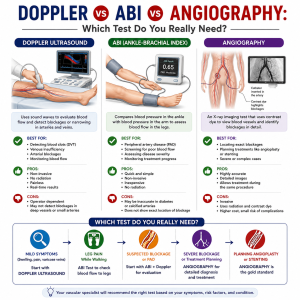
ABI is a basic screening test, Doppler evaluates blood flow in detail, and angiography is used when planning treatment like angioplasty. The correct test depends on your symptoms and severity. Understanding this difference helps avoid delays and ensures the right treatment at the right time.
Which test do you actually need?
- Start with ABI → if symptoms are mild or for screening
- Do Doppler → if symptoms are present or ABI is abnormal
- Do Angiography → only if severe disease or procedure is planned
This is the standard stepwise approach followed in vascular practice.
What is Peripheral Artery Disease and why are these tests needed?
Peripheral Artery Disease (PAD) is a condition where arteries supplying blood to the legs become narrowed due to cholesterol deposits and long-term vessel damage.
Common symptoms include:
- Pain in the calf while walking
- Pain that improves with rest
- Reduced walking distance
- Cold or numb feet
- Non-healing wounds
- Discolouration of toes
In Indian patients, PAD is commonly seen in those with diabetes, smoking history, and high cholesterol. Many patients ignore early symptoms, which delays diagnosis.
These tests help in:
- Detecting reduced blood flow
- Identifying the location of blockage
- Assessing severity
- Planning treatment
Which test is best for leg blockage or poor blood flow?
There is no single test that is best for everyone.
- ABI is best for screening
- Doppler is best for diagnosis
- Angiography is best for treatment planning
From a clinical perspective, the best test is the one that matches the stage of disease.
What is ABI (Ankle-Brachial Index)?
ABI is usually the first test done when PAD is suspected.
How it works:
- Blood pressure is measured in the arm
- Blood pressure is measured in the ankle
- A ratio is calculated
Interpretation:
- 1.0 – 1.4 → Normal
- 0.9 – 1.0 → Borderline
- 0.5 – 0.9 → Moderate disease
- Below 0.5 → Severe disease
Why ABI is useful:
- Simple and quick
- Non-invasive
- Cost-effective
- Useful for early screening
Limitations of ABI
ABI is not always reliable, especially in Indian diabetic patients.
- Arteries may become stiff and calcified
- Readings may appear falsely normal
- Disease may be missed
In such cases, Doppler is more accurate.
What is Doppler ultrasound?
Doppler is a non-invasive scan that evaluates blood flow in arteries.
What it shows:
- Speed of blood flow
- Direction of flow
- Location of narrowing
- Severity of blockage
When Doppler is used:
- Abnormal ABI
- Symptoms of PAD
- Non-healing wounds
- Follow-up after treatment
Advantages:
- No radiation
- No injection
- Real-time results
- Widely available
In routine practice, Doppler is the most commonly used test.
What extra information does Doppler provide?
Doppler helps identify:
- Exact segment of blockage
- Percentage narrowing
- Multiple blockages
- Collateral circulation
This helps decide whether treatment can be medical or requires intervention.
What is angiography?
Angiography is an advanced imaging test used to map arteries in detail.
Types commonly used:
- CT Angiography (CTA)
- MR Angiography (MRA)
- Digital Subtraction Angiography (DSA)
When is angiography required?
Angiography is needed when:
- Pain occurs even at rest
- There are non-healing wounds
- Severe blockage is suspected
- Planning angioplasty or surgery
From a clinical standpoint, angiography is mainly used for treatment planning.
Why angiography should not be done first
Many patients assume angiography should be done first. This is not correct.
- It is more expensive
- Involves contrast
- Not needed in early stages
- Should be used only when required
Quick comparison: ABI vs Doppler vs Angiography
| Test | Purpose | Best use | Invasiveness |
|---|---|---|---|
| ABI | Screening | Early detection | Non-invasive |
| Doppler | Diagnosis | Identifying blockage | Non-invasive |
| Angiography | Treatment planning | Before procedures | Minimally to fully invasive |
How doctors decide step by step
- Symptoms assessment
- Clinical examination
- ABI for screening
- Doppler for confirmation
- Angiography if intervention is planned
This approach avoids unnecessary testing.
How symptoms guide the choice of test
Mild symptoms:
- Occasional pain while walking
- ABI or Doppler is sufficient
Moderate symptoms:
- Reduced walking distance
- Doppler required
Severe symptoms:
- Pain at rest
- Non-healing wounds
- Doppler + angiography needed
Quick decision guide for patients
- If pain starts only while walking → ABI or Doppler
- If you have diabetes with foot wound → Doppler
- If pain occurs at rest → Doppler + angiography
- If surgery is planned → angiography required
Special note for diabetic patients
In diabetes:
- ABI may be unreliable
- Blood vessels become stiff
- Disease is often more severe
Doppler is usually more useful in these patients.
Common mistakes patients should avoid
- Ignoring early symptoms
- Delaying testing
- Asking directly for angiography
- Not following up after diagnosis
These mistakes can lead to advanced disease.
What happens if PAD is not diagnosed early
- Pain worsens
- Walking distance reduces
- Wounds may develop
- Infection risk increases
- Risk of amputation in severe cases
Early testing prevents complications.
What happens after diagnosis
Treatment depends on severity.
Options include:
- Lifestyle changes
- Walking program
- Medicines (Aspirin, Clopidogrel, Statins)
- Diabetes control
- Angioplasty if required
When should you seek medical attention?
Seek evaluation if you notice:
- Leg pain while walking
- Reduced walking distance
- Non-healing wounds
- Colour changes in feet
If you are in Bangalore and have symptoms like leg pain or non-healing wounds, especially in South Bangalore or nearby areas, early vascular testing can help prevent serious complications.
When to consult your doctor
Consult early if:
- Pain is increasing
- Wounds are not healing
- Diabetes is poorly controlled
In areas like Basavanagudi and surrounding regions, early consultation helps avoid complications.
Frequently asked questions
Which test is best for detecting leg artery blockage?
Doppler is usually sufficient for diagnosis. Angiography is used when planning treatment.
Is Doppler enough to detect blockage in legs?
Yes, in most cases Doppler provides enough detail to assess severity.
Is ABI reliable?
It is useful for screening but may not be accurate in diabetics.
Do all patients need angiography?
No. Only patients requiring intervention need it.
Are these tests painful?
ABI and Doppler are painless. Angiography involves mild discomfort.
How long do these tests take?
ABI and Doppler are quick. Angiography takes longer.
Can these tests prevent complications?
They help in early diagnosis and timely treatment.
Conclusion
ABI, Doppler, and angiography are not competing tests. They are part of a structured diagnostic pathway. ABI is used for screening, Doppler for diagnosis, and angiography for treatment planning.
From a clinical perspective, choosing the correct test at the right time is more important than choosing the most advanced test. A stepwise approach ensures accurate diagnosis, avoids unnecessary procedures, and improves outcomes.
Early evaluation remains the key to preventing complications and maintaining vascular health.
